

After removing Maduro from Venezuela, Trump commits to another foreign policy project
WASHINGTON (AP) — President Donald Trump declared Saturday's military operation that led to the overthrow of Nicolás Maduro a great success, as he offered a vague plan for his administration to "lead" Venezuela until a transition of power can take place.
Though there are no visible signs of a U.S. presence on the ground in Caracas, Trump was demonstrating the boldness that has become the trademark of his foreign policy approach. It is an approach characterized by great confidence that his will on the international stage is an immovable force.
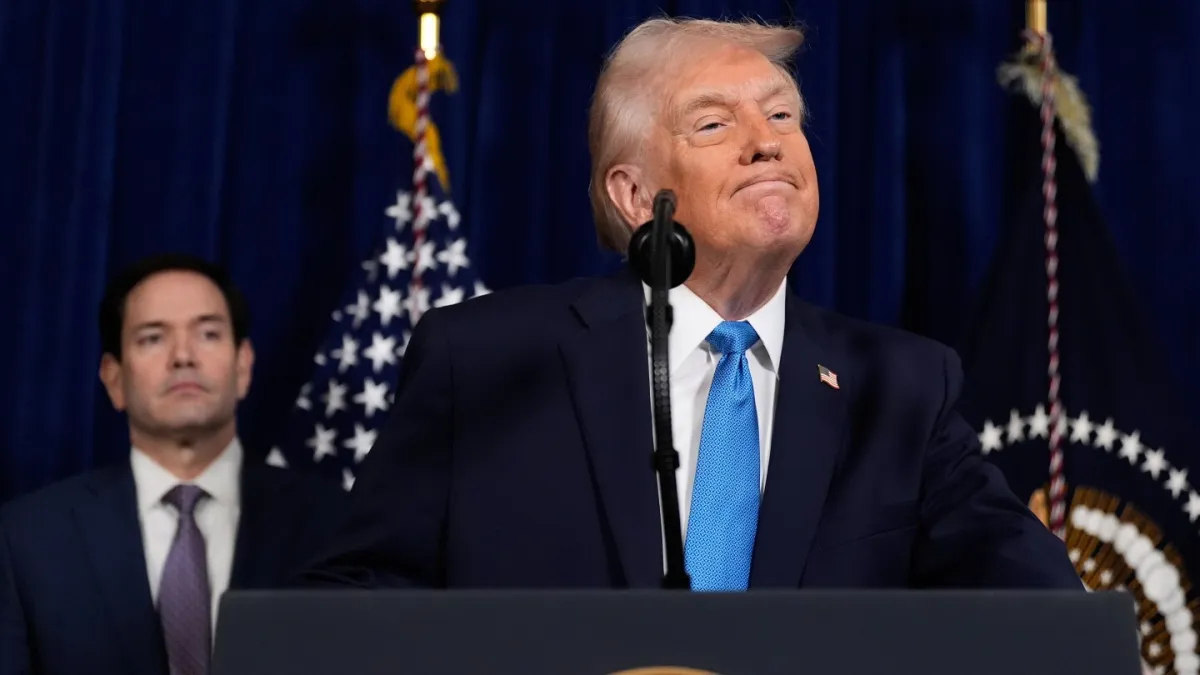
“This was one of the most impressive, effective and powerful demonstrations of American military might and competition in American history,” Trump declared at a press conference at his Mar-a-Lago resort in Florida.
The president took office promising to turn the page on decades of U.S. foreign entanglements. But on Saturday, he pledged to help Venezuela begin a period of “peace” and “justice” after decades of heavy-handed governments.
The president's promise of a project in Venezuela comes as he is battling to achieve permanent peace between Israel and Hamas in Gaza and find an outcome to Russia's nearly four-year war in Ukraine.
Stay up to date with the news and the best of AP by following our WhatsApp channel.
Follow on
But the road ahead is dangerous. The White House will have to deal with any power vacuum caused by Maduro's overthrow and the inevitable complications of trying to maintain stability in a country that has endured years of hyperinflation, food and medicine shortages, and brain drain despite its vast oil wealth.
It also remains to be seen what lessons America's adversaries can take from Trump's decision to demonstrate American power in his sphere of influence following Trump's move in Caracas. Chinese President Xi Jinping has vowed to annex the self-ruled island of Taiwan, and Russian President Vladimir Putin has plans for Ukraine and to shrink NATO's eastern flank.
However, Trump did not waver in his confidence that the negative actors of the old government will be sidelined while he helps make Venezuela “great again.” He also sought to reassure American taxpayers that they will not have to pay for his plan to help Caracas.
“The money coming out of the ground is very substantial,” Trump said. “They are going to reimburse us for everything we spend.”
Trump has not hesitated to show off American military power even as he has promised to keep the United States out of the war. It has now twice used its forces to carry out risky operations against US adversaries. In June, he led US strikes on key nuclear sites in Iran.
Saturday's action raised new anxiety in capitals around the world that have sought to adapt to a new normal in Trump 2.0, where the idea of the United States trying to find a global consensus on issues of war and peace is now a thing of the past.
What's next for Venezuela?
European allies had expressed concern as Trump built up a massive troop presence in the Caribbean in recent months and carried out dozens of deadly attacks on suspected drug traffickers, many of whom the administration claimed were an arm of the Maduro government.
Now, the Trump administration's overnight extradition of Maduro and his wife and his plans to "run" the country, even temporarily, are raising new and serious questions about the legality of the United States' moves under a broader campaign against the South American nation.
Maduro was hardly seen as a saint by the international community. His 2018 and 2024 elections were seen as plagued by irregularities and considered illegitimate.
But many US allies received the news of Maduro's capture with some concern.
The president of the European Commission, António Costa, said he had “great concern” about the situation in Venezuela after the US operation.
The French Foreign Minister, Jean-Noël Barrot, said that “the military operation that led to the capture of Maduro violates the principle of non-use of force that underpins international law.”
Criticism from some Democrats about Trump's military action to overthrow Maduro was immediate.
“This war It is illegal, it is shameful that we have gone from being the world's policeman to being the world's thug in less than a year," Senator Ruben Gallego of Arizona wrote in X. “There is no reason for us to be at war with Venezuela.”
The Russian Foreign Ministry condemned the United States' “act of armed aggression” against Venezuela in a statement posted on its Telegram channel on Saturday. The overthrow of Maduro, who had Russian backing, comes as Trump urges Putin to end his war in Ukraine.
“Venezuela must be guaranteed the right to determine its own destiny without any destructive, much less military, intervention from outside,” the statement said.
Similarly, China's Foreign Ministry condemned the US operation in a statement, saying it violates international law and Venezuela's sovereignty.
The capture follows months of pressure
The operation was the culmination of a push within the administration led by Secretary of State, Marco Rubio, and other like-minded Maduro foes who have urged Trump to take action against the Venezuelan leader for years.
In South Florida, the epicenter of the anti-Maduro Venezuelan diaspora that has influenced Rubio's thinking, Saturday's operation was hailed as an era-changing moment for democracy.
Representative Carlos Gimenez, a Florida Republican, said he had spoken with Rubio and thanked Trump for having “changed the course of history in our hemisphere. Our country and the world are safer for it," he wrote in had sought a way out of power while saving face.
Venezuelan government officials had proposed a plan in which Maduro would eventually leave office, The Associated Press reported in October.
The proposal called for Maduro to step down in three years and hand power to his vice president, Delcy Rodríguez, who would complete Maduro's six-year term that ends in January 2031. Rodríguez would not run for reelection under the plan.
But the White House rejected the proposal because the administration questions the legitimacy of Maduro's government and accuses it of overseeing a narco-terrorist state.
Earlier this week, Maduro said that Venezuela was open to negotiating an agreement with the United States to combat drug trafficking and work with Washington to promote greater US investment in the Venezuelan oil industry. Trump assured that Maduro had recently been offered opportunities to surrender, but the. rejected.
Rubio had a long telephone conversation on Saturday with Rodríguez, Trump reported. In a speech to the nation, she demanded that the United States release Maduro, but left open the possibility of dialogue with Trump.
“If we simply left, (Venezuela) would have no chance of recovering. We will direct you appropriately. We will run it professionally," Trump said. "We will have the best oil companies in the world coming in, investing billions and billions of dollars... And the biggest beneficiaries will be the people of Venezuela.”
The Venezuelan opposition says the legitimate president is exiled politician Edmundo González, an ally of opposition leader María Corina Machado.
Trump said he was not ready to commit to a particular leader, but vowed that his administration must remain “very involved” in Venezuela.
“We cannot risk letting someone else lead (Venezuela), who will simply take control where (Maduro) left him,” Trump said.
_______
Darlene Superville in Palm Beach, Florida, Matthew Lee in Washington, Kanis Leung in Hong Kong, Sylvie Corbet in Paris and Elise Morton in London contributed reporting.
_______
This story was translated from English by an AP editor with the help of a generative artificial intelligence tool.