

After Saudi Arabia’s Yemen strike, UAE rejects support for separatists
Saudi Arabia has said its national security is a “red line” it would defend, hours after a coalition it leads struck vehicles and cargo in Yemen that it said had been supplied by a foreign military to separatists in that country’s south.
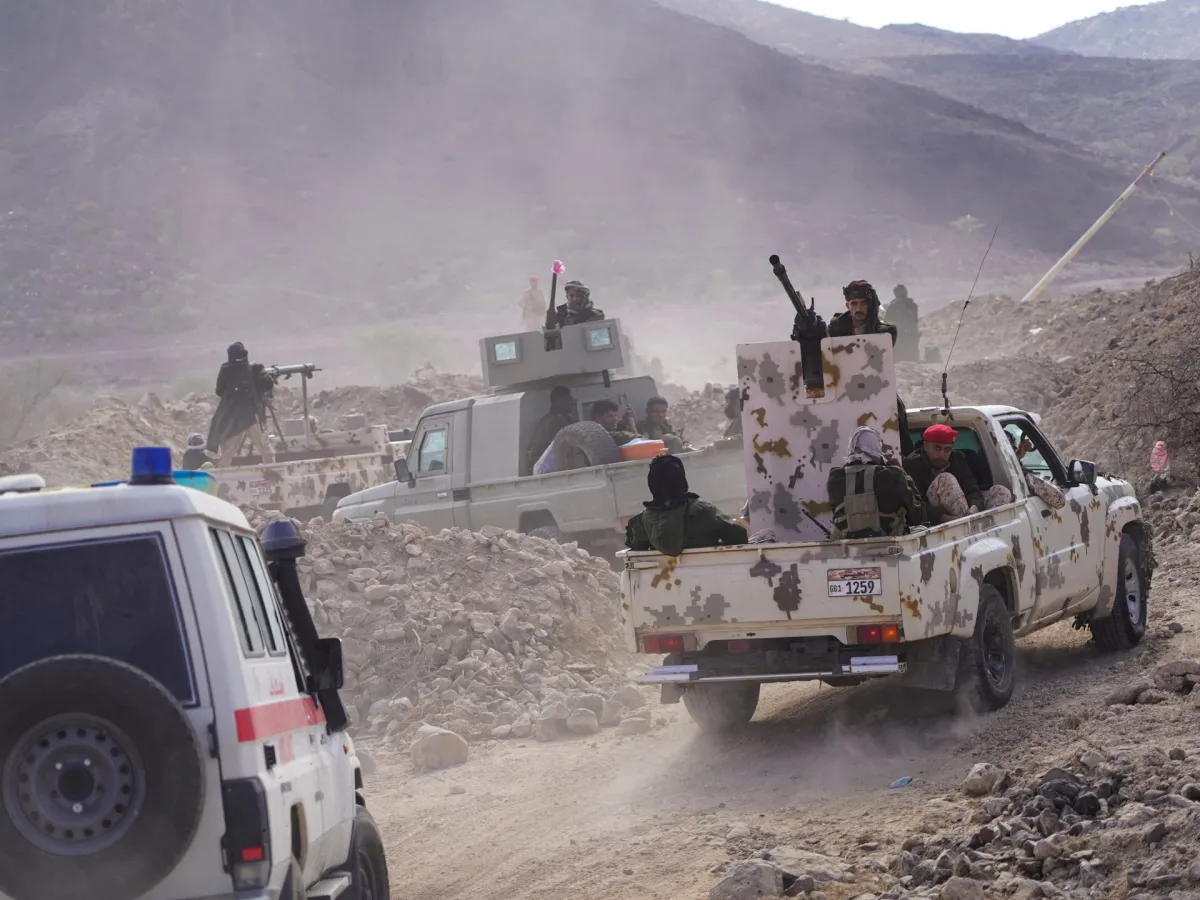
The coalition’s “limited military operation” at Mukalla port came days after it warned the separatist Southern Transitional Council (STC) group against taking military action in Hadramout province.
Recommended Stories
list of 4 items- list 1 of 4US claims attack on dock in Venezuela, as missiles also kill two in Pacific
- list 2 of 4UN Security Council members condemn Israel’s recognition of Somaliland
- list 3 of 4China fires several rockets around Taiwan during live military drills
- list 4 of 4Russia-Ukraine war: List of key events, day 1,405
Yemen’s Saudi-backed Presidential Leadership Council (PLC) has named the United Arab Emirates as the country that supplied the assistance to the STC that was targeted in the coalition’s strike.
The Saudi Ministry of Foreign Affairs said in a statement on Tuesday that it hoped the UAE would take the necessary steps to preserve bilateral relations between Gulf Arab nations.
The UAE later rejected the allegations, saying it was disappointed by the Saudi statement and surprised by the strike.
“The shipment in question did not contain any weapons, and the vehicles unloaded were not intended for any Yemeni party,” a government spokesperson Afra Al Hameli wrote on X, adding the arrival of the shipment had been coordinated with Riyadh
The UAE Ministry of Foreign Affairs said in statement that it “categorically rejects any attempt to implicate it in the tensions between Yemeni parties and condemns the allegations of pressuring or directing any Yemeni party to carry out military operations that threaten the security of the sisterly Kingdom of Saudi Arabia or target its borders.”
Dealing with the recent developments “must be done responsibly and in a manner that prevents escalation,” it added.
Any action must be “based on verified facts and existing coordination among the concerned parties, in a way that preserves security and stability, safeguards shared interests, and contributes to supporting the political solution pathway and ending the crisis in Yemen”, it said.
Thereafter, the UAE defence ministry announced it has ended the mission of its counterterrorism units in Yemen voluntarily, state news agency WAM reported. It said the decision came after a comprehensive assessment following developments.
The head of PLC, Rashad al-Alimi, said earlier after the air strike that all forces of the UAE must leave Yemen within 24 hours.

In a televised address, al-Alimi framed the move as a sovereign requirement and renewed his praise for Saudi Arabia and the coalition for their support. He also cancelled the joint defence agreement with the UAE, announced a 72-hour air, land and sea blockade, and declared a state of emergency for 90 days.
“Given the danger and escalation posed by these weapons … the coalition air forces carried out a limited military operation this morning targeting weapons and combat vehicles that had been unloaded from the two ships at the port of al-Mukalla,” the official Saudi Press Agency (SPA) reported.
Coalition spokesperson Turki al-Malki said that two ships entered Mukalla port on Saturday and Sunday without coalition authorisation, disabled their tracking systems, and unloaded large quantities of weapons and combat vehicles “to support” the STC.
Two sources told the Reuters news agency that the strike specifically targeted the dock where the cargo had been unloaded. The coalition said there were no casualties or collateral damage and emphasised that the operation was conducted in accordance with international humanitarian law.
The strike comes amid heightened tensions following an offensive earlier this month by the STC against Yemeni government troops backed by the coalition.
Saudi Defence Minister Khalid bin Salman Al Saud posted on X that the STC troops should “peacefully hand over” two regional governorates to the government. Meanwhile, United States Secretary of State Marco Rubio called for “restraint and continued diplomacy, with a view to reaching a lasting solution”.
A divided Yemen
The UAE joined the Saudi-led military coalition to attempt to reverse the Houthis’ takeover of Sanaa in 2014, but relations between the two countries have since become more complex, Sultan Barakat, professor in public policy at Hamad Bin Khalifa University, told Al Jazeera.
“Little by little, the UAE started the habit of undertaking foreign policy and independent decisions in Yemen without going back to Saudi Arabia,” Barakat said. “This resulted to some extent in strengthening the position of the southern separatists in Yemen.”
The STC was initially part of the Saudi-led coalition that intervened in Yemen in 2015 against the Houthis, but the group later pursued self-rule in southern Yemen. Since 2022, the STC, which has previously received assistance from the UAE, has controlled southern territories outside Houthi areas under a Saudi-backed power-sharing arrangement.
In recent weeks, however, the STC has swept through swaths of the country, expelling other government forces and their allies.
The head of the STC in the districts of Yemen’s recently seized Hadramout has signalled later on Tuesday that his forces have no intention of withdrawing from the region.
Mohammed Abdul Malik al-Zubaidi told Al Jazeera Arabic that the Saudi-led bombing of Mukalla port was “a blatant attack on Hadramout and its people”.
He described the UAE as an “allied and friendly country” to the group working to take control of the southern parts of Yemen as a separate country, adding that it would be “unreasonable to reward them by leaving Hadramout”.
The STC official also tried to portray the internationally recognised government of Yemen as a “clear enemy” since it is allegedly “inciting Saudi Arabia against us”.