

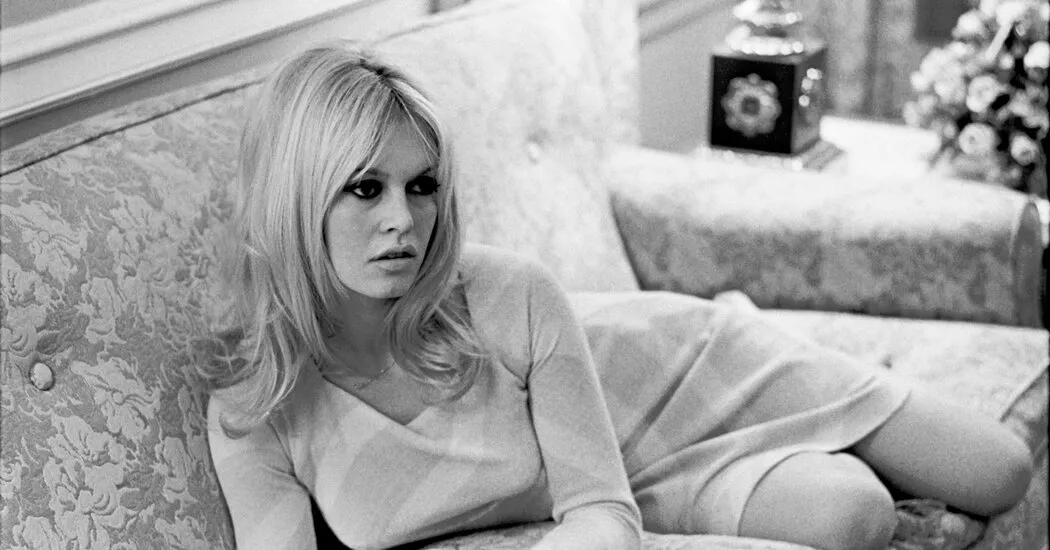
Brigitte Bardot, French film star, dies at 91
Brigitte Bardot, the wild-haired, pouty French actress who redefined the sexual symbolism of mid-20th-century cinema in films like And God Created Woman, then stopped acting at age 39 to devote her life to animal welfare, died Sunday at her home in the south of France. She was 91 years old.
The Brigitte Bardot Foundation, created by her for the protection of animals, announced her death.
Bardot was 23 years old when And God Created Woman, a box office failure in France in 1956, was released in the United States the following year and made her an international star. Bosley Crowther, writing about it in The New York Times, called it “an undeniable creation of superlative craftsmanship” and a “phenomenon that must be seen to be believed.” Like many critics, he was not impressed by the film itself.
Bardot's image was distinctive, compared to other cinema sex symbols of the time, not only for her overflowing youth, but also for her unapologetic carnal appetite. Her director was her husband, Roger Vadim, and although they divorced soon after, he continued to shape her public image by directing her in four more films over the next two decades.

Writer Simone de Beauvoir, in a 1959 essay, Brigitte Bardot and the Lolita Syndrome, saw Bardot's powerful erotic presence on the screen as a feminist challenge to “the tyranny of the patriarchal gaze” represented by the film camera. The challenge failed, Beauvoir concluded, but it was a “noble failure.”
Few of Bardot's films were serious film ventures, and she later told a French newspaper that she considered The Truth, Henri-Georges Clouzot's 1960 Oscar-nominated crime drama, the only good film she had ever made.
Nicknamed BB (pronounced very similarly to the word baby in French), it was Best known for light comedies such as La mariée est trop belle (1956), Babette goes to war (1959) and Les femmes (1969), but she worked with some of France's most respected directors.
Early in her career she appeared in Les grandes manoeuvres (1955), by René Clair. Jean-Luc Godard directed her in the 1963 film industry drama Contempt. Louis Malle was her director in Love is a Private Business Private (1962), a drama that also starred Marcello Mastroianni, and Viva María! (1965), a western comedy in which she and Jeanne Moreau played singing strippers who become revolutionaries in Central America at the beginning of the 20th century. That film earned her the only acting award nomination of her career, for best foreign actress, from the British Academy of Film and Television Arts.
Although she shot several films in English, Bardot never worked in the United States. The closest she came to Hollywood roles were small characters, when she was still unknown, in Helen of Troy (1956), by Robert Wise, a Warner Bros. film filmed in Italy, and in Un acte d’amour (1953), a film by Kirk Douglas filmed in France and directed by Anatole Litvak. Shalako, a 1968 Western in which she starred alongside Sean Connery, was a British-German production filmed in Spain and England.
At the height of her popularity, almost everything about Bardot was copied: her deliberately messy hair, her intense eye makeup, and her fashion choices, which included tight knit tops, tight pants, gingham checks, and ruffled skirts that showed off bare, sun-kissed legs. In 1969, she became the first celebrity used as a model for Marianne, a traditional symbol of the French Republic that adorns town halls across the country.
In a statement on Sunday, French President Emmanuel Macron said: “Her films, her voice, her dazzling fame, her initials, her sorrows, her generous passion for animals, her face that became Marianne: Brigitte Bardot embodied a life of freedom.”
He helped turn Saint-Tropez, once a sleepy fishing port in the south of France, into a painfully fashionable resort town after he bought a house there in 1958. Two decades later, when he publicly complained about the deteriorating quality of life in Saint-Tropez, the mayor responded: “I wonder, who brought vice and lewdness?”
When Bardot announced that she was retiring from film in 1973, she had already begun her work on behalf of animal rights and welfare (although in 1965 she had declared to an American reporter: “I love fur”). But it was not until 1986, a year after receiving the French Legion of Honor, that she created the Brigitte Bardot Foundation, based in Paris, which has fought battles against wolf hunting, bullfighting, vivisection and the consumption of horse meat. In 1987, she auctioned off her jewelry and other personal items to secure the foundation's financial foundation.
“I gave my beauty and my youth to men,” she said then, “and now I give my wisdom and experience, the best of me, to animals.”
Four decades later, the foundation said in its statement Sunday, it has taken in more than 12,000 animals and has worked in 70 countries. He called Bardot an “exceptional woman who gave everything and sacrificed everything for a more animal-friendly world.”
In recent decades, Bardot continued to appear in public to promote animal rights, but gained notoriety for her political views, which many considered racist. This especially came to light in his two-volume memoir, Initials B.B. (1996-97), in which he made negative comments about various groups, including Muslims. In 2004, she was convicted of inciting racial hatred and fined for similar comments in Un cri dans le silence, a non-fiction best-seller in which she referred to Muslims as “cruel and barbaric invaders” and made derogatory comments about homosexual people.
By 2008, she had been convicted five times for the same position.
At best In all cases, Bardot was considered eccentric in her later years, prompting observations that this former sex kitten, as she was often called, had become a “crazy cat.” When she was interviewed by Paris Match magazine in January 2018, she denounced the #MeToo movement and called actresses' allegations of sexual harassment “hypocritical, ridiculous, uninteresting.”
A few weeks later, in a Saturday Night Live sketch, Kate McKinnon, in the role of Bardot, shouted: “Free Harvey Weinstein!” Catherine Deneuve, played by Cecily Strong in the sketch, explained: “Brigitte is very old and very wrong.”
But Bardot defended at least one important aspect of the way of life she had chosen.
“I'm not a recluse,” she told The Toronto Star in 1988. “I live as an unsociable person; it's different.”
“People,” she added, “make me angry.” nerves.”
Brigitte Bardot was born into a wealthy family on September 28, 1934, in Paris. She was the eldest of the two daughters of Louis and Anne-Marie Bardot. Her father was an industrialist, and she grew up in the city's wealthy 16th district. She began working as a model as a teenager and appeared on the cover of Elle magazine at age 15.
Her parents opposed her aspirations as an actress and her relationship with Vadim, then a young assistant to film director Marc Allégret. This led to the first of at least four suicide attempts. In the end, the Bardots relented on Vadim, and she married him in 1952, less than three months after her 18th birthday.
That year she had already made her film debut in Manina, la Fille Sans Voile, a romantic adventure that was released in the United States six years later as The Girl in the Bikini, and in a family comedy, Le Trou Normand. When And God Created Woman made Bardot a star, she had already appeared in more than a dozen films. In total it would make about four dozen.
His last film appearance was a supporting role in Colinot's L’histoire très bonne et très joyeuse Trousse-Chemisea 1973 comedy about a young man's many romantic encounters (she played an older woman who taught him valuable life lessons). Her last leading role was in Don Juan ou Si Don Juan était une femme..., a 1973 drama directed by Vadim that received poor reviews and was released in the United States in 1976.
Bardot was married four times and had public, long-term romantic relationships with other men, such as the actor Jean-Louis Trintignant and the singer and songwriter Serge Gainsbourg. She and Vadim divorced in 1957. Her second husband (1959-62) was the actor Jacques Charrier, with whom she had a son. Following the couple's divorce, the boy was raised by Charrier's parents, but reconciled with his mother in adulthood. Charrier died in 2025.
Bardot was married to Gunter Sachs, a German industrialist, from 1966 to 1969. After divorcing, she did not remarry until 1992.
She is survived by her fourth husband, Bernard d'Ormale, former advisor to the late right-wing French politician Jean-Marie Le Pen; his son, Nicolas Charrier; a sister, Marie-Jeanne Bardot; two granddaughters, and three great-grandsons.
Bardot often spoke bitterly of her film career and fame, which she said had robbed her of her privacy and happiness. In 1996, he summarized his point of view to a journalist from The Guardian.
“For me, life is made up only of the best and the worst, of love and hate.”
Ségolène Le Stradic contributed reporting from Paris.