

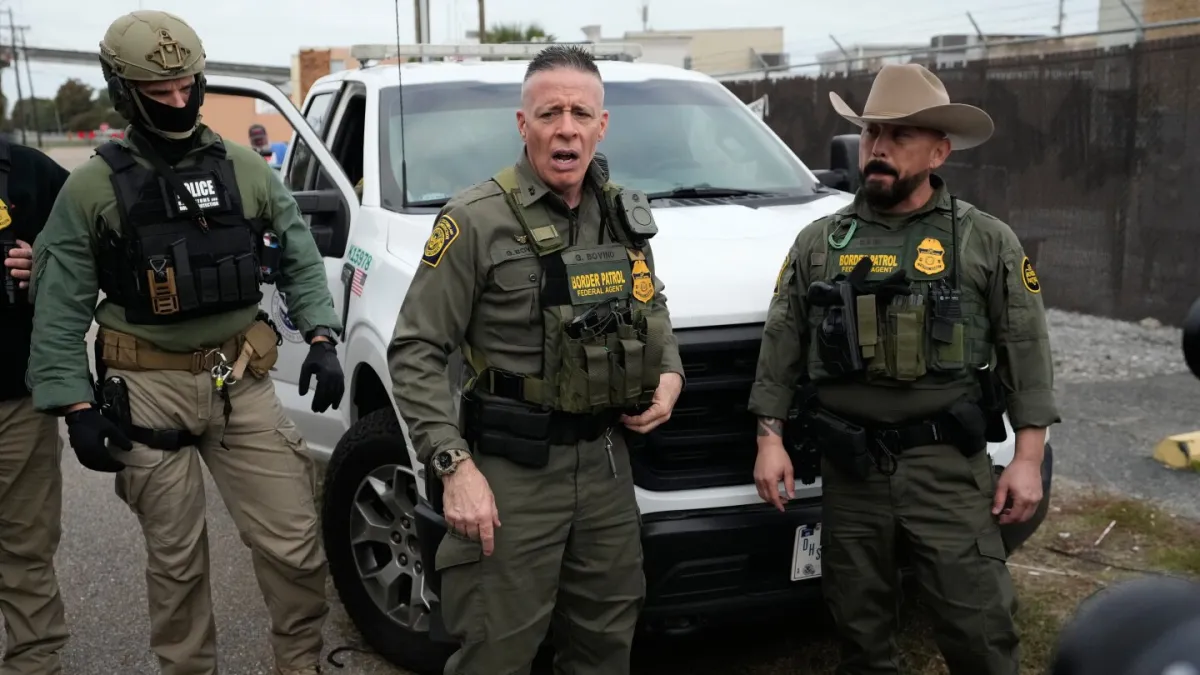
Justice Department sues Illinois governor over laws protecting immigrants
CHICAGO (AP) — The Justice Department filed a lawsuit Monday against Illinois Governor JB Pritzker over a series of new state laws that aim to protect immigrants inside courthouses, hospitals and day care centers.
Pritzker signed a set of laws a few weeks ago that prohibit civil arrests in and around courthouses across the state and require hospitals, child care centers and public universities to have procedures to handle civil immigration operations and the protection of personal information.
The laws, which went into effect immediately, also provide legal steps for people whose constitutional rights were violated during federal immigration raids in the Chicago area, which include compensatory payments of $10,000 for those who were unlawfully arrested while attempting to attend a court proceeding.
Immigration and legal activists have applauded the initiative, saying that many immigrants avoided showing up at courts, hospitals and schools for fear of being detained.
Lawrence Benito, executive director of the Illinois Coalition for Immigrant and Refugee Rights, called the laws “a brave choice.”
Stay up to date with the news and the best of AP by following our WhatsApp channel.
Follow on
“Our collective resistance to violent attacks by ICE and CBP in our communities goes beyond a rapid community-led response — it also includes legislative solutions,” he said at the time, referring by their initials in English to Immigration and Customs Enforcement and Customs and Border Protection, respectively.
The Justice Department argues that Pritzker and Attorney General Kwame Raoul, the Democrats named in the lawsuit, violated the United States Constitution with these laws, which, they claim, "threaten the safety of federal agents," according to a statement released Monday night. The lawsuit is part of an effort by Attorney General Pam Bondi to identify state and local laws that the agency says hinder federal immigration operations.
Pritzker and Raoul did not immediately respond to requests for comment.
In enacting these measures, Pritzker acknowledged that they could be challenged in court.
“They certainly have the ability to go to court, but I think this is not just a good law, but a great law,” Pritzker said.
U.S. Immigration and Customs Enforcement's “Operation Midway Blitz,” which appears to have greatly diminished by now, resulted in the arrest of more than 4,000 people. Data on people arrested from early September to mid-October revealed that only 15% of them had criminal records, the vast majority for traffic violations, misdemeanors or non-violent crimes.
___
This story was translated from English by an AP editor with the help of a generative artificial intelligence tool.