

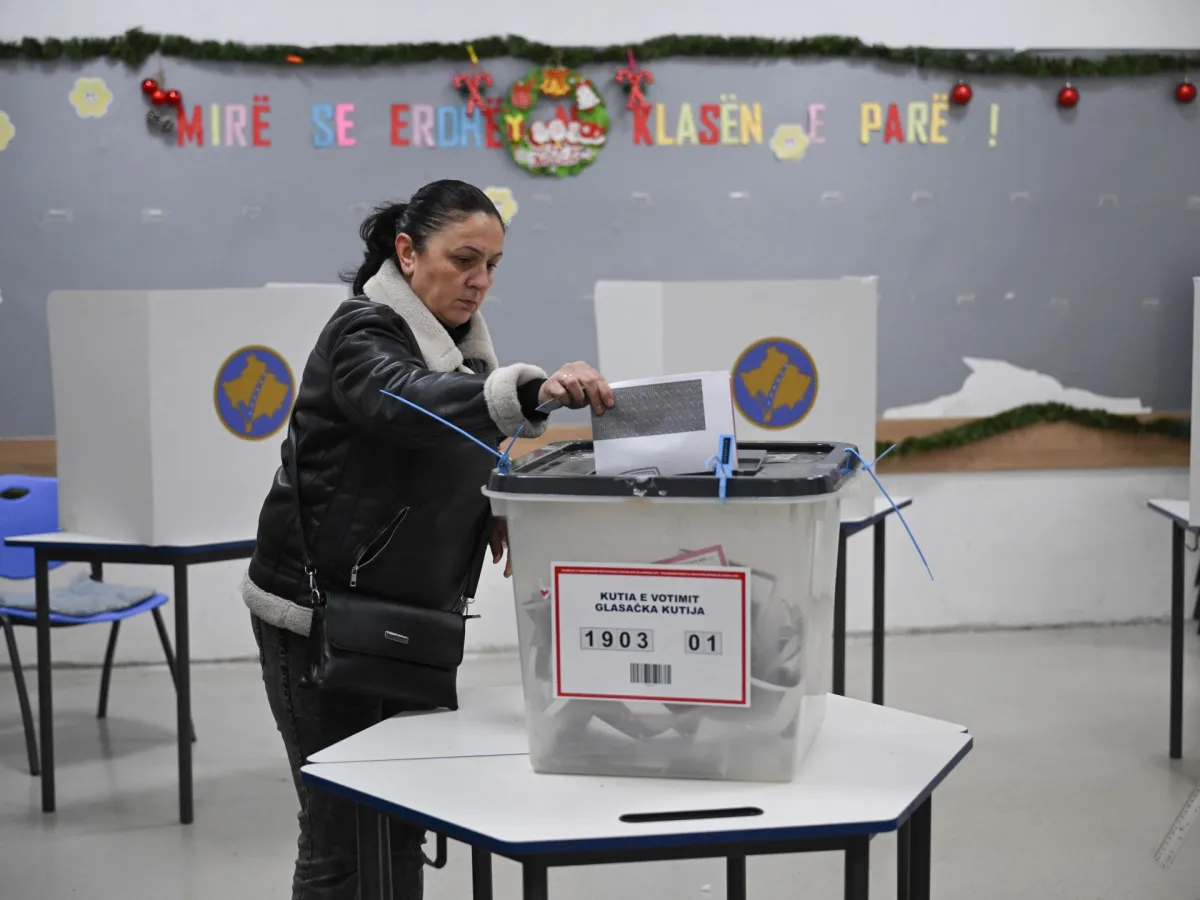
Kosovo votes in snap election in bid to end a year of political deadlock
Kosovo is voting to elect a new parliament for the second time in 11 months, as nationalist Prime Minister Albin Kurti’s party seeks a majority to end a yearlong political deadlock.
Polls opened at 7am local time (06:00 GMT) and will close at 7pm (18:00 GMT) on Sunday, with exit polls expected soon after voting ends.
Recommended Stories
list of 3 items- list 1 of 3PM Albin Kurti declares victory in Kosovo election
- list 2 of 3Kosovo police arrest eight people over canal explosion blamed on Serbia
- list 3 of 3Kosovo: The Making of a State
The snap parliamentary vote was called after Prime Minister Albin Kurti’s Self-Determination Movement (LVV) party failed to form a government despite winning the most votes at a February 9 ballot.
Failure to form a government and reopen parliament would prolong the crisis at a critical time. Lawmakers must elect a new president in April and ratify 1 billion euros ($1.2bn) in loan agreements from the European Union and World Bank that expire in the coming months.
The Balkan country’s opposition parties have refused to govern with Kurti, criticising his handling of ties with Western allies and his approach to Kosovo’s ethnically divided north, where a Serb minority lives.

Despite international support, the country of 1.6 million has struggled with poverty, instability and organised crime. Kurti’s tenure, which began in 2021, was the first time a Pristina government completed a full term.
To woo voters, Kurti has pledged an additional month of salary per year for public sector workers, 1 billion euros per year in capital investment and a new prosecution unit to fight organised crime. Opposition parties have also promised to focus on improving living standards.
The political deadlock in Kosovo is raising fears of another vote in 2026, local journalist Erjone Popova warned.
“We voted also for local election twice this year. This is the fourth time that people are voting this year in Kosovo, and maybe they are tired,” Popova told Al Jazeera.
“Kosovo has been facing many problems during the year it has had an acting government. Energy costs are high. Salaries have not increased enough, and this is making daily life of the people … very difficult.”
Tensions with Serbia
Formerly a province of Serbia, Kosovo, whose population is almost exclusively Albanian, declared independence from Serbia in 2008 following an uprising and NATO intervention in 1999.
It has been recognised by more than 100 countries, but not by Russia, Serbia, Greece or Spain. It is seen as a potential candidate for accession to the EU.
Tensions with Serbia flared in 2023, prompting the EU to impose sanctions on Kosovo.
The bloc said this month it would lift them after ethnic Serb mayors were elected in northern municipalities, but the measures likely cost Kosovo hundreds of millions of euros.
Kosovo remains one of the poorest countries in Europe. It is one of the six Western Balkan countries striving to eventually join the EU, but both Belgrade and Pristina have been told they must first normalise relations.