

Maduro's capture shows Trump's goal of dominating the American continent
The city was left in darkness. The air defenses were disabled. Explosions rang out. And under the night sky, a fleet of American helicopters swooped in and captured the president.
Hours later, celebrating the U.S. government's capture of Venezuelan leader Nicolás Maduro, President Donald Trump mentioned Venezuela's oil 20 times.
The moment shocked Latin America perhaps more than any other event this century, but its meaning depends on who you ask.
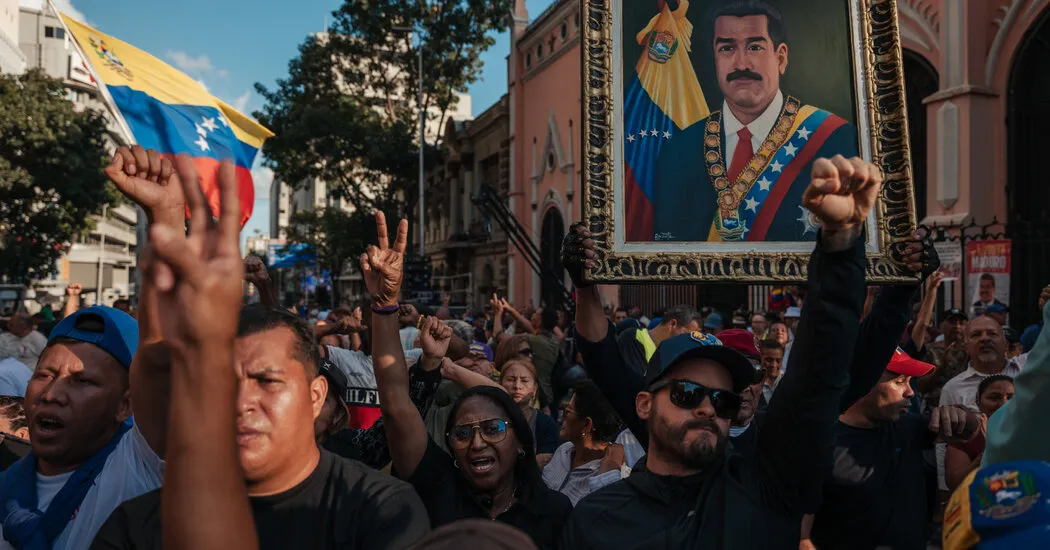
To the Latin American left, confirmed what certain leaders have been warning for decades: the United States is an imperial power willing to invade and exploit its southern neighbors for its own benefit and their natural resources.
For the Latin American right, Trump had just rescued a bankrupt Venezuela from a left-wing dictatorship and would now finally realize the country's immense economic potential.
Brazil, Mexico, Colombia, Chile, Spain and Uruguay — all of them led by leftists—jointly denounced the attacks and capture as “an extremely dangerous precedent” and warned against “any attempt at government control, administration or external appropriation of natural or strategic resources” in Venezuela.
Argentine President Javier Milei, the region's most prominent right-wing leader, applauded the U.S. action. “There are no half measures or grays here,” he said. “You are on the side of GOOD, or you are on the side of EVIL.”
What everyone can agree on is that the intervention showed that the United States is once again the center of gravity in Latin America, for better or worse.
Trump is among them. "The Monroe Doctrine is a great thing, but we have surpassed it by a long, long way. Now they call it the Donroe Doctrine," he said Saturday, referring to President James Monroe's 1823 policy, which sought to prevent European powers from meddling in the American continent. “With our new national security strategy, American dominance in the Western Hemisphere will never be questioned again.”
In the 30 years before the current Trump administration, American foreign policy in Latin America had largely focused on supporting democracy and free trade.
Trump has revised that approach to focus on what is best for the United States or, in many cases, him.
He imposed tariffs on Brazil in a failed attempt to save Brazil from jail. his ally, former president Jair Bolsonaro. It applied sanctions to the president of Colombia after he criticized US policy. He supported a right-wing candidate in Honduras, in a surprise that could have tipped the electoral balance. And it gave Argentina a $20 billion lifeline to help Milei in the legislative elections.
Those actions unsettled many in Latin America, reminding them of Washington's long history of interventions in the region, such as its invasions of Mexico, Panama and Haiti, and its support for military coups.
“Thinking as a region, this is scary in a way I haven't seen in a long time,” Celso said Amorim, the main foreign policy advisor to the president of Brazil, Luiz Inácio Lula da Silva, and one of the most experienced government officials in Latin America, having been Minister of Foreign Affairs, Minister of Defense and special advisor of Brazil for 16 years on various occasions.
“The most serious thing for me is that this return to interventionism is not even disguised,” he said in an interview. “There isn't even a, let's say, 'No, we went there to defend democracy.' There is an objective that is obviously economic.”
Lula, Latin America's most influential statesman, held two separate meetings with his ministers on Saturday about the US attack, according to the Brazilian government. He then issued an especially harsh criticism, stating that Washington's actions “cross an unacceptable line” and that “the international community, through the United Nations, must respond forcefully.”
On Sunday, the Community of Latin American and Caribbean States — the region's main multilateral organization — held an emergency meeting to address the situation in Venezuela. Many countries led by left-wing politicians sent their foreign ministers, while others, led by conservative leaders, sent lower-ranking diplomats.
At the meeting, Venezuelan Foreign Minister Yván Gil warned that the rest of Latin America should be concerned. “This attack is not only against Venezuela, it is an attack against Latin America and the Caribbean,” he told the group of 33 countries. "Today it was Venezuela; tomorrow it could be any other country that decides to exercise its sovereignty."
Many Latin Americans disagreed. Maduro's government was corrupt and repressive, they said, and that drew the ire of the US government. “For all Chavista narco criminals, their time has come,” Ecuador's President Daniel Noboa said Saturday, referring to followers of Maduro's socialist predecessor, Hugo Chávez. “Its structure will end up falling across the continent.”
However, it remains to be seen if countries will do more than issue angry statements. The United States is the most crucial economic partner for much of the region, and Trump has proven willing to intervene economically, politically, and now militarily against countries that oppose him.
“I think we are at the lowest point of inter-American diplomacy because all the countries have turned in on themselves and all are developing transactional approaches in their relationship with this government,” said Arturo Sarukhán, former ambassador. of Mexico in the United States. Given the growing partisan divide in the region, he added, “I think it's going to be very difficult to see a powerful approach from Latin American and Caribbean nations to this.”
Mexican President Claudia Sheinbaum's response illustrated that political tightrope.
Although she condemned Venezuela's attack, Sheinbaum did so more diplomatically than several of her counterparts. It should be taken into account that, at the same time, on Saturday, Trump once again warned that the Mexican cartels could be his next military target.
Brazil, however, is much further away from the United States and its main trading partner is now China. That has allowed Lula to take a much more combative approach toward Trump, which has yielded positive results for Brazil.
Amorim suggested that Trump's policies could push other countries toward China. The interventions “are going to have the opposite effect to that desired by the United States,” he said. Countries “will have to look for more and more counterweights, to avoid getting involved in this type of situation.”
What seems more likely now is that Latin America's conflicting views on Venezuela — and each country's efforts to preserve itself — will lead to loosely cohesive action. Sarukhán said it would probably take a full-scale occupation of Venezuela to push for more than just statements.
That also means a possible emboldening of Trump.
In the last year, his actions in Latin America have become more aggressive. This has left many countries unsure what to make of his harsh words.
Hours after watching the US military carry out a successful operation in Venezuela, he was already hinting that Cuba could be next. “I think we're going to end up talking about Cuba, because Cuba is a nation in decline,” he told reporters Saturday.
On Sunday morning, in a phone call with The Atlantic, he said, “We need Greenland, for sure.”
On Sunday night, he had another goal in the hemisphere in mind
“He's not going to do it for a long time,” Trump said of Colombian President Gustavo Petro, who has frequently criticized Trump. “It has cocaine factories.”
Asked if the United States would carry out an operation against Colombia, he responded: “That sounds good to me.”
Jack Nicas is the Times' bureau chief in Mexico City and leads coverage on Mexico, Central America and the Caribbean.