

The City’s Most Impressive Skylights
Natural light is particularly precious in New York on these shortest days of the year. It’s not easy to punch windows into city buildings made of brick and concrete, but owners with top-floor real estate and dreams of sunshine can sometimes saw through the roof.
Skylights were once added to buildings to grab sunshine when electric lightbulbs were still rare. Many larger skylights arrived in the late 20th Century, along with the modern penchant for interior daylight and a closer connection to nature. Today, any skylight is a luxury — a privilege afforded only on the top floor — but exceptional design elevates some to works of art. Here are a few.
A Storied Skylight in NoMad
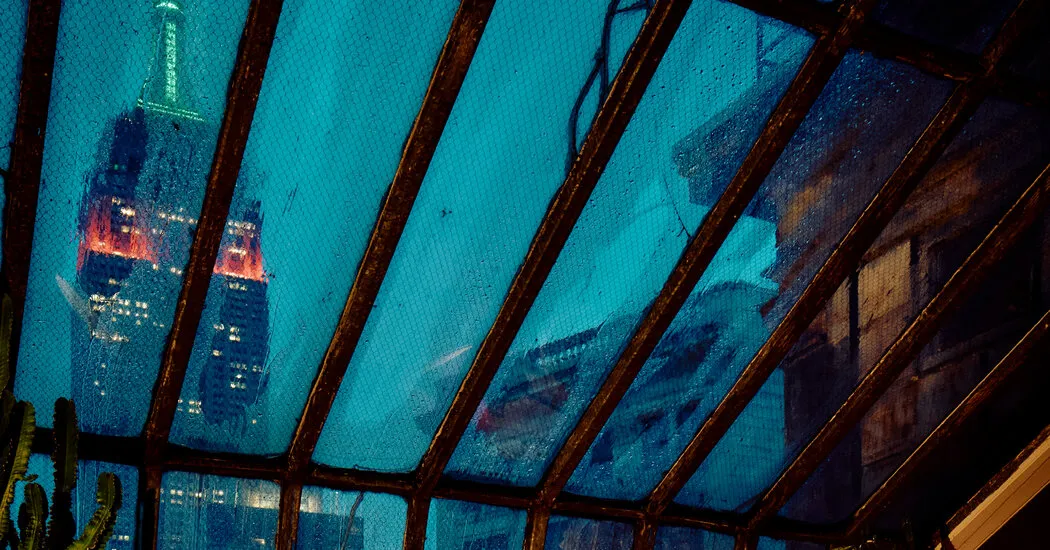
For his interiors studio, the designer Alfredo Paredes leases a 2,250-square-foot penthouse loft with an enormous skylight on 28th Street and Broadway. The glass slants up 15 feet from the floor and frames an impressive view of the Empire State Building. It “looks like a movie set,” he said.
The space did gain fame as a photo backdrop when it was the home of the illustrator Ruben Toledo and his wife, Isabel Toledo, the late fashion designer who dressed Michelle Obama in a lemongrass-colored ensemble for the 2009 Inauguration. The geometry of the skylight inspired the shape of angular glass bottles for her perfume line.
Mr. Paredes has taken press photos in the loft, just like its notable former occupants. In some of these, the Margot sofa, upholstered in fuchsia cotton velvet, basks under the skylight. The designer, who created the Polo Bar for Ralph Lauren and has a line of furniture, isn’t typically known for such vibrant hues. “I hope it fades,” he said
‘Wavelets’ of Light off Tompkins Square

In 2019, the architect Richard Gluckman, converted a former Con Edison substation for art exhibitions by the Brant Foundation in the East Village. His client Peter M. Brant admired roof gardens at Rockefeller Center and, improbably, requested he turn the substation roof into a similar landscape, with a reflecting pool. Mr. Gluckman told him, “Peter, I don’t want a pool. I want a skylight.”
Remarkably, he was able to supply both at once: a central skylight with a shallow pond on top. “It’s not my original idea but seemed like a perfect solution,” said Mr. Gluckman.
The skylight is 120 square feet, its cast-polyester lens almost five inches thick and crystal clear. The water on top is just four inches deep and ripples endlessly thanks to outflow from a filter for dirt and bird droppings. The architect notes how looking skyward through “the flutter of the little wavelets” of water from the space below, a top-floor gallery, reminds him of scuba diving. Look down for the bright squiggles of sunshine swimming restlessly across the gallery floor.
Illuminating a Restored Landmark
Decades ago, neighbors of this landmark 1879 East Village townhouse called it “haunted.” Plywood blocked the shattered windows. It had decrepit single-room apartments, two per floor, when investors proposed an addition for luxury rentals. The city rejected the proposal as too massive, and probably too modern, so the property returned to the market. Tasso Argyros, a Greek data entrepreneur, and Victoria Katsarou, a digital marketing executive, bought it for $3.65 million in 2019. They loved the 3,000-square-foot house, “even when it looked awful and needed the full works,” said Ms. Katsarou.
When it came time to rebuild within the brick shell, they learned the historic front windows could not be enlarged, but an oversized modern skylight would be welcome, even in a landmark district. Michael K. Chen, a contemporary architect, drew a geometrically complex new helical stair. It spirals up to a bulkhead clad in black charred pine planks.
Mr. Chen called the triple-paned skylight capping the stairwell “otherworldly.” It is oval, with smooth plaster trim that conjures an airplane window. “You can see the sky from the parlor floor three stories down,” he said, but you can’t see this skylight from the sidewalk.
A Skylit Sanctuary for Friends Seminary
When he was head of school at Friends Seminary in New York, Bo Lauder wanted a new religious experience for his students. The artist James Turrell was raised Quaker and had worshiped at the adjoining Friends meetinghouse on Rutherford Place. He offered to donate the design for one of his Skyspace rooms, a profound white cube where classes gather on teak benches beneath a hole cut in the roof.
Following a decade of planning and construction, the room opened to the community in 2024, the final puzzle piece atop a campus structure extensively remodeled by Kliment Halsband Architects.
This is actually an oculus without glass, and the ceiling around it ends crisply, in a knife edge. Nothing but the sky — no metal frames, no vertical walls of a skylight well — is visible from below. Framed this way, the heavens beyond look remarkably saturated and completely flat, until a cloud or a bird floats by. When an opaque robotic lid must close the oculus against the weather, hidden color-changing LED lights are programmed by Mr. Turrell to shepherd visitors to spiritual transcendence.
Sun Showers in Carnegie Hill
When showering, pure natural light “helps you feel cleaner,” said Adam Glickman, a Queens architect. Both Mr. Glickman and his partner, the architect Lauren Schlesinger, love to shower al fresco. When designing a small bathroom on the top floor of a redbrick Carnegie Hill townhouse for Ji Park Kwak and Edward S. Kwak, they wanted to create an outdoor feeling since “the natural world can be so inaccessible in Manhattan,” Ms. Schlesinger said.
Formerly a closet, it sits wedged between a party wall and the stairwell. Natural light from an old skylight, which they replaced, liberated them to explore strong textures and a palette of Earth tones. Glossy wall tiles are jungle green and three-dimensional. Their “pleats,” she said, cast “interesting shadows.” The figured slab marble floor looks “geological,” said Mr. Glickman. To shower here feels like standing under a Mexican waterfall in a lush cenote.
Layered Color in a Gowanus Studio
There were no skylights at the Brooklyn workshop where Tom Fruin, an artist, built a colorful “skylight” sculpture from transparent acrylic scraps. It was a lark, unfinished and never intended as watertight. Short walls supported the hip roof, like a kneecapped greenhouse resting on the floor.
The 27-square-foot plastic patchwork for the piece recalled his luminous Watertower, a bold 2012 sculpture of colored acrylic and steel in the shape of a water tank. Mr. Fruin installed it in a prominent location on a DUMBO rooftop, then placed similar tanks in other locations, from Korea to New Orleans.
He moved into a huge Gowanus studio in 2019 and hoisted the old skylight sculpture up off the floor. It hangs under a slightly larger real skylight, above the studio mezzanine. “A lucky fit,” he said. Sunbeams project through the colored plastic, splashing onto the low mezzanine sofas where the artist naps in the gaudy, dazzling glow of his work.
Walking on Skylight Glass in TriBeCa
A skylight you walk on raises several concerns. First, it “needs to not break,” said the architect Wayne Turett. His walkable skylights have laminated glass with a strong plastic inner core between the outer glass layers.
Skylights are a favorite way Mr. Turrett brings daylight into buildings “shoehorned between other buildings.” Urban construction can block windows, he said, but “skylights always face the sky.” He calls them the best “light fixtures” both because of the light quality and the novelty of daylight shining straight down, rather than at an angle through a window. He sunk a handful of walkable skylights into outdoor terraces at a TriBeCa maisonette with 7,800 square feet for the owner, Sherri Schnall.
In the kitchen, skeletal framework supports the glass minimally, making the ceilings feel even higher. The architect noted how someone walking on the skylight could experience vertigo while “floating in space.” So he frosted the clear glass with stripes that also add a measure of privacy, though “women in dresses,” still avoid crossing the glass, he said.
Greenhouse Effect in Gramercy
Two decades ago, Shaler Ladd, an interior designer, traded a West Village triplex for a fixer-upper across town, in a co-op between Gramercy Park and Stuyvesant Square. He shares the 1,650-square-foot apartment with Lilia Garcia Leyva, his wife, and their interiors firm. The office inhabits the top floor, opening onto a south-facing roof terrace planted with yellow climbing roses and chives.
Not long after moving in, Mr. Ladd discovered fuzzy language in his proprietary lease that blurred responsibility for the leaking 10-foot-long skylight overhead. He replaced it himself with a commercial model from Wasco. Insulated clear glass blunts the cold but skips a cooling brown or green tint that would reflect summer heat. He knew tinted light would muddy the paint swatches he reviews at his desk.
The bright, tropical environs have nurtured a fig tree that arrived under the skylight as a sapling more than a dozen years ago; it has since grown to 13 feet. Mr. Ladd grew up in a Southern California avocado grove and described this fig as “almost a member of the family.” Recently the fig leaves started to drop, so he said he paid extra attention to watering and fertilizer. “I have an emotional attachment to my tree.”