

Trump's campaign against Maduro is also focused on oil
The Nobel Peace Prize winner made her presentation via live video at a business conference in Miami attended by American executives and politicians, including President Donald Trump.
“I'm talking about a $1.7 trillion opportunity,” María Corina Machado,
He highlighted the enormous oil and gas reserves. of Venezuela —“We are going to open everything, upstream, midstream, downstream, to all companies”—, as well as its mining and energy infrastructure. His message has been unwavering since earlier this year, when he boasted of his country's "infinite potential" for American businesses on a podcast hosted by the president's eldest son, Donald Trump Jr.
He has had a receptive audience.
The president and his advisers have publicly insisted that the lethal military operations around Venezuela and the pressure campaign against Maduro have as their main objective protecting Americans from drug trafficking. But Venezuela is not a drug producer, and narcotics smuggled through the country mostly end up in Europe.
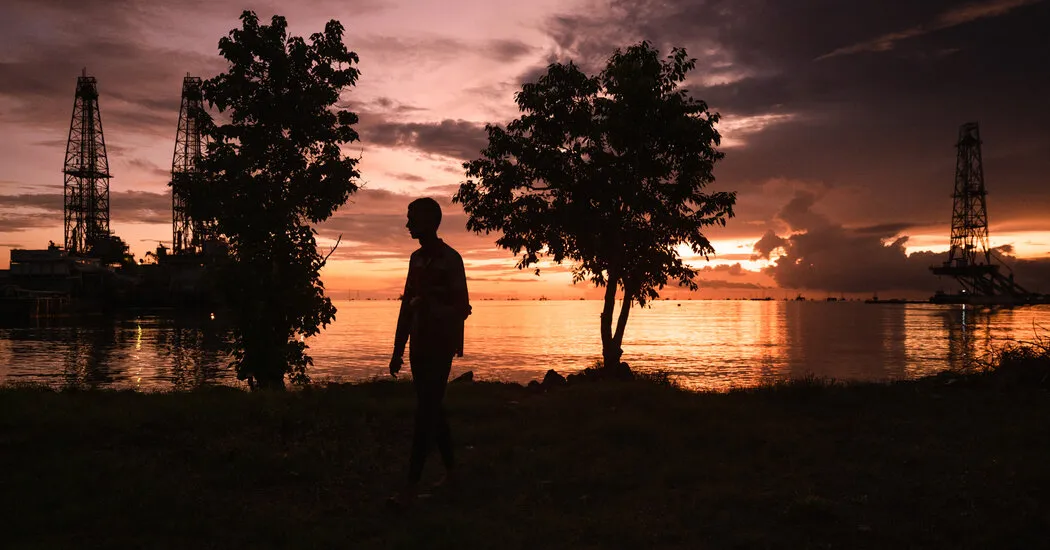
Behind the scenes, government officials have also been intensely focused. in Venezuela's oil reserves, the largest in the world.
Its importance is evident in the secret negotiations between US officials and Maduro on oil matters, and in the conversations that Trump's aides and allies have had with Machado and other Venezuelan opposition figures.
Trump has publicly made clear his interest in controlling Venezuela's reserves. In a speech to North Carolina Republicans in 2023, four years after backed efforts to overthrow Maduro In his first term, Trump said: “When I left, Venezuela was about to collapse. We would have taken it over, we would have gotten all that oil, it would have been right next door.”
Herole of oil in the growing tensions between Maduro and Trump highlighted on Wednesday with thedramatic US seizure of an oil tanker traveling through the Caribbean Seatransporting crude oil for Cuba and China. Trump said he would keep the cargo, although his legal authority to do so is questionable

This action marked a sharp escalation in the Trump's campaign against Maduro, which has lasted for months and included 25 attacks on ships in which at least 95 people have died, acts that, according to many legal experts, they are illegal.omy of Venezuela.
Venezuela and its oil are at the center of two of the domination of energy resources and control of the Western Hemisphere. Venezuela has around 17 percent of the world's known oil reserves, that is, more than 300 billion barrels, almost four times the amount that the United States has. And no nation has a greater presence in Venezuela's oil industry than China, the superpower whose immense commercial footprint in the Western Hemisphere the Trump administration seeks to curb.
“When President Trump has talked about Venezuela and other comparable countries, he has always emphasized the importance of the United States having access to those oil resources,” said Francisco R. Rodríguez, a professor at the University of Denver who studies the political economy of Venezuela.
Trump has repeatedly spoken of obtaining oil and other natural resources as a reward for US military intervention on foreign soil. “I've always said we have to take the oil” was one of his favorite phrases in his 2016 presidential campaign.
In his first term, he said he was going to “keep the oil” from Syria due to the presence of US soldiers there. He has said that the United States should have kept the oil from Iraq and Libya as payment for the military interventions that overthrew those governments.
In 2019, Trump ordered his advisers to have Juan Guaidó, then the leader of the Venezuelan opposition, commit to giving the United States access to his country's oil and excluding China and Russia if Guaidó seized power from Maduro in a US-backed effort, according to a memoir by John Bolton, then national security adviser. Bolton called it a “great overreach.”
Maduro also considers Venezuelan oil an important geopolitical tool.
The country's leaders depend on oil purchases from China as a bulwark against the economic sanctions imposed by the first Trump administration and maintained by President Joe Biden. In April, during a visit to Beijing, Delcy Rodríguez, vice president of Venezuela, called on Chinese leaders to make greater investments in her country's oil industry and to buy more crude oil. China already accounts for 80 percent of Venezuela's oil purchases.
Oil under pressure
In recent months, Trump aides have debated how to get greater access to Venezuelan oil for American companies, given Maduro's hostility and the presence of China, current and former officials say.
Richard Grenell, special envoy in charge of dealing with Venezuela and president of the Centro Kennedy, has led the talks aimed at reaching a grand agreement with Maduro. The Venezuelan leader made an offer to Trump that included opening the country's oil industry to Americans, beyond Chevron's limited access, which it operates there with a confidential license recently expanded by the US government.
Trump has rejected that offer, because other senior advisors have successfully argued that Maduro cannot be trusted and is seeking to buy time. That side, led by Marco Rubio, Secretary of State and National Security Advisor, has pushed to overthrow Maduro by force. They argue that a conservative, free-market-oriented leader — that is, Machado — would favor American companies and limit Chinese investment.
Trump suggested Maduro in a phone call last month that he leave office. Maduro has refused to give up power in the near future, despite the buildup of US military forces in the Caribbean and Trump's repeated threat to go beyond attacks on ships and attack targets inside Venezuela.
The The seizure of the oil tanker and the new sanctions against Venezuela's oil sector aim to overthrow Maduro's obstinacy by demonstrating that the United States is willing to suffocate the country's largest source of income, officials and officials said. former officials.
The United States is likely to soon seize more ships carrying Venezuelan oil, US officials said. The US government could justify future seizures by citing a history of tankers transporting oil from Iran, which is subject to a stricter set of sanctions than Venezuela; He already used this justification last week.
The United States has only seized a handful of oil tankers in recent years. All of those actions have been based on suspicion that Iranian crude was used to finance the Islamic Revolutionary Guard Corps, a branch of the Iranian military that the first Trump administration designated as a foreign terrorist organization, said Edward Fishman, a former sanctions specialist.
A few more seizures of vessels carrying Venezuelan oil by the United States could lead to companies avoiding the country and the subsequent loss of oil revenue, said Tom Warrick, a former State Department official who also worked as an industry lawyer.
“It is now revealed that the Trump administration's strategy is very clearly aimed at that flow of money,” he said. “Venezuela has a fairly small amount of cash on hand, so losing that tanker will start to bite you pretty quickly.”
Trump has not publicly talked about helping American companies obtain a greater share of Venezuela's oil as a goal of that campaign. But he has mentioned it often in private, people familiar with the conversations said.
In talks this year, U.S. officials negotiated with Maduro on possible deals to expel Chinese and Russian oil companies from Venezuela and expand the role of U.S. companies.
China has curbed its direct investment in Venezuela's industry in recent years. Maduro seemed interested in attracting more investment from the United States, U.S. officials said. But he remained steadfast in his efforts to cling to power, so the talks stalled.
Wartime Drilling
Trump has authorized the CIA to carry out covert operations in Venezuela, and could decide to overthrow Maduro with violence, using the agency, the US military or both as the spearhead.
However, many experts in Venezuela anticipate that the consequences of such an action will be chaotic. U.S. officials from several agencies in the first Trump administration came to that conclusion in military simulation games in 2019.
Unrest in a Venezuela without Maduro could complicate the desire and ability of companies Americans to expand their presence there.
No major oil companies in Europe or the United States immediately entered Iraq or Libya following US military interventions that overthrew governments and sparked civil wars. It took years for the largest companies to start operating there. In contrast, Chinese oil companies signed contracts to operate in the fields of southern Iraq during the civil war, and have generally had a much higher tolerance for risk in conflict zones.
The appetite of large American companies to enter the industry Venezuela could well depend on whether the U.S. pressure campaign and any military operation lead to chaos or stability.
“American oil companies work in pretty dangerous areas, but what they're going to be interested in is the bottom line,” said Oliver B. John, who worked as a U.S. diplomat on economic affairs in Arab Gulf nations.
Chevron has operated in Venezuela for a century and is the only American company that remained in the country when, decades ago, the Venezuelan government forced Western companies to become minority partners in joint ventures with the state oil company, Petróleos de Venezuela, S.A. (PDVSA).
American companies had a significant presence in the industry until the 1970s. In those years, Venezuelan leaders placed the industry under state control and created PDVSA, in a popular action that was a hallmark of the country's democratic and nationalist movements. Hugo Chávez, the socialist leader, enshrined it in the Constitution after he came to power in 1999.
Machado has spoken in general terms about how he would reshape the sector if he came to power. In June, in a video chat with the Council of the Americas, a New York business group, he said he would launch a “privatization process” and have a national agency open the sector to private investment. The goal would be for Venezuela to produce about three million barrels a day of oil within 10 years, triple current production, he said.
However, a nationalized industry is popular among Venezuelans because of its historical roots, and “privatizing Venezuela's oil industry would be controversial in many ways,” Rodríguez said.
The industry's struggles intensified after the first Trump administration imposed sanctions on it. These hampered operations across the country, including refineries that can process oil with high sulfur content, typical of Venezuelan crude. Chevron's joint venture in Venezuela has used Gulf Coast oil refineries, and other U.S. companies expanding in Venezuela could take advantage of that capacity.
The largest foreign company with investments and operations in the Venezuelan industry is China National Petroleum Corporation, or CNPC, a state-owned company that conducts joint ventures with PDVSA. But since 2019, it has taken a more passive role in Venezuela to avoid violating US sanctions. Last year, a private Chinese company, China Concord Resources Corporation, signed a 20-year contract with PDVSA to invest more than $1 billion in the exploitation of Venezuelan oil fields.
Currently, Venezuelan oil going to China is the result of purchases by private Chinese companies, Rodríguez said.
Chinese national energy companies received Venezuelan oil thanks to China's state banks accepting the oil as payment for loans to the Venezuelan government. But Venezuela defaulted years ago — the debt stood at $19 billion in 2020 — and China has stopped lending to it.
Chinese officials and executives have become more cautious about engaging with Venezuela, although they continue to look for ways to collaborate with Maduro's government, said Margaret Myers, a scholar at Johns Hopkins University who studies China's relations with Latin America.
“There has been growing disillusionment on the part of Venezuela. China,” he said. “But they remain committed to staying overall.”
Edward Wong covers global affairs, U.S. international politics and the State Department for the Times.
Julian E. Barnes covers US intelligence agencies and international security affairs for the Times. He has written on security issues for more than two decades.