

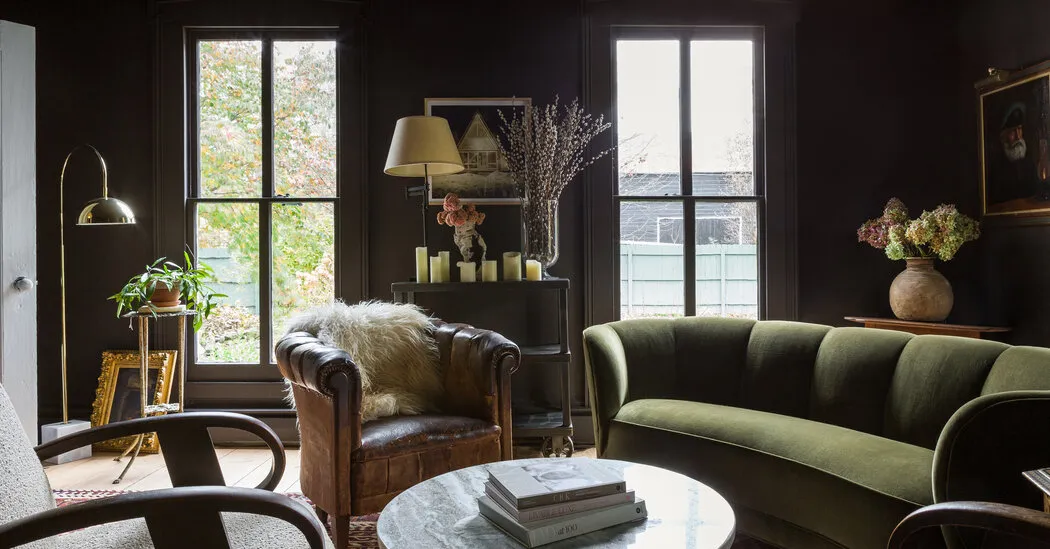
Would You Let A.I. Design Your Living Room?
When Lee Mayer launched the interior design platform Havenly in 2014, she used technology to help make design more affordable to the masses.
The site connects clients to professionals who manage most of the design process online, using Havenly’s site to host video consultations and chats, exchange measurements and mood boards, or share new floor plans and links to products.
Now Ms. Mayer is hoping to ride out the industry’s next high-tech shift with Havenly A.I., an app with the potential to redesign a room without any professional help at all.
Upload a few photos, answer a few queries, and your design dreams will be translated to an image of your home as you watch. (You can even click on a couch to buy it.)
The app, which is still in development, does get something wrong “one every in 20 times,” said Ms. Mayer, and it is not as creative as one of Havenly’s real designers. “But we now have 3-D rendering in 30 seconds,” said Ms. Mayer. “It’s kinda crazy.”
Havenly is one of a growing number of home renovation and interior design platforms rolling out A.I.-enabled imaging tools, many of which show up in Instagram and TikTok ads that promise faster and easier home refreshes. Spoak has “Viz;” Hover has “Instant Design;” and from Block comes the new “Renovation Studio.” Even Lowe’s, the home improvement big box store, is planning to add similar functionality to Mylow, the company’s A.I.-powered shopping tool.
In the design and construction industry, instant renderings derived from a blend of photos and data are known as “visualization,” said Sumeet Howe, the head of product at Hover, a property and renovation management platform primarily used by insurance adjusters and contractors.
In the past, interior designers would come to your home with samples and swatches, said Ms. Howe, get accurate measurements, then spend several days, or even weeks, working on product research and floor plans. Until A.I. arrived, these were usually done as a mock-up, rather than realistic images that showed your home as it really existed.
You also couldn’t change them on the fly, said Ms. Howe. “Now, I am able to just change the siding to ‘Countrylane Red,’” she said, referring to a popular exterior paint color.
Hover’s 2025 study of both homeowners and construction professionals showed that 74 percent of homeowners now expect exactly these kinds of images before committing to a project, said Ms. Howe.
The company had already been using aspects of this technology to help builders, contractors and insurance adjusters produce accurate measurements, budgets and timelines, and to select and order construction materials. Now they’re planning to bring these tools directly to homeowners.
The trend is also driven by advances in A.I. technology itself, said Hilah Stahl, the founder of Spoak, which offers a suite of interior design tools for everything from making accurate floor plans to budget-based mood boards geared toward design professionals and D.I.Y.-ers. (The suite is similar to Canva’s low-cost tools for graphic design, a company whose success Ms. Stahl hopes to mirror.)
Ms. Stahl took a few weeks of maternity leave in August, and when she returned, she said, her lead engineer told her that the capabilities of A.I. had changed so much that “it had gone from ‘I don’t know how we do it,’ to now it is ‘there are seven different ways to do this.’”
Their Viz tool now allows users of all skill levels to apply their designs to real images of their rooms, or to change those on the fly.
Julie Kheyfets, the chief executive of the renovations platform Block, said that visualizations are also a game changer for contractors in terms of helping reach consensus with clients.
Most people don’t know the language of design — whether something is midcentury modern or coastal, for example — and don’t know what is possible in their space. By translating a designer’s vision almost instantly, visualizations can reduce the time, cost and stress of making sure a designer or contractor are on the same page as the client.
Block’s platform also uses algorithms to help refine bids and proposals from contractors, create timelines for projects and see the cost of comparable renovations by neighborhood, similar to the way you’d see pricing for hotels.
Like most professionals in the industry, Eppie Vojt said that making sure an A.I.-designed project is “actually buildable” — that measurements are accurate, that the materials shown exist, that building codes are followed — is the real hurdle. Mr. Vojt is the chief data and A.I. officer for West Shore Home, a contracting company that does remodeling mostly of bathrooms and exteriors.
“A.I. is, ‘it looks pretty’ — that’s its brain,” said Mr. Vojt. But there are many “invisible impediments,” to construction, like HVAC systems or plumbing, that need to be taken into consideration, he said.
Some of the errors Mr. Vojt has seen include shower heads placed on exterior walls, or shower doors that don’t have enough clearance to open.
“Step one is probably never going to be, somebody shows up to start tearing stuff up,” he added. “Step one is, we send someone out.”
Michelle George, an architect and national director of innovation at the firm BSB Design, is worried less about companies like Hover and Block, which target a customer who likely can’t afford to hire her, and more about how to adopt the technology itself into her practice.
“We use it as an ideation tool,” said Ms. George.
If you don’t manage expectations about what is possible “you sell yourself almost like a false dream,” said Ms. George.
Gregory Melitonov, an assistant professor of interior design at the Fashion Institute of Technology, said that from his perspective, A.I. tools are the latest in a progression of things that allow the homeowner to take a more active role in a discussion of what they like.
“Pinterest was the first wave of, ‘I like this, can you make this for me,’” he said.
He is wary of the future for his students, who worry A.I. may take many of their jobs, or even their ideas, if models riff on images of their work found online. But he’s also hopeful that A.I. tools could lead to more artistry and creativity from the humans left in the field.
“I’m already seeing kind of a return to craft,” he said, referring to an increasing interest in the old-fashioned practice of drawing design plans by hand.
Ellen Fisher, a dean at the New York School of Interior Design, feels similarly optimistic. If A.I. can remove the grunt work of learning software programs, as well as scheduling or writing meeting notes, “who doesn’t want that?” she said.
Like Mr. Melitonov (and Ms. Mayer from Havenly), Ms. Fisher still thinks humans bring a deeper level of design. She recently used an A.I.-enabled tool to see sample interiors at a major furniture retailer. It was competent, she said, but it lacked soul and surprise.
“There is a difference,” said Ms. Fisher. “You can feel it.”