

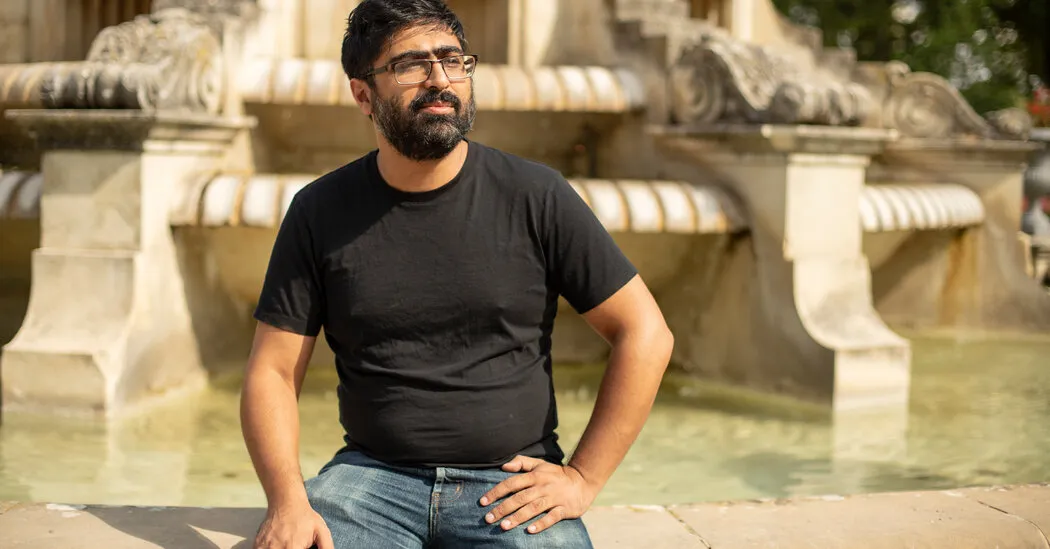
Asad Haider, Leftist Critic of Identity Politics, Dies at 38
Asad Haider, a scholar of political theory whose 2018 book, “Mistaken Identity: Race and Class in the Age of Trump,” critiqued identity politics from a far-left perspective, in contrast to the more familiar attacks voiced by many Republicans and commentators on Fox News, died on Dec. 4 in Toronto. He was 38.
His death was caused by injuries resulting from a fall from an apartment building, Shuja Haider, his twin brother, said, adding that the police had ruled out foul play.
Mr. Haider was an associate professor of politics at York University in Toronto and the co-founder of Viewpoint Magazine, which declared its intention to “reinvent Marxism for our time.” He also contributed political essays to publications like Salon, The Baffler and n+1.
His argument about the limits of identity politics, a paradigm that shaped the center-left Democratic Party of Barack Obama and Hillary Clinton, caught the attention of young activists with socialist views and was widely debated on the far left.
When the book was published — between the two presidential campaigns of Senator Bernie Sanders of Vermont, the democratic socialist who made strong runs for the Democratic nomination — it coincided with a surge of interest in socialism on the part of young voters.
Mr. Haider defined identity politics as the view that belonging to an oppressed group by dint of one’s race or gender was the main determinant of one’s political interests.
Conservative critics have denigrated the Democratic Party as a collection of special-interest groups focused on grievances about racism and sexism, separating and polarizing Americans.
In critiquing identity politics from the left, Mr. Haider did not minimize the effects of racism and sexism. But he argued that framework obscured a more fundamental injustice in American society, that of economic inequality. He argued that what was needed was radical change — the end of capitalism — rather than the incremental change offered to groups that had suffered discrimination and simply wanted a seat at the table.
Identity politics “is not a politics that wants to change the social structure; it’s a politics which is about individual recognition,” he said in a 2019 interview.
For inspiration, Mr. Haider looked to earlier waves of radical politics, especially the Black Power movement of the 1960s. He wrote that Malcolm X and Huey P. Newton, a founder of the Black Panther Party, sought to overhaul all of society, especially the capitalist system, and saw the need to enlist a broad coalition, not just members of one racial group.
“The Black freedom struggle,” he wrote, “is what most closely approached a socialist movement” in the United States.
“Mistaken Identity” was a popular book group read among chapters of the Democratic Socialists of America, and Mr. Haider spoke widely about it, including in Germany, Brazil and China. The book was reviewed favorably in The New Statesman, the progressive British magazine, and in The Guardian, which wrote that Mr. Haider “moves deftly over difficult terrain” and that “his Marxism is not a mausoleum but a living, breathing thing.”
But Jacobin, a magazine of American socialism, wrote that Mr. Haider’s “political conclusions, however well intentioned, fail to impress.”
Asad Haider was born on June 2, 1987, in State College, Pa., to Jawaid Haider, a professor of architecture at Penn State, and Talat Azhar, who later became the associate director of the university’s Hubert H. Humphrey Fellowship Program.
His parents had immigrated to Pennsylvania from Pakistan in the early 1980s, when Pakistan was under conservative military rule, following an era in which the country had seemed to be on the road to secular democracy.
Mr. Haider’s views about political identity derived from his background. Speaking Urdu at home and English at school, he would spend the academic year in bucolic Pennsylvania, but summers with his extended family in Karachi, an often violent city in Pakistan. After the terrorist attacks of Sept. 11, 2001, he was called “Osama” by classmates in the United States.
“I knew that my identity could never serve as a foundation for politics or for anything else really, because it was so unstable,” he said in an interview about his book.
While he was in high school, Mr. Haider picked up a copy of the philosopher Herbert Marcuse’s “An Essay on Liberation” at a used book sale, which “got him started on finding a form of thought that mattered to him,” his brother, Shuja, said in an interview.
He then worked his way through the writings of other members of the Frankfurt School of Marxist philosophers. As a semifinalist for the National Merit Scholarship, Mr. Haider told his hometown newspaper that he planned to study philosophy in college and aspired to become “a public intellectual.”
He enrolled in an interdisciplinary honors program at Cornell University and earned his bachelor’s degree in 2009. In 2018, he received a Ph.D. from the University of California, Santa Cruz, where he studied in the history of consciousness department.
He went on to be a Mellon postdoctoral fellow in the department of philosophy at Penn State and then a visiting assistant professor of philosophy at the New School for Social Research in New York before joining York University’s faculty in 2021.
Besides his brother, who is an editor at The Nation magazine, Mr. Haider is survived by his mother. His father died in 2018.
Viewpoint Magazine, which Mr. Haider founded with a colleague to analyze class struggles in contemporary social movements, published its first issue, titled “Occupy Everything,” in 2011, amid the start of the Occupy Wall Street movement.
For many years, Mr. Haider considered himself a Marxist, but eventually came to resist the label, his brother said.
“The important things for him,” Shuja Haider said, “were the notions of egalitarianism and emancipation.”