

Inside Mississippi’s Apron Museum
One July day in 2011, the Apron Museum in Iuka, Miss., received a small bib apron shaped like a rabbit, its frame embroidered with front paws mischievously digging into two sewn-on pockets. The apron arrived with a typed letter from its 81-year-old owner, Nelda Young, who lived in Jacksonville, Fla. Ms. Young’s aunt had made the apron for her in 1934, when Ms. Young was 4 and living in Kansas. For decades, she had kept it wrapped in tissue in a drawer.
“I simply could not think, after my demise, of it being tossed in some trash pile,” she wrote. Of her four children, seven grandchildren and six great-grandchildren “nobody wanted to give my bunny apron a home.”
Fortunately, she’d recently read an article about the little museum dedicated to aprons.

“There was a need for a place to send all these aprons before we started,” said Carolyn Terry, 74, who founded the museum with her husband, Henry Terry, 73, in 2006. “We’re meeting that need.”
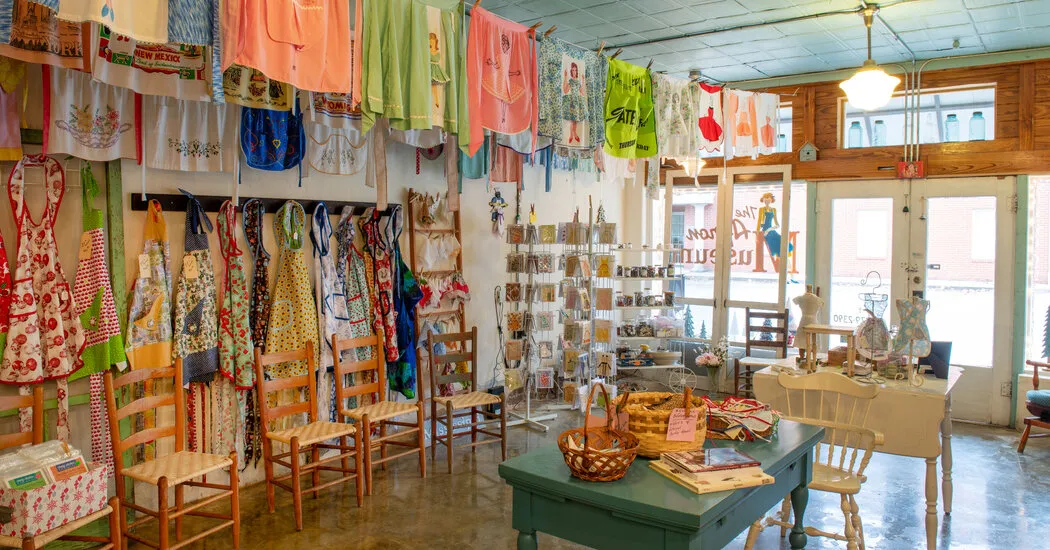
The stout brick structure, on a quiet street two hours east of Memphis and bookended by church steeples, houses some 6,000 aprons dating back to the 1860s. Displayed on walls, mannequins and racks and draped on clotheslines from the tin-print ceiling, the collection runs the gamut: domestic armor from 19th-century homesteads; exquisite, lacy Claudia McGraw aprons (status symbols of the 1930s); branded garments from Alka Seltzer and Progressive Insurance; and “manly” backyard BBQ bibs. “YES, I’M A FEMINIST,” one apron proclaims, mere feet from several 1950s-era aprons appliquéd with women in flouncy dresses with amply padded breasts.
Few objects have endured alongside humankind like the humble apron, cradling eggs and catching sauce, ale, paint, oil and blood. Their designs follow fashion and reflect how the economy was faring during different eras: At times they have all but conveyed a woman’s worth, as in “how well you could cook or do needlework,” Ms. Terry said. Though enjoying a resurgence alongside the rise of the modern rural fantasy manifested in tradwife iconography and Cottagecore, aprons are underrepresented as historical artifacts, often relegated to landfills.


“When I look at an apron, I see history,” Ms. Terry said. “Each one tells a story, and it’s all connected to food and life, work and art.”
The Terrys didn’t plan to open the world’s largest apron museum. After returning to Ms. Terry’s native Iuka in 1995, they bought a block of four 100-year-old buildings, thinking they might open a bookstore and sell antiques. (Ms. Terry is an avid book collector.)
But a visit to an apron show at the Women’s Museum in Dallas, which closed in 2011, prompted Ms. Terry to revisit her own small collection. She asked around about local apron stockpiles and forged connections with apron collectors — including EllynAnne Geisel, who wrote “The Apron Book,” and the vintage apron scholar Kathleen Brown — thanks to Google and eBay. She recalled a bidding war with the apron expert Peggy Harris, who died in 2023. (Ms. Terry emailed her to surrender. Ms. Harris got the apron, and the women became friends.)
The Apron Museum opened with a single rack of aprons, including the first Ms. Terry received as a child: a half apron with a gathered skirt and Seussian brown-and-yellow print, stitched by her grandmother Annie Hester Medley.
Aprons arrive in boxes and suitcases from Menomonie, Wis.; Washougal, Wash.; Littleton, Mass.; Pinehurst, N.C.; Canada; France; and Australia. They’re made of cotton, muslin, plastic, organza, canvas and repurposed feed sacks from the Depression era — “when they didn’t have much material but got very creative,” Mr. Terry said. Some look too threadbare to touch. Others, like the wispy, drop-waist calico smocks from the 1920s, could be worn to a party.
The Terrys take them all, including the controversial (some of which they don’t display), the personal, the ugly and those caked in paint, food and, occasionally, bodily fluids. (Ms. Terry swears by Dawn Powerwash.)
The museum sells a few items, too, including aprons that the Terrys buy at estate sales and during their travels, mainly to help them afford all the hangers and pricey textile boxes. Indeed, about 3,000 aprons are still nestled in storage, or waiting in an adjacent building to be cleaned, labeled and displayed.


Reactions to the museum’s trove vary widely. Sewing geeks make a beeline for the lacy tatting and crocheting dotting the 1800s racks. Some find offensive what others love, like a series of Betty Boop-like face aprons of different races from the ’40s. A few visitors have walked in and promptly left, or come reluctantly and stayed for hours. One man walked in, gazed up and burst into tears. “That apron looked like my mother’s,” he said.
“Everything people see and hear, they run it through their own filter system,” Mr. Terry said. “People see aprons differently depending on their background.”
When asked if they plan to step back from “far too much work for two,” Ms. Terry replied, “I’d no sooner step back from life.” She added that they were also working on a book.
Hopefully, she said, visitors who come to rifle through all these aprons and page through all the apron-themed books she has amassed feel inspired to get a little dirty themselves, by cooking or baking or starting a painting.
“I do believe the world would be better if everybody put an apron on.”
Follow New York Times Cooking on Instagram, Facebook, YouTube, TikTok and Pinterest. Get regular updates from New York Times Cooking, with recipe suggestions, cooking tips and shopping advice.