

The US plans to “govern” Venezuela and exploit its oil, says Trump, after removing Maduro from the country
▶ Follow our live coverage of the capture of Venezuelan President Nicolás Maduro
CARACAS (AP) — Hours after a military operation in which the United States ousted President Nicolás Maduro from Venezuela, President Donald Trump said Saturday that the United States would administer Venezuela at least temporarily and exploit its vast oil reserves to sell to other nations.
The most assertive US military operation to achieve regime change since the invasion of Iraq in 2003 capped a US pressure campaign on the South American nation and its president. Legal experts immediately raised questions about whether the operation was legal.
Speaking to reporters hours after Maduro's capture, Trump revealed his plans to exploit the leadership vacuum to "fix" the country's oil infrastructure and sell "large amounts" of oil to other countries.
Maduro and his wife, captured overnight at their home on a military base, were first taken aboard a U.S. warship on their way to the United States, where the Justice Department accuses them of being part of a narcoterrorism conspiracy. A plane believed to be carrying the president landed in New York on Saturday afternoon.
One detained person was escorted off the plane and cautiously down a staircase before being led down the tarmac surrounded by federal agents. Several agents appeared to record the person with their phones.
So far, the legal authority for the US incursion into Venezuela, which was carried out without congressional approval, is unknown, although the Trump administration promoted the impeachment as a step toward reducing the flow of dangerous drugs into the United States.
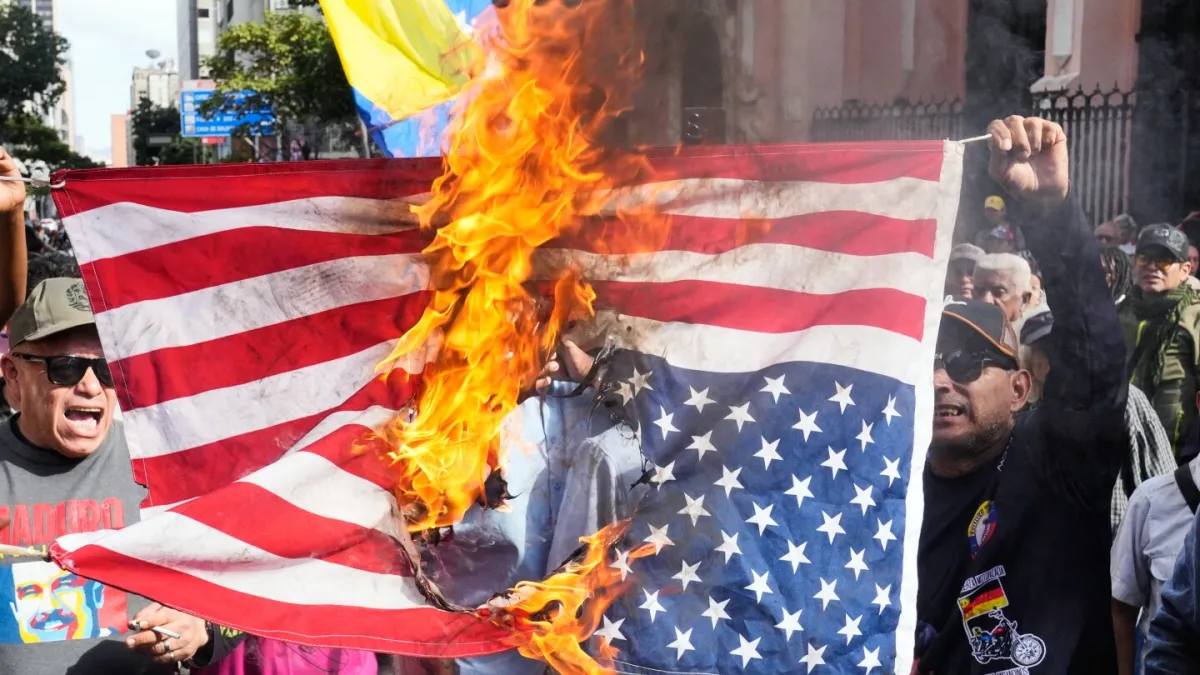
Trump also claimed that the United States government would help manage Venezuela and was already doing so, although there were no immediate signs that this was the case. Venezuelan state television continued to broadcast pro-Maduro propaganda, showing live images of supporters taking to the streets of Caracas in protest.
“We are going to manage the country until we can make a safe, appropriate and judicious transition,” Trump said at a press conference at Mar-a-Lago, where he boasted that this “extremely successful operation should serve as a warning to anyone who threatens American sovereignty or endangers American lives.”
Maduro and other Venezuelan officials were charged in 2020 with conspiracy to commit “narcoterrorism,” but the US Department of Justice issued a new indictment on Saturday against Maduro and his wife, Cilia Flores, describing the regime as a “corrupt and illegitimate government” fueled by a drug trafficking operation that flooded the United States with cocaine. The US government does not recognize Maduro as the country's president.
Trump posted on his Truth Social account a photo that he said showed Maduro in custody, blindfolded and wearing a track suit aboard the USS Iwo Jima.
Attack in the early morning
The attack came after months of pressure that the Trump administration launched against the Venezuelan president, which included a significant deployment of US forces in the waters off South America and attacks against boats in the Pacific and the Caribbean that it accused of transporting drugs. Last week, the CIA was behind a drone attack on a docking area allegedly used by Venezuelan drug traffickers.
Maduro had indicated that these operations were part of a thinly veiled plan to overthrow him.
The United States military operation against Venezuela, which took place 36 years after it invaded Panama in 1990—which led to the surrender and capture of its leader Manuel Antonio Noriega—took place under the darkness in the early hours of Saturday, when the United States turned off “almost all the lights” in the capital city of Caracas as the armed forces moved to extract Maduro and his wife, Trump said.
General Dan Caine, chairman of the Joint Chiefs of Staff, said US forces had rehearsed their maneuvers for months, learning everything about Maduro: where he was and what he ate, as well as details of his pets and clothing.
“We think, we develop, we train, we rehearse, we report, we rehearse over and over again,” Caine said. “Not to do it right, but to make sure we don't do it wrong.”
In the early hours of Saturday, multiple explosions and aircraft flying at low altitude were heard over the Venezuelan capital. Maduro's government accused the United States of attacking civilian and military facilities, calling it an “imperialist attack” and urging citizens to take to the streets.
The attack lasted less than 30 minutes and the explosions — at least seven — sent many running into the streets, while others took to social media to report what they had seen and heard. Some Venezuelan civilians and members of the military were killed, Vice President Delcy Rodríguez said, without giving a number. Trump said some U.S. forces were wounded in Venezuela, but none were killed.
Videos obtained in Caracas and an unidentified coastal city showed tracer munitions and smoke clouding the landscape as repeated explosions lit up the night sky. Other videos showed cars driving on a highway as explosions illuminated hills in the background. The videos were verified by The Associated Press.
Smoke was seen billowing from the hangar of a military base in Caracas, while another military facility in the capital was without power.
Under Venezuelan law, Rodríguez would take over from Maduro. But Rodríguez made clear during a Saturday appearance on state television that he did not plan to take power. He demanded Maduro's release and proclaimed him president.
“There is only one president in this country, his name is Nicolás Maduro Moros,” he said.
People take to the streets of Caracas
Venezuela's ruling party has remained in power since 1999, when Maduro's predecessor, Hugo Chávez, took office, promising to uplift the poor and then implementing a self-proclaimed socialist revolution.
Maduro assumed power after the death of Chávez in 2013. His re-election in 2018 was considered a fraud because the participation of the main opposition parties was prohibited. During the 2024 elections, electoral authorities loyal to the ruling party declared him the winner hours after the polls closed, but the opposition gathered evidence that he lost by a margin of more than 2 to 1.
In a sign of how polarizing the figure of Maduro is, people took to the streets to deplore his capture and some to celebrate it.
At a protest in the Venezuelan capital, Caracas Mayor Carmen Carmen Meléndez joined a crowd demanding Maduro's return.
“Maduro, hold on, the people rise up!” chanted the crowd. "We are here, Nicolás Maduro. If you hear us, we are here."
Earlier, armed people and uniformed members of a civilian militia took to the streets of a Caracas neighborhood long considered a stronghold of the ruling party.
In other parts of the city, streets remained empty hours after the attack, as residents digested the events. Some areas were still without electricity, but vehicles were moving freely.
Caracas resident Noris Prada, who was sitting on an empty avenue looking at her phone, said she felt scared, like everyone else. He noted that Venezuelans woke up scared and that many families were unable to sleep.
In Santiago, the Chilean capital, people waved Venezuelan flags and banged pots and pans as vehicles passed by honking.
In Doral, Florida, home to the largest Venezuelan community in the United States, people wrapped themselves in Venezuelan flags, ate fried snacks and celebrated as the bell sounded. music. At one point, the crowd chanted "Freedom! Freedom!" Freedom!”
Doubts about legality
Some legal experts raised immediate concerns about the legality of the US military operation.
At Colombia's request, the UN Security Council planned to hold a meeting on US operations in Venezuela on Monday morning, according to a council diplomat who spoke on condition of anonymity to discuss a meeting that has not yet been made public.
Legislators from the two main political parties in the Congress has expressed deep reservations and outright objections to US attacks on boats allegedly used for drug trafficking near the Venezuelan coast, and Congress has not specifically approved the use of military force in those operations in the region.
Congressman Jim Himes, the ranking Democrat on the House Intelligence Committee, said he had not seen any evidence that justified Trump attacking Venezuela without congressional approval, and demanded an immediate report from the US government on “his plan.” to ensure stability in the region and legal justification for this decision."
___
Toropin and Tucker reported from Washington. Associated Press writers Jorge Rueda in Caracas, Venezuela, Lisa Mascaro, Michelle L. Price, Seung Min Kim and Alanna Durkin Richer in Washington, and Larry Neumeister in South Amboy, New Jersey, contributed to this report.
___
This story was translated from English by an AP editor. with the help of a generative artificial intelligence tool.