

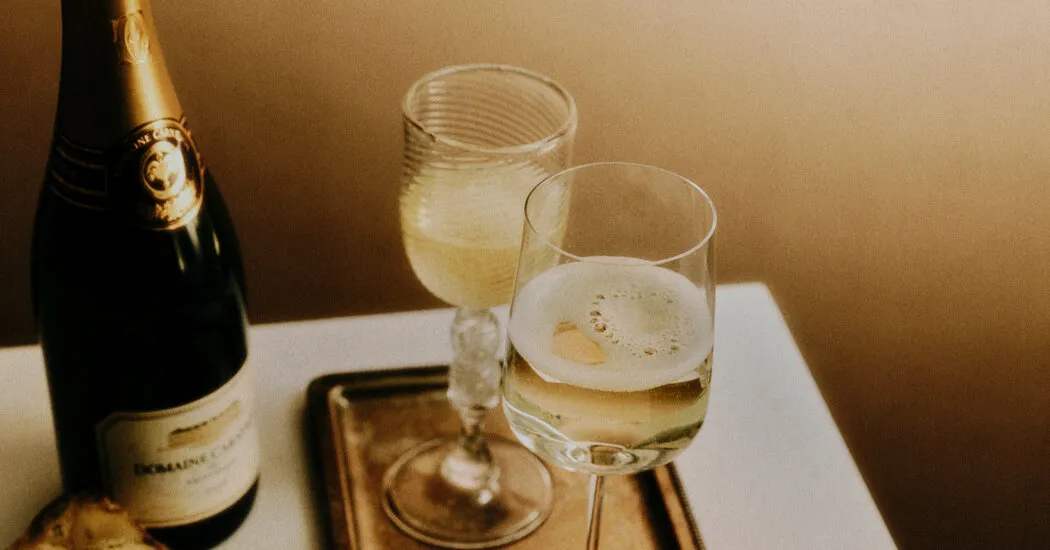
Toast the New Year With These Sparkling Wines
Champagne for the New Year is such a cliché, shouldn’t we drink something else?
No. Well, not really. As wonderful as sparkling wines are regardless of the occasion, celebrations would not be complete without them. But Champagne is not the only option.
Almost any place that makes wine makes sparkling wine as well. They can be cheap commodities, as is the case with much of Prosecco and cava. They can be pale imitations of Champagne. Or they can be wonderful beverages with their own singular personalities, regardless of where they came from, how they were made or what grapes were used.
The universe of sparkling wine has expanded greatly, and quality has soared. From almost every region, I can point to great sparkling wines, even from the worlds of Prosecco and cava. They come from all over France and Italy. Germany, Spain and the United States can stand with anyone. So can England.
And what of Champagne?
While it has its share of clunkers like all wine regions, Champagne is unparalleled in its number of great producers, from small farmers to big houses, and for the volume of exceptional wines that are made. I love it.
But this year in particular, Champagne seems expensive. Decent bottles start at $50 — barely. More likely, you will be asked to pay at least $70 for good, entry-level wines, and prices skyrocket from there, with vintage Champagnes costing sometimes hundreds of dollars. This is partly because of tariffs, but prices have been rising for years now.
Price is only part of the equation. For many, Champagne, and only Champagne, can connote the proper combination of festivity and warm hospitality. I understand that and offer a set of updated Champagne recommendations as well.
But this year I want to focus on a less expensive alternative, like American sparkling wines, which I think have been long undervalued. Great bottles now come from all over the country, though California produces by far the most.

I highly recommend these 12 bottles that I bought retail. They include 11 from California and one from the Finger Lakes of New York. All these wines were made by the traditional method, just like Champagne, in which the sparkle is generated in the bottle by a second fermentation. That means no pétillant naturels or bottles produced by other methods.
Wines from the bigger California producers should not be difficult to find. They include pioneers like Schramsberg, Iron Horse and California outposts opened by Champagne companies in the 1970s and ’80s. Many smaller producers are now making excellent sparkling wines, too. I’ve included a few, though I could not find some that I like very much, like Cruse Wine Company, Hammerling and Rhys.
This year, I drank some wonderful sparkling wines from Oregon, but sadly they are difficult to find in New York, so I haven’t included any. But I would highly recommend sparklers from newer producers like Pashey, Corollary, Maison Jussiaume and Mellen Meyer as well as old favorites like Soter, Argyle, Domaine Serene and Sokol Blosser.
Here are the 12 sparkling wines I recommend, from least to most expensive.
Gloria Ferrer Carneros Rosé NV, 12.5 percent, $23
Gloria Ferrer is a Spanish import, established in the Carneros in the 1980s by Freixenet, the big cava company. If this pale golden wine were not labeled a rosé, I would not have guessed. But it’s smooth, clean and lively, and it certainly tasted exactly like a good sparkling rosé with the aromas and flavors of red berries.
Roederer Estate Anderson Valley Brut NV, 12.5 percent, $25
For 40 years, Roederer Estate, the California branch of the Louis Roederer Champagne house, has been making excellent sparkling wines from the Anderson Valley in Mendocino County. It says it now farms an astonishing 25 percent of the Valley’s 2,500 acres of vineyards. This entry-level bottle has real personality — it’s tangy with citrus and herbal flavors, balance and finesse, and it’s a great value.
Laetitia San Luis Obispo Coast Brut Cuvée NV, 12.5 percent, $30
Laetitia, too, has its roots in Champagne. It was established in 1982 as the American outpost of the Champagne producer Deutz, but was sold in 1997 to Jean-Claude Tardivat, who renamed it after his daughter, and then sold again last year to Eric Hickey, the winemaker, and his partners. It now makes a full range of reds, whites and sparklers. Brut Cuvée is the entry level sparkling wine and it’s quite good — rich, creamy, toasty and apple fresh.
Chandon California Blanc de Pinot Noir NV, 12 percent, $32
Chandon in California is part of LVMH’s worldwide sparkling wine empire, encompassing Argentina, Brazil, India, China, Australia, California and France, where its holdings include Veuve Clicquot, Krug and Dom Pérignon. Whatever your opinion is of multinational conglomerates making wine, this company’s expertise is undeniable. Chandon’s blanc de pinot noir is clean, crisp, fresh and lively. It’s not complex, but it’s easy to enjoy.
Schramsberg North Coast Blanc de Blancs Brut 2022, 12.2 percent, $40
Schramsberg is one of the modern pioneers of American sparkling wine. Its first vintage was 1965, shortly after the founders, Jack and Jamie Davies, bought an abandoned winery on Diamond Mountain in Napa Valley and restored a network of caves that had been dug by Chinese railroad workers in the 1870s and ’80s. Today, the grapes come from cooler areas in Northern California. The blanc de blancs, made entirely of chardonnay, is fresh, light-bodied and creamy. Don’t serve too cold or the nuances will be obscured.
Domaine Carneros Carneros Brut 2021, 12 percent, $40
Domaine Carneros was founded as the California outpost of a Champagne producer, Taittinger, in 1987. It’s still owned by Taittinger, which has a consistent record of understated quality. The ’21 Brut, made roughly half and half with chardonnay and pinot noir, is fresh and yeasty, rich, full-bodied, dry and lively.
Maître de Chai Clarksburg Wilson Vineyard Sparkling Chenin Blanc NV, 11.5 percent, $40
Alex Pitts and Marty Winters are the team behind Maître de Chai, an excellent small négociant that buys grapes from interesting, well-farmed California vineyards. This bottle is made with chenin blanc, which has historically been superb material for sparkling wines in the Loire Valley. It’s a lovely wine, rich but not heavy and bone dry, with yeasty, bready aromas and lightly floral flavors.
Limnad Finger Lakes Blanc de Blancs Extra Brut 2020, 12 percent, $40
This elegant blanc de blancs, made entirely from chardonnay, is like drinking a cloud. It’s dry, delicate and perhaps a bit austere, like an icy martini, but it would be perfect as an aperitif or with a shrimp cocktail. Limnad is a sparkling wine label from Nancy Irelan of Red Tail Ridge, the excellent Finger Lakes producer.
Iron Horse Green Valley Classic Vintage Brut 2019, 13.5 percent, $42
Iron Horse has been making wine in Green Valley, a sub-appellation of the Russian River Valley, for decades. It produces many different cuvées of sparkling wine, but the Classic Vintage Brut is its flagship bottle, a kind of overview of its philosophy and style. It’s composed of two-thirds pinot noir and one-third chardonnay and is smooth, creamy and stylish.
Bravium Anderson Valley Wiley Vineyard Blanc de Noirs 2022, 12.5 percent, $47
The proprietor of Bravium, Derek Rohlffs, makes this blanc de noirs entirely from barrel-aged pinot noir from the Wiley Vineyard in the Anderson Valley. Mr. Rohlffs takes a minimalist approach, adding nothing to the wine beyond a small amount of sulfur dioxide, a widely used stabilizer and antioxidant. The wine is dry and highly refined, with length, depth and complexity. It’s very good now and will get even better with a few years of age.
Roederer Estate Anderson Valley L’Ermitage Brut 2019, 12.5 percent, $80
L’Ermitage is Roederer Estate’s tête de cuvée, the top expression of its sparkling wines. Compared with the jaunty Brut, L’Ermitage is more refined, elegant and complex, made with great finesse and precision. It’s roughly half chardonnay, half pinot noir. This bottle is delicious now but will certainly benefit from additional aging.
Racines Santa Rita Hills Chardonnay Sparkling Wine Grand Reserve NV, 12.5 percent, $82
Racines is a joint project of Étienne de Montille and Brian Sieve of Domaine de Montille in Burgundy, and Rodolphe Péters of Pierre Péters in Champagne. After years of searching, they decided to situate their American estate in the Santa Rita Hills of Santa Barbara County. I have had the sparkling wines several times (they also make still chardonnays and pinot noirs) and they are excellent. This bottle is lovely, soft, complex and graceful with stony, floral flavors.
Follow New York Times Cooking on Instagram, Facebook, YouTube, TikTok and Pinterest. Get regular updates from New York Times Cooking, with recipe suggestions, cooking tips and shopping advice.