

Trinidad and Tobago allows the installation of a US radar on its territory
People living next to the new airport in the coastal neighborhood of Crown Point, Tobago, spent the last week of November listening to the deafening roar of huge US military planes, which they said arrived in the dead of night.
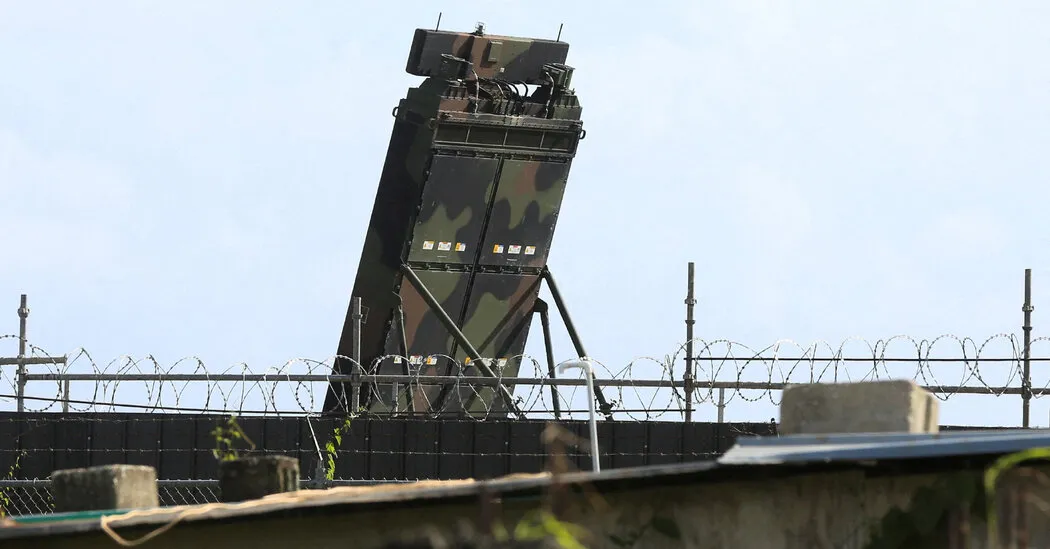
They woke up on November 28 to see a mysterious, large rotating machine pointing towards the sky.
One resident wondered if it was a bomb, and others feared it was emitting radiation.
The device turned out to be a next-generation long-range mobile sensor known as G/ATOR, or Ground/Air Task-Oriented Radar, owned by the US Marines and valued at tens of millions of dollars.
The effort to bring a military tool to the nation of Trinidad and Tobago, just days after a visit by the head of the US Joint Chiefs of Staff, has become a point at the center of a heated debate over Trinidad's involvement in the Donald Trump administration's escalating conflict with nearby Venezuela.
Tobago, a small island of 60,000 people off Trinidad's northern coast, is about 70 nautical miles (about 129 kilometers) from Venezuela.
The prime minister of Trinidad and Tobago, who has expressed strong support for deadly U.S. attacks on nearby ships of Venezuela, has offered shifting explanations for why U.S. soldiers were deployed to the island. Critics fear that, in its desire to curry favor with President Trump, the Trinidad government has put the country in the line of fire.
The Trinidad government announced Monday that it would allow the US military to use its airports. Shortly after, Venezuela's Interior Minister accused Trinidad of helping the United States seize a Venezuelan oil tanker last week.
The minister, Diosdado Cabello, said Trinidad's leader had embarked on a "hostile agenda" toward Venezuela, "including the installation of US military radars for the siege against ships transporting Venezuelan oil."
Trinidad's prime minister said the radar it improves the country's surveillance capabilities and offers a “top layer of protection,” but has not said what the country received in response for allowing the United States to place it.
The mobile radar is one of the latest elements of the United States' expansion in the Caribbean, part of the Trump administration's growing military operations directed against Venezuela.
As the United States increases pressure against Nicolás Maduro, Venezuela's authoritarian president, experts They say that Trinidad and Tobago, the country closest to Venezuela's northern coast, has already taken sides.
“I firmly believe that we have gotten ourselves into something that we have no business in,” said Ancil Dennis, leader of the opposition party and former senator from Tobago.
Both the United States and Trinidad say the radar is intended to combat drug trafficking.
But G/ATOR, one of the 60, which the Air Force and Marines purchased from defense contractor Northrop Grumman in deals totaling about $1.5 billion, is a military asset used to detect incoming aerial threats such as aircraft and missiles, according to the company's website.
A vast majority of drug trafficking in the Caribbean takes place by sea, and this particular device is not designed for maritime purposes, the manufacturer confirmed in an interview with The New York Times.
“They are helping us with something related to the airport: they are helping us with a bit of road,” Kamla Persad-Bissessar, Prime Minister of Trinidad and Tobago, told the press on November 26, when asked for the first time about the presence of US military aircraft in Tobago. "The Marines are here, they train with our people, and that's what it was about. There is no military force as such; they are not here on the ground. We are not going to launch any campaign against Venezuela."
But after radar photos came to light, Persad-Bissessar, in a Dec. 3 statement, said the radar system helped "detect Venezuelan oil sanctioning activities and traffickers who have been making deliveries of narcotics, firearms, ammunition and emigrants to our country from Venezuela.”
On Thursday, Trinidad police announced the seizure of 1,560 kilos of marijuana worth $25 million captured in wetlands in northwest Trinidad as a result, they said, of the new radar.
Experts were skeptical. The radar is not police equipment.
Northrop Grumman's website says that with a single scan, G/ATOR provides the data needed for air defense weapons to destroy aerial threats, including cruise missiles, hypersonic missiles, ballistic missiles, manned aircraft and drones. The radar can determine the source of hostile fire.
The tool is not designed to track maritime or land targets, said a Northrop Grumman executive who spoke on condition of anonymity because of the sensitivity of the matter. She said the radar helped identify and destroy a target.
Norman Dindial, retired commander of the Trinidad Coast Guard, who ran the country's coastal radars and is now leader of a small opposition party, said the prime minister's explanations have not been enough, and that the device is clearly intended to better position the United States in the event of war with Venezuela.
The radar, he added, would be a "legitimate military target" if hostilities broke out between the United States. United States and Venezuela.
“That radar is specifically to intercept air targets,” he said. “We know it's not for drugs.”
Less than 10 percent of drugs confiscated in the region between 2018 and 2021 arrived by plane, according to the most recent data from the United Nations.
The US Southern Command, which runs military operations in the region, said drug cartels used various methods, including planes, to traffic illicit substances, but declined to give more. details.
The Southern Command, in a statement, confirmed that the Marines had delivered the radar with the permission of the Trinidad government and that the device supported “US military forces deployed in the Caribbean to disrupt illicit drug trafficking and protect the homeland.”
Mark Cancian, senior adviser at the Center for Strategic and International Studies in Washington, said the radar could help direct attacks
“So, it can't help in anti-drug efforts against ships, but it can detect any Venezuelan aircraft that leaves,” he said.
Dan Caine, chairman of the Joint Chiefs of Staff, met with Persad-Bissessar in Port of Spain, capital of Trinidad, on November 25, days before the radar was installed.
The USS Gravely, a guided missile destroyer, docked in the port of Port of Spain in late October along with members of the 22nd Marine Expeditionary Unit. In November, at least seven US military aircraft, including C-17s and a Super Hercules, a military transport plane, were tracked landing in Tobago, according to open source flight trackers.
Also in November, some 350 Marines were in Trinidad conducting joint training exercises with the Trinidad and Tobago Defense Forces. Tobago.
“The government does not want to openly announce its real support for regime change in Venezuela,” said Pearce Robinson, an independent Trinidadian journalist and activist, who first published the radar images. “Everything the government has done so far points to that, frankly.”
The government of Grenada, another Caribbean nation, announced in October that it was studying a request from the United States to allow the same radar to be placed there, but the prime minister told the country's parliament that allowing it might not be legal.
Trinidad's prime minister has not said what benefits Trinidad could receive if it cooperates with the Trump government.
Trinidad has long requested permission to drill in gas fields in Venezuela's shallow waters, near Trinidad's maritime border.
Allowing radar strengthens military-to-military cooperation in Trinidad, said Brian Fonseca, director of the Jack D. Gordon Institute for Public Policy at Florida International University.
“The agreement creates diplomatic and political leverage for Trinidad and Tobago,” Fonseca said, “giving the government a valuable point of goodwill to which it can draw resort to future engagements with Washington.”
Prior Beharry contributed reporting from Port of Spain, Trinidad, andEric Schmitt contributed reporting from Washington, D.C.
Frances Robles is a Times reporter covering Latin America and the Caribbean. He has been reporting on the region for more than 25 years.