

2025 Was the Year of the Rotisserie Chicken
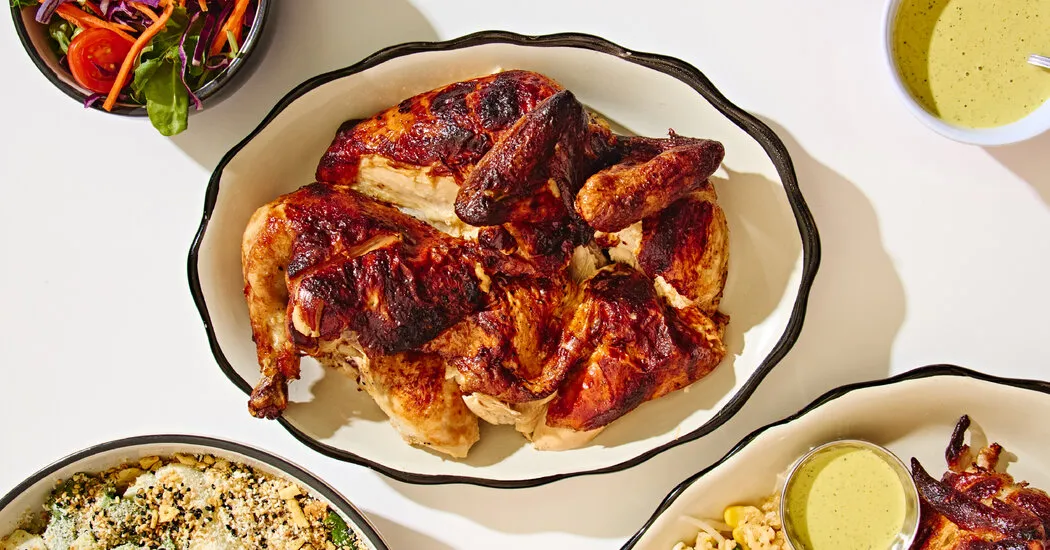
For $27 at Johnny’s in Williamsburg, Brooklyn, the whole rotisserie chicken arrives neatly quartered, with lacquered skin and juicy, seasoned meat. Stephanie Tang, an owner, is no stranger to a good rotisserie chicken. In 1973, her grandfather opened Peking BBQ, a Peruvian and Cantonese rotisserie spot in Woodside, Queens, which still operates today. In New York, decent and flavorful rotisserie chicken is relatively easy to find, whether at the Peruvian spot down the block or a local grocery store.
But Ms. Tang wanted to pivot from the majority-takeout model of her family’s restaurants to “a place you want to have dinner and hang out with friends.” Along with a full bar, she added items like a sesame Caesar salad to the menu at Johnny’s and tweaked the green sauce recipe. (Her family wasn’t a fan of the sauce, but she kept it anyway.)
A handful of new restaurants are turning the affordable grocery-store staple into a sit-down dining main attraction. In Brooklyn, Johnny’s opened in July, preceded by the rotisserie bistro Badaboom in Bedford-Stuyvesant in May. Mister Cheeks, an all-day cafe in Carroll Gardens where rotisserie chicken is the signature dish, opened in November.
In New Orleans, the chef Michael Stoltzflus pivoted from a tasting-menu approach when he opened Here Today Rotisserie in February. In Philadelphia, Picnic has been spinning rotisserie chickens alongside oysters and small plates since July 2024.
Some are Peruvian, others French, but they are a far cry from the birds in domed plastic containers one might find under a heat lamp at Costco — both in appearance and in price. At Badaboom, for example, a whole rotisserie chicken is $58.
As food prices climb, chicken is especially attractive to restaurant owners and diners alike. At grocery stores, the average retail price of a whole chicken was $2.04 per pound in November, down by 1.5 percent from last year, according to the Bureau of Labor Statistics. Meanwhile, the price of beef has soared this year, with the price of a round roast up by 25 percent, to an average of $8.94 a pound.
Ms. Tang credits the stability of chicken with keeping her family’s restaurants afloat, particularly in times of economic uncertainty. “My family’s restaurants have been recession-proof,” she said. “They all survived turbulent times like Covid. Many restaurants couldn’t make it through financially.”
At Johnny’s, the chicken is their top seller, beating out the ribs, burger and lomo saltado. “Everybody likes chicken, so it’s a safe option,” Ms. Tang said.
Rotisserie chicken can also present a lifeline. In Oakland, Calif., the cost of running Daytrip, a neighborhood restaurant once focused on “experimental food” and fine-dining techniques, was so high that it forced Finn Stern, the chef and an owner, to re-evaluate his business model.
After Daytrip closed last year, Mr. Stern had just enough money remaining to flip the restaurant. He and Stella Dennig, his wife and business partner, reopened as Daytrip Counter in May, a fast-casual restaurant where a rotisserie chicken, one salad or grain bowl, two sides and two sauces cost $54.
“I really think of us as salad first, plus rotisserie chicken, but rotisserie chicken really sells,” Mr. Stern said. Chicken, he said, allows them to deliver a “super high-quality protein at a cost that customers are able to pay more regularly.”
Rotisserie chicken, Mr. Stern added, can be hard for diners to replicate at home, but offers consistency for restaurants. The price point also allows diners to return more frequently, he said.
“I think, ultimately, it is a sign of macroeconomic times that you’re seeing this more than anything else,” he said. “It’s a food trend as far as it is a macroeconomic trend.”
Americans started eating more chicken after World War II asthe poultry industry modernized and chicken became cheaper and accessible, and rotisserie chickens took off in the early 1990s as consumers prioritized convenience, said Steve Striffler, a chicken scholar and professor of anthropology at the University of Massachusetts Boston. The appeals of the rotisserie chicken are many, including nostalgia and the perception that it is healthier than fried counterparts.
“Getting a bucket of fried chicken at K.F.C. doesn’t quite scratch that itch,” said Mr. Striffler, the author of “Chicken: The Dangerous Transformation of America’s Favorite Food.”
At supermarkets, rotisserie chicken is usually a loss leader, a retail strategy where items are priced lower than their production cost. At Costco, for example, a roughly three-pound rotisserie chicken still costs just $4.99.
For consumers, the draw of a whole rotisserie chicken has long been that it’s “a cost-efficient meal,” said Johnny Novokmet, 29, who rates and reviews grocery-store and fast-casual rotisserie chickens on social media. A rotisserie chicken with a side of rice, he said, can be as low as $10 and stretch across multiple meals.
“A good ’tissy, it’s tough to beat man,” Mr. Novokmet said. “A tender breast, a real juicy leg — there’s not much better, and it has your body feeling good, too.”
When Mr. Novokmet was growing up, his father would get two rotisserie chickens from Costco and cut them up for the week. Since he began posting his review videos, Mr. Novokmet has gained more than 100,000 followers and eaten more than 100 grocery store rotisserie chickens. “I did not think people loved chicken this much,” he said.
Hugo Hivernat, a founder of Fulgurances Laundromat, a fine-dining restaurant in Greenpoint, Brooklyn, has fond childhood memories of eating rotisserie chicken in France, where his family would pop a bottle of nice wine while sharing a bird from the nearby market. Next year, he plans to open Gigi’s, a wine bar and rotisserie, where chicken will be the star of the menu.
Mr. Hivernat said he wants to resist the reputation of a typical wine bar, where diners can easily rack up a high bill sharing small plates. Instead, he wants to focus on accessibility. The menu is still in its research phase, but he estimates that half of a rotisserie chicken will cost roughly $35.
“It’s going to be definitely a bit more cheffy chicken, but we want to keep the price affordable,” he said. “I mean, affordable for New York.”
Follow New York Times Cooking on Instagram, Facebook, YouTube, TikTok and Pinterest. Get regular updates from New York Times Cooking, with recipe suggestions, cooking tips and shopping advice.