

A $600 Suckling Pig? Wagyu for All? On Menus, It’s a New Gilded Age
When the term “conspicuous consumption” joined the language during the Gilded Age, it didn’t specifically apply to food. But it certainly does at many of the new restaurants opening in Manhattan’s current gold rush.
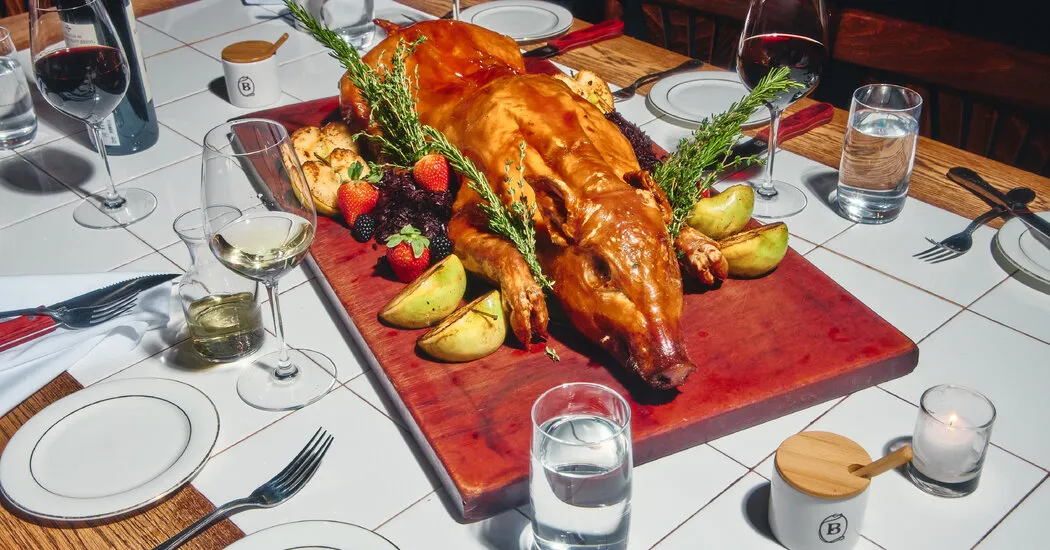
At Le Chêne, a cozy new bistro in the West Village where you might expect to find boeuf bourguignon and bouillabaisse, those spots are occupied by a $435 tomahawk steak and a $260 turbot fillet. A lobster roll at Lex Yard, the gleaming new restaurant in the refurbished Waldorf Astoria hotel, is topped with caviar and truffles, and costs $68. At La Grande Boucherie nearby, foresighted diners can advance-order a whole roast suckling pig for the table, for $600.
Around the city, would-be Morgans and Mellons are indulging as never before in old-school luxuries like foie gras, Dover sole and seafood towers, as well as trendy ones like crudo, uni and toro.

“Customers message us, asking what we have that night that’s extraordinary, and never ask the price,” said Alexia Duchêne, the chef at Le Chêne, who pays about $1,000 for each turbot she imports from France. Ms. Duchene said she moved to the United States partly because of the challenges of turning a profit in Europe, where high-quality ingredients are expensive but diners are frugal.
“Here, the more expensive it is, the faster it sells.”
The rich have always spent freely on food, but today’s menu prices are reaching dizzying heights. And they’re no longer confined to New York City. In Dallas and Las Vegas, Miami and Aspen, Colo., restaurants designed for the 1 percent (and the influencers who want to emulate them) now routinely offer shavings of truffles or flights of Wagyu.
Across the country, even restaurants with more modest ambitions and prices offer upgrades like bumps of caviar with a martini, potato chips or chicken nuggets. (That last pairing was pioneered by Cocodaq, a Korean fried chicken restaurant in the Flatiron district, which sold $100 boxes of six nuggets with Petrossian caviar at the U.S. Open tennis tournament last summer.)
“I think it’s as much about the tablescape as the gold flakes on the toro,” said Emily Sundberg, whose popular newsletter on Substack, Feed Me, chronicles the doings of New York’s young and well-heeled. “And I think a lot of people are just getting it for the photo, and it gets thrown out.”
A lot of people, of course, can’t afford fine dining at all, and that disparity mirrors what economists are calling the nation’s “K-shaped economy,” with two trend lines diverging like the arms of the letter to represent growing wealth inequality. Income and net worth have risen rapidly for affluent Americans as the stock market and tech sectors have led the post-pandemic recovery, while inflation and a stagnant job market have drastically reduced disposable income for households of lesser means.
The top 10 percent of U.S. households now account for nearly half of all spending, Moody’s Analytics estimated this fall.
Like airlines and credit card companies, reservation services and couture brands, restaurateurs are chasing that market. The chef Dominique Crenn collaborated with LVMH this year to create menus for the Orient-Express train and the restaurant at the House of Dior in Beverly Hills. Next to the new Carbone Riviera at the Bellagio in Las Vegas, the Italian yacht maker Riva has docked a 33-foot craft that sails the casino’s “lake” with the restaurant’s customers aboard.
“People want to celebrate, they want to spend,” said Elizabeth Blau, a longtime restaurant developer in Las Vegas. “Why wouldn’t we bring them the organic chicken, the tomahawk steaks, the beautiful dining room?”
Some restaurateurs say these extravagances are crucial to staying afloat amid rising costs of rent, labor, ingredients and services.
“It’s the only way to make sure you turn a profit these days,” said the pastry chef Fabián von Hauske Valtierra. He and the chef Jeremiah Stone opened the influential Manhattan restaurant Contra in 2013, with an innovative multicourse tasting menu that cost $55. It closed in 2023.
After decades in which American chefs built prestige through creative expression, farm-to-table restraint and cultural authenticity, the in-demand dishes of this new Gilded Age include many of the same ones that signaled luxury during the last one, near the turn of the 20th century: lavish centerpieces like prime rib, roasted game and whole fish from faraway waters. Carbone Riviera has a tankful of whole fish on the menu: sea bream ($75), turbot ($295) and branzino ($325). Santi, the new Manhattan restaurant from the chef Michael White, offers a $140 rabbit “per la tavola.”
These large-format dishes have the advantage of being easy to share, at the table and on social media.
Nowhere in the country is the spending spree more visible than in Manhattan, where the restaurant economy is inextricable from real estate. Many of the most expensive restaurants that opened this year are anchors for glossy new office towers, like 270 Madison Avenue (which houses Santi), 425 Park Avenue (Jean-Georges Vongerichten’s Four Twenty Five) and One Madison Tower (Daniel Boulud’s La Tête d’Or).
Opulent restaurants “confirm the building’s place in the luxury order of things,” said Jonathan Miller, a top Manhattan real estate appraiser.
Since the turn of the (21st) century, players in high-end real estate have competed to attract chefs who draw deep-pocketed customers. Since the pandemic, those relationships have become even more important to tenants as they aim to lure employees back to the office.
“It’s a real generational shift.,” said Marc Holliday, the chief executive of SL Green, which built One Madison Avenue, a new commercial tower in the Flatiron district where IBM, Franklin Templeton and Coinbase have their New York headquarters. “The next wave of workers have the option of working remotely, so they have to feel compelled to be in the office, with high design and fine dining.”
Mr. Boulud’s new corporate catering wing, Cuisine Boulud, provides the tenants with private dinners, deskside lunch deliveries and grab-and-go cafes. At street level is La Tête d’Or, where four ounces of top-grade Wagyu sells for $160 and the seafood towers start at $130.
Mr. Boulud, who built his reputation on French fine dining, said he had resisted opening a steakhouse until he had a kitchen that could handle everything from a blazing hot wood-fired grill for steak to mountains of ice for shellfish plateaux. “These are not inexpensive journeys to create,” Mr. Holliday said of building multiple kitchens and dining options into an office building.
Two of the city’s hottest new restaurants, the Eighty Six and the Corner Store, have menus that blend lavish dishes and mass-market hits, both at premium prices. The Eighty Six, a West Village speakeasy, serves a $110 lobster and a $165 whole roast duck, but also a cheesesteak ($39) and Danish butter cookies straight from the tin (those are free). At its sister restaurant Corner Store, a Dover sole ($89) shares space on the menu with spinach-artichoke dip ($24), pizza rolls ($20) and a French dip sandwich with a Wagyu upgrade ($39).
“Those guys did their research,” said Mr. von Hauske Valtierra, admiring the high-low approach of the Catch restaurant group, which is expanding rapidly in New York and beyond.
“If we were opening a place of our own right now it would have to be can’t-fail, no risk.”