

Après-Ski, Without the Ski
Earlier this month, Samantha Haufsk, a hairdresser who lives on Long Island, enjoyed her share of the warming snacks and drinks that anchor après-ski, the cozy gatherings that follow a long day of skiing.
Ms. Haufsk and her sister dipped bananas and choux pastry into chocolate fondue, shared fried zucchini and calamari, and ordered rounds of espresso martinis and mulled wine. At the chalet, white shearling fur draped each chair, and red- and white-checkered cloths covered tables decorated with pine cones, gold ornaments and candles. “It was so warm and toasty in there,” Ms. Haufsk, 31, said.
But the sisters were 140 miles from the nearest ski mountain, at a Greek restaurant in Southampton.
Calissa Chalet, the restaurant’s seasonal space, is among dozens of new ski chalet-inspired pop-ups taking over in cities far removed from any actual slopes. While some feel less incongruous in cold-weather locations like New York City, where people still want to thaw out and cozy up, others are showing up in balmier climates like Los Angeles and Las Vegas.
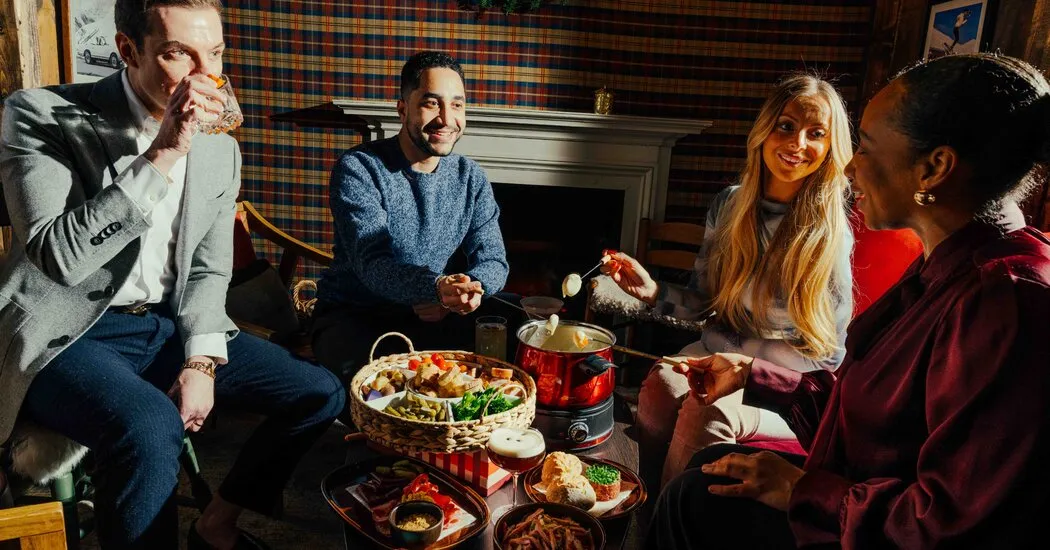
Restaurants, bars and hotels are using mountainside favorites like raclette and warm cocktails, alongside fireplaces and wood-paneled walls draped with vintage skis, to draw in customers during sleepier winter months. In chillier cities, some owners want to make creative use of outdoor spaces like rooftops with actual chalet structures that are natural successors to faux igloos, which became ubiquitous in 2020.
“It’s not that we don’t like igloos,” said Malte Kontor, the executive chef at Peninsula New York. “But we saw so many people doing them, and it also reminds us a little too much of the pandemic.”
This fall the Peninsula opened Chesa, a rooftop with four custom-built chalets adorned with vintage sleds, plaid wallpaper and wooden furniture, each named after a ski resort in Switzerland. The surrounding space is decorated with twinkling lights and real evergreen trees.
Warmed by blankets and electric fireplaces, guests can order fondue, of course, or beef tartare — made with ketchup instead of egg. “I have concerns with refrigeration,” Mr. Kontor said. “I substituted it with ketchup that gives it a creamy texture of an egg, but improves the color of the meat.”
It’s hardly the only place of its kind in New York City, let alone in a six-block radius of the hotel.
Rockefeller Center has built “après skate chalets,” heated cabins with views of the famous Christmas tree and ice rink. Haven Rooftop, on top of the Sanctuary Hotel just off Times Square, has transformed into a mountainous escape styled with cranberry bundles and holly arches. Dumbo House, the private members’ club in Brooklyn, installed cabins on its terrace, surrounded by a private tree installation by the artist Derrick Adams. The ski chalet experience at Industry Kitchen, a restaurant in the Seaport district, includes a three-course dinner that starts with a lobster bisque shooter served in a shot ski.
Many of these experiences do not come cheap. Booking a chalet at Chesa requires a $500 minimum spend. The chalets at Rockefeller Center start at $90 (for six guests before food or drinks) and can cost as much as $470 during peak times.
“I don’t think there is such a thing as too many ski chalets,” Ms. Haufsk said. “Things like that book up quickly, so you can’t even get into half of them.”
There are some logistical challenges to serving food in these structures.
Greg Baxtrom, the owner of 5 Acres, which handles food and drink for Rockefeller’s après skate chalets, said his team has spent much of their time keeping up with the demand for hot chocolate. Employees make 20 gallons of it a day on an electric stove in the kitchen of the nearby restaurant and then battle the crowds to bring it in thermoses to the chalets. “I just sent up eight gallons, and I have another eight coming up,” he said, laughing.
In warm-weather destinations, these attractions come with their own challenges.
“It’s amazing when you’re skiing and you go into a ski lodge and you get warm, but how do you create that in Vegas when it could be 85 degrees outside?” said Ross Mollison, the founder of Ski Lodge, an après-ski-themed cocktail bar in the Cosmopolitan.
A scent machine gives the bar a campfire aroma, and an LED screen makes it look like snow is falling outside the windows. For a party during Las Vegas’s Formula 1 race, Mr. Mollison even brought in a snow machine.
Even without nearby slopes, the bar attracts skiers from around the world who order cocktails named after famous ski runs. The ceiling is plastered with thousands of stickers from ski resorts.
Sarah Citron, a founder and the chief executive of Bricoleur Vineyards in Sonoma, Calif., hoped an après-ski experience would attract tourists during the off-season. “No one really thinks about wine country in the winter months, because there are no leaves on the vines and the harvest is over,” she said.
Despite weather in the 60s, her staff asked if they could wear sweaters and fur earmuffs to commit to the bit. Demand has been so high that Ms. Citron is considering extending the special until February.
Ian Curtis, the general manager of Wolfgang Puck’s Cut inside the Beverly Wilshire hotel, said that as someone from New Jersey, he felt like Los Angeles doesn’t do enough to differentiate the winter holidays from other seasons. “When you have 75-degree weather during the day and it’s bright and sun-shining and palm trees everywhere, people are more concerned about what Gucci store they are going to,” he said.
The restaurant has transformed into an alpine escape with 10-foot trees, an electric fireplace decked with stockings and velvet couches with white fur throws, with warming cocktails to match. “For me, it’s more of a draw to bring people back to the season.”
Mr. Curtis does not think warm weather will deter guests from hot drinks. “At night it gets down to 40 degrees,” he said.
Follow New York Times Cooking on Instagram, Facebook, YouTube, TikTok and Pinterest. Get regular updates from New York Times Cooking, with recipe suggestions, cooking tips and shopping advice.