

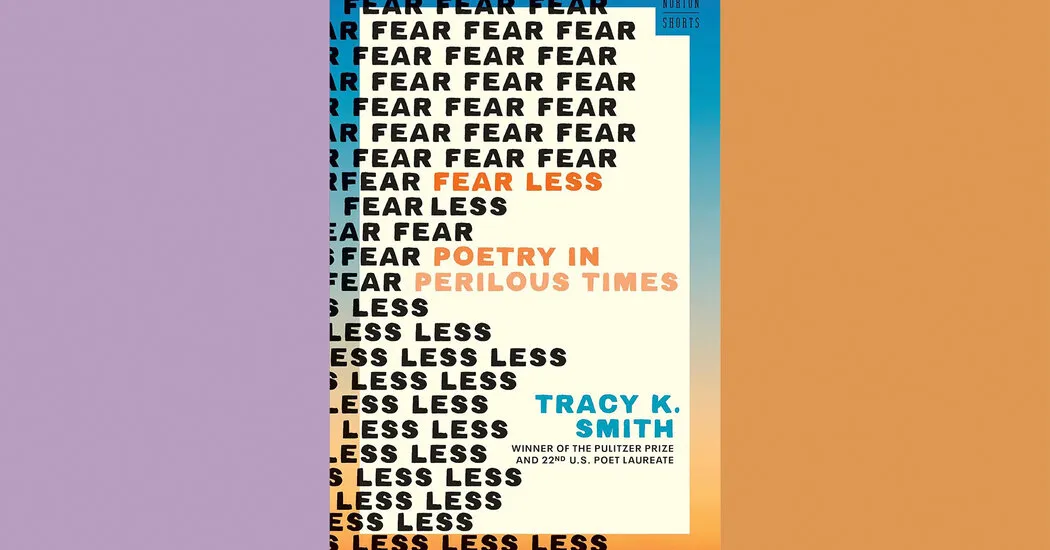
Book Review: ‘Fear Less,’ by Tracy K. Smith
FEAR LESS: Poetry in Perilous Times, by Tracy K. Smith
Poems never really sleep, do they? Just when you thought it was safe to make a quesadilla or go out to the garage and sort nails, here comes one poem or another to delight or baffle you or, like as not, leave you indifferent. Poems, like people, are everywhere: from weddings and funerals to Paris park benches and New York subway cars.
That poems are like people is a point the former U.S. poet laureate Tracy K. Smith nods to repeatedly in her wonderful new book of criticism, “Fear Less,” which will open your eyes to aspects of poetry you may not have thought of on your own. Smith comes away from a great poem, she writes, “as from a profoundly generous, vulnerable exchange with someone I’ve only just met.”
And like the people who mean the most to us, with age a great poem can change in a way that continues to engage us. In Smith’s words, “like the best of friends, somehow the poems I’ve loved for years manage to keep evolving, meeting me where I am and then — how do they do it? — leading me still further along toward what will startle, console and even change me.” Elsewhere she says that “a poem is like an eagerly awaited letter from a stranger.” Exactly: Just as you can’t kiss your own elbow or sneak up on yourself, you need something like the concentrated power of a poem to tell you what you don’t already know.
Smith became poet laureate in the fraught days of 2017, and she recognizes that in the years since then the world has grown only more fractious, more beholden to the idea that “unless we lived in the same place and prayed to the same deity and voted the same way, we in this country had nothing whatsoever to say to one another.” Our “climate of language” — our “national vocabulary,” as Smith also calls it — has steered toward “fear, derision and the notion of an intractably divided nation.”
Enter poetry. As opposed to the me-good/you-bad view, poems avoid “a fixed or foretold outcome” and provide instead an “uncharted encounter — an adventure.”How do they do this? Through images, the one ingredient Smith describes as “essential” because they draw the reader into “proximity to and even participation in the events and feelings the poem explores.”Using images instead of abstractions, a poem “may instill in you an interest in strangers and an investment in their thoughts and experiences that, in turn, makes you increasingly at ease and at home in a world comprised of all manner of others.” (Good fiction and journalism can do this too, of course, but these fall outside Smith’s purview.)
Similarly, a poem “can mitigate fear by facilitating a form of dialogue with it,” which is another way of saying that if a poem can use images to tease the monster out of the cave, we might see that it’s not as big or as scary as we thought.
To make these and other telling points, Smith looks closely at poems by everyone from Frank Bidart and Elizabeth Bishop to Natasha Trethewey and John Yau, working in old-timers like Shelley and Dickinson as well as contemporaries in the early stages of their careers.
If there’s a misstep in “Fear Less,” it’s that a couple of poems here rely more on sloganeering than those images Smith champions elsewhere. Too, the overall tone is a little too reverent at times — poetry’s important, but it’s also fabulous, and there could be more here of Keats’s schoolboy enthusiasm over the sheer fireworks a poem can set off. As James Dickey put it: “What you have to realize when you write poetry, or if you love poetry, is that poetry is just naturally the greatest god damn thing that ever was in the whole universe.”
But these are small matters in light of this rewarding little book’s achievement. A poem either sends you a bill or writes you a check, and that’s equally true of books about poetry. By the time I finished “Fear Less,” I’d been paid in full.
FEAR LESS: Poetry in Perilous Times | By Tracy K. Smith | Norton | 192 pp. | $24