

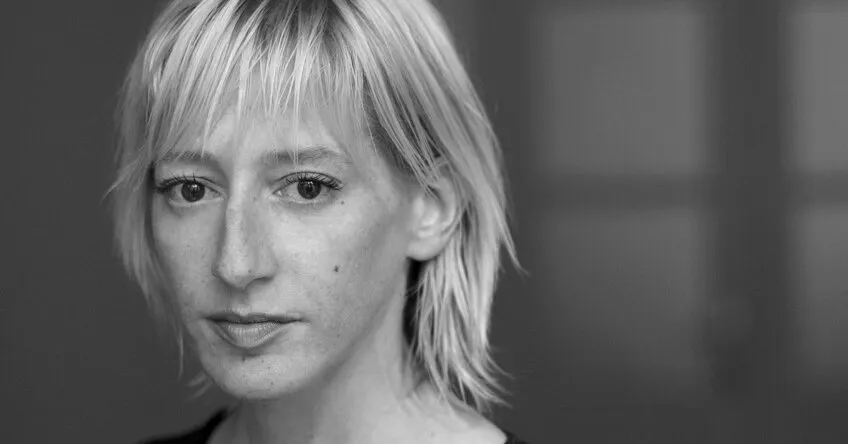
Ceal Floyer, Incisive Conceptual Artist, Dies at 57
Ceal Floyer, a conceptual artist whose elegant installations and performances charted the surprisingly heartfelt territory where philosophical propositions meet comic one-liners, died on Dec. 11 in Berlin. She was 57.
Her death, in a hospital, was caused by a malignant brain tumor, her half brother James Floyer said.
By the time Ms. Floyer started working as an artist, it had long been established that anything could be an artwork if it was presented as such, including a store-bought object or a phrase lettered on a wall. Ms. Floyer used manufactured objects and wall texts alike, as well as many other forms. What she added to them all was a precise, uniquely self-aware sensibility that could turn even a work as simple as a color photograph of a pool of water in an overturned umbrella (“Umbrella,” 2018) into an acute satire of the human need to make sense of the world.

The typically clean and minimal aesthetic of her work was an ironic nod to the self-serious conceptualists of the 1960s. But it was also a way of removing anything that might come between her and the clearest expression of a given idea. Emblematic of this economy was a work called “Conversation Piece,” which comprised nothing but a pair of black vinyl quotation marks placed high on either side of a doorway. Leading into an art gallery, these quotation marks suggested that everything in the exhibition, if not all of art history that came before, constituted a series of quotations or hypotheses, or a single, composite work of art, or a joke.
Two of her best-known pieces were “Light Switch” and “Nail Biting Performance.” In the first, a slide projector, sitting on a plinth near a gallery wall, projects a life-size color image of a light switch — a “switch” in the viewer’s perception effected by the projector’s “light.” Ms. Floyer changed the projected image to match the location, so that visitors who encountered the piece in Japan or Canada would see a Japanese or Canadian light switch. The anxious nail biting — which debuted before a City of Birmingham Symphony Orchestra concert in Birmingham, England, in 2001, and was reprised in 2012 in Kassel, Germany, as part of Documenta 13 — she executed herself, earnestly, into a microphone.
“Very conceptual work is often very complicated for a broader public to understand, but with Ceal we never had that,” the gallerist Esther Schipper recalled in an interview. “She would just pin something down, and people would understand immediately — but then the image opens in your head.”
The apparent clarity of Ms. Floyer’s pieces set up a potent contrast with the ambiguities and unresolved questions they tended to conceal. Lurking behind a piece like “Ladder (Minus 2-8),” an aluminum ladder with all but its first and last rungs removed, were insoluble philosophical and linguistic problems: Is it still a ladder if it can’t function as one? And if it isn’t a ladder, what is it?
If images like an unclimbable ladder, an umbrella full of water or a line of dominoes too tightly packed to fall down have an absurdist humor to them, the fact that none of us can help wrestling with such absurdities has an unmistakable pathos. Ms. Floyer’s work could be read as expressing a defiant kind of fatalism, a commitment to thinking, living and making art despite their inevitable conclusion.
“She had a lifesaving sense of humor,” the artist Thomas Demand, a close friend, recalled in an interview. “In the worst situations, she would crack a joke.”
Cecile Anne Floyer was born on April 18, 1968, to Gerlinde (Mayer) Floyer and David Floyer in Karachi, Pakistan, where Mr. Floyer, a Canadian, was a representative for British Petroleum.
Never fond of her given name, Cecile began going by Ceal in early childhood. A natural mimic, she acquired new accents in Sydney, Australia, and in Rabat, Morocco, where her father’s job took the family after Karachi; speaking German as an adult, she sounded like her Austrian mother.
By the time Ceal started school, the family had settled near Exeter, in England. Later they moved to Dittisham.
After a year of studying theater at Dartington College of the Arts in Devon, she moved to London and enrolled at Goldsmiths College (now Goldsmiths, University of London), where she earned a B.F.A. in 1994.
By 2002, she had settled in Berlin, though her life remained mobile. Over the years, she was a visiting artist, guest professor or instructor at De Ateliers in Amsterdam and HFBK Hamburg in Germany, among other institutions. Students remembered her as a dedicated teacher who approached the job with characteristic rigor.
“As in her work, a minimal intervention — a single question or brief comment on our work, often delivered with dry humor — was enough to produce a lasting shift in how one approached one’s own work,” Sonia González, a curator who studied with Ms. Floyer in Hamburg, said in an interview.
Gina Fischli, an artist who also studied with Ms. Floyer in Hamburg, said: “As a student, no one takes you or your art seriously. So when your mentor does, it’s a big gift — and it challenges you to take yourself just as seriously.”
Ms. Floyer’s work is in the permanent collections of museums around the world, including the Museum of Modern Art in New York, Museo Jumex in Mexico City and Tate Modern in London. She was represented by Esther Schipper in Berlin, Lisson Gallery in London and 303 Gallery in New York.
Ms. Floyer was first diagnosed with a malignant brain tumor in 2002. Though she was operated on successfully, her doctors gave her five years to live. With an experimental treatment, radiation and chemotherapy, she survived for more than two decades — but always with the knowledge that the cancer could recur.
Experiencing coordination problems earlier this year, she had an MRI that revealed that the cancer had indeed returned and was too advanced, and too aggressive, to treat.
In addition to Mr. Floyer, a hotelier, she is survived by another half brother, Mark Floyer, a poet.
In her final months, her friend Mr. Demand said that he helped Ms. Floyer realize a piece that she’d had in mind for years: a stock photo of sheep grazing in a verdant pasture, to which she would add a small, black number on every sheep. The photograph, just over two feet wide in a clean, white frame and titled “644,” is included in “Seriously.,” a group show currently on display at Sprüth Magers gallery in London.
“It’s kind of typical Ceal,” Mr. Demand said of the piece. “There’s something very cold about it, very conceptual and rigid and radical. And there’s also something very funny and warm.”