

How Japanese Scallops Became a Pawn in Diplomatic Tensions With China
In early November, a ship carrying six tons of Hokkaido scallops slipped out of a northern Japanese port, bound for China. The shipment was meant to be a milestone, a sign of warming ties between the countries after Beijing lifted a yearslong ban on Japanese seafood.
But midway through the vessel’s journey, tensions flared again when Japan’s prime minister signaled a willingness to defend Taiwan against China. Her comment drew a sharp rebuke from Beijing and an announcement that the seafood ban was back on.
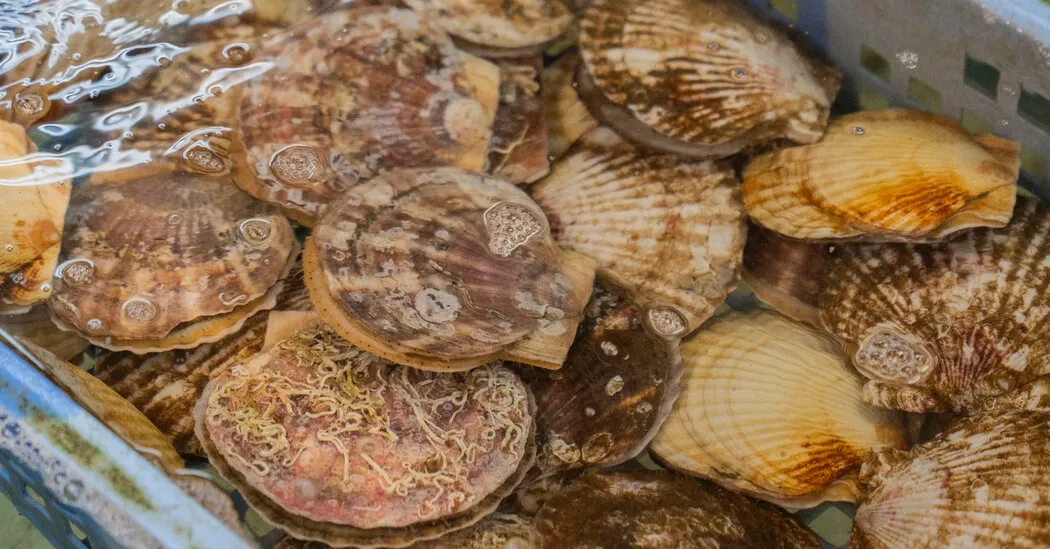
The Hokkaido scallop has emerged as an unlikely pawn in the volatile relationship between Tokyo and Beijing.
For Beijing, scallops have served as a diplomatic pressure point. For Japan’s allies, consuming them is portrayed as an act of defiance against what they characterize as economic coercion. For Tokyo, the mollusks have become a case study in the difficult — and perhaps increasingly necessary — task of curbing its reliance on China.
In Hokkaido, the country’s northernmost island, where most Japanese scallops are harvested, the prevailing sentiment is confusion.
“We’re being used as some kind of tool in political maneuvering,” said Mitsugu Saito, executive managing director of the group that represents Hokkaido’s seafood-processing industry. “I never would have thought that Japanese seafood products, especially scallops, would become a card in diplomatic negotiations.”
As China has emerged as a global economic power, its 1.4 billion citizens have become critical consumers of international goods. Beijing has dangled market access to its growing middle class as a diplomatic lever, imposing import restrictions for Taiwanese pineapples, Australian wine, American soybeans and Lithuanian beef in recent years.

The latest trade spat between Japan and China began in August 2023, when Beijing suspended imports of Japanese seafood after the release of treated wastewater from the decommissioned Fukushima Daiichi nuclear plant. While Japanese officials and U.N. regulators defended the move — noting the water was filtered and heavily diluted — Beijing protested.
Before the freeze, China was the top buyer of Japanese seafood, with scallops accounting for most of that trade. Hokkaido’s scallops, harvested from the region’s nutrient-rich, frigid waters, are prized for a distinct buttery flavor and deep umami. They command a premium in China, where they have become a staple luxury at high-end celebratory banquets.
Japan had also shipped scallops to China for processing before re-exporting them.
The disruption was immediate. In 2022, the year before the halt, Japan exported roughly $641 million worth of scallops, with China accounting for more than half of all sales. Scallop exports plunged 30 percent in 2023 from a combination of China’s trade ban and a fallow period of production.
At Kyuichi, a scallop processing company in Hokkaido, China-bound products once accounted for a quarter of total sales. Shipments ground to a halt overnight. Tatsuhiko Etori, the company’s president, said he had never imagined the mollusk would become a diplomatic point of contention when his Osaka-based firm acquired Kyuichi in 2022, a year before the import ban.
“It was entirely unfathomable,” he said.
As China pulled away, Japanese allies rallied. Rahm Emanuel, then the U.S. ambassador to Japan, coordinated bulk purchases for the American military and championed the “#Taberuze Nippon!” (Let’s Eat, Japan!) movement, framing the consumption of Hokkaido scallops as a patriotic act of defiance against China.
In Hokkaido, producers began moving scallop-processing operations to Vietnam and other parts of Southeast Asia. They also exported directly to the United States whenever possible. In 2024, the American share of Japan’s scallop exports grew to 28 percent, from single digits before.
This past year, the geopolitical winds shifted yet again.
In April, the Trump administration announced a wave of “reciprocal” tariffs targeting U.S. trade partners, including Japan and its scallops. Sensing an opening to court regional allies, Beijing announced in May that it would lift its ban on Japanese seafood exports that had undergone testing for radioactive materials.
Kyuichi joined nearly 700 Japanese firms scrambling for certification, and on Nov. 5, the milestone shipment of six tons of frozen scallops departed Hokkaido for China.
Two days after trade resumed, Japan’s prime minister, Sanae Takaichi, stated in the National Diet that a Chinese attack on Taiwan could be a “survival-threatening situation,” a legal trigger implying Japan could use military force. It was a rare public declaration regarding an island that Beijing considers a breakaway province.
Within two weeks, Beijing abruptly froze all new seafood export applications. For Kyuichi and hundreds of other firms still in the registration queue, the window slammed shut.
“Everyone was waiting to see what would happen, and then the ban hit,” Mr. Etori of Kyuichi said. “To be honest, I felt, ‘Oh, here we go again.’”
China experts say targeting scallops is a logical move in Beijing’s playbook. Given its own domestic economic challenges, Beijing is wary of more drastic measures that could endanger broader commercial ties with Tokyo, according to Shin Kawashima, a professor of Asian politics and diplomacy at the University of Tokyo.
The seafood ban, coupled with recent advisories urging Chinese tourists to reconsider travel to Japan, is an effort to “irritate Japan” without triggering a full-scale diplomatic rupture. For China, “it keeps its line there to protect its economy,” Mr. Kawashima said. “But for Japanese scallop producers, I can understand why it’s like, ‘Why us?’”
Now, Japanese allies are again rallying to the cause.
On Dec. 2 — the day Japanese and Chinese coast guard vessels engaged in a tense standoff in the East China Sea — the U.S. ambassador to Japan, George Glass, posted on social media that “Americans can’t get enough of scallops” and included a flag of Japan. In Taipei, President Lai Ching-te shared photos of himself dining on Japanese sushi. Featured prominently in the spread: Hokkaido scallops.
Mr. Saito of the Hokkaido seafood group said that while the industry was “definitely shaken up” in 2023, the latest ban had not stung as much after two years of forced diversification. Businesses, he said, are adapting as the situation lingers.
In Hokkaido, changes are visible on factory floors. Kyuichi has repatriated part of the scallop processing process that was once outsourced. Other companies have begun using government-subsidized automated shucking machines to replace the manual labor previously performed in China.
Ayumu Katano, chief executive of the fisheries consultancy Fisk Japan, views the 2023 “China shock” as a necessary corrective. “Because the China route vanished, markets diversified,” he said, noting that Japanese firms now have higher margins after cutting out middlemen processors in China.
With trade policies in the world’s two largest economies shifting — from U.S. tariffs to Beijing’s import bans — Mr. Katano is urging more seafood businesses to put in place safety standards required for them to sell in the European Union.
“The most important thing is not to rely on a single market,” Mr. Katano said.
At Kyuichi, the Hokkaido-based processor, Mr. Etori said the company would not be quick to make a significant pivot back to China, even if the ban was lifted again.
“There’s the saying, ‘What happens once can happen twice,’” he said. “Well, it happened twice. It could happen a third time.”
Still, even as Mr. Etori builds a business model designed to bypass Beijing, he wonders whether the doors will eventually swing back open.
“Hokkaido scallops and China are perhaps inseparable,” he said, citing a demand he believes could ultimately transcend politics. “They have originality. They are sweet and delicious — something that everyone finds tasty.”