

How to Make Döner Kebab Like a Cypriot Mom
It’s an old tale: A boyfriend visits his girlfriend’s parents’ house for the first time and nerves ensue. But in Michael Wilkes’s case, he arrived in Cyprus to not only a warm reception, but also a traditional Cypriot mezze: yogurty cacik, vibrant green parsley, warm pita, olives picked from a nearby tree.
“It was so fresh and beautiful,” he said.
The spread wasn’t complete. Nefise Kansu, his girlfriend’s mother, was making döner, a kebab of marinated ground lamb or beef. Its origins are disputed, but döner has a long history, stretching as far back as the Ottoman Empire, and now found across the Middle East and beloved around the world. Translated from Turkish as “turning” or “revolving,” döner is roasted on a large rotating skewer, becoming a deep brown, until ordered. The prized crispy outer layer is sliced off, revealing a fresh layer that then crisps until the next order.
Recipe: Sheet-Pan Döner Kebab
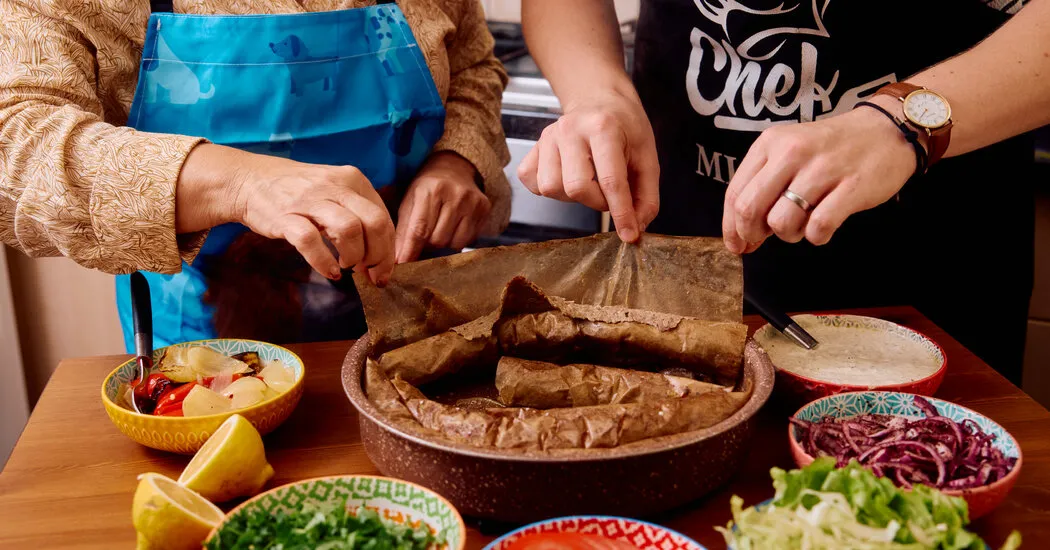
Mr. Wilkes was most familiar with them from late-night shops in London, where he lives now, and from Manchester, where he grew up. But Mrs. Kansu’s version looked quite different: For one, obviously, there was no skewer. Instead, she spread a blended mixture of meat and onion onto sheets of parchment paper and rolled them into long cylinders on a well-worn baking sheet.

“I remember thinking, ‘What are we doing here with this brown paste?’” he said.
After the rolls were cooked, broken up and tucked into and topped in a warm pita, Mr. Wilkes understood. Mrs. Kansu’s technique was mimicking the spit’s gentle browning, cooking it while maintaining its moisture. It was a recipe she had made in her own kitchen for 10 years or so and had seen in her community for even longer.
“I loved it,” Mr. Wilkes said. “I even sent pictures back home to my family.”
When Mr. Wilkes decided to start chronicling his favorite recipes on his TikTok, @MezeMike, he and his girlfriend, Defne, took another trip to Cyprus to document some of Mrs. Kansu’s older recipes.
She was shy at first, not wanting to be on camera, but eventually got comfortable.
“I was honestly quite surprised that he was so interested, because, here, it’s not so common for men to be involved in cooking at home,” she said through a translator. “But I really liked him and was glad he enjoyed the food.”
Mr. Wilkes posted regularly on his account, gaining a dozen, maybe a few dozen views, but it was Mrs. Kansu’s döner that would prove to be his most popular video, garnering thousands of views in its first hour. The recipe has been viewed more than 8.6 million times on TikTok alone, and prompted many videos of people remaking the recipe.
“I think it’s the uniqueness and novelty of it that made it viral,” he said, adding that it didn’t hurt that it was an easy way of making a restaurant dish at home.
For Mrs. Kansu, the appeal is much simpler. “Döner,” she said, “is something that’s universally loved.”
The comments haven’t all been positive. Some viewers have said the method doesn’t produce traditional döner, but Mr. Wilkes and Mrs. Kansu have taken it in stride. “It’s all according to people’s taste buds, and we just take the negative comments and turn them into positive ones,” she said.
Mr. Wilkes recently proposed to Defne, and, soon, Mrs. Kansu will go from girlfriend’s mother to mother-in-law. The couple held a traditional Cypriot proposal at the family’s home and have begun planning their wedding in Cyprus.
But the döner that made them all internet-famous won’t be on the menu.
“I don’t want us to be in the kitchen that day,” Mrs. Kansu said.
Follow New York Times Cooking on Instagram, Facebook, YouTube, TikTok and Pinterest. Get regular updates from New York Times Cooking, with recipe suggestions, cooking tips and shopping advice.