

James Barnor Has Photographed Ghana Since the 1940s. He Remembers Everything.
What doesn’t James Barnor remember? The photographer, who is 96, with an archive of more than 32,000 images and a mind like an encyclopedia, remembers Ghana before it was called Ghana, when it was still the Gold Coast, a British colony. He remembers each of the times he met and took pictures of Kwame Nkrumah, the country’s first prime minister and first president. He remembers — when he was in his early 20s and hadn’t yet opened his first studio, Ever Young, in Accra — turning his aunt’s spare room into a darkroom, and he can recount, in meticulous detail, how to turn a camera into an enlarger — specialized knowledge that, he says, has been largely forgotten. After Barnor hears my last name, he speaks excitedly of his mentor with a variant spelling, A.Q.A. Archampong, who encouraged him to move to England in the late 1950s, and he recalls the exact words that convinced him: “London is the place for you,” Archampong wrote in a letter, riffing on a calypso song that was popular at the time. Barnor would spend the next several decades alternately living in and around both London and Accra, making portraits of Ghanaians and Black diasporans who were busy becoming postcolonial cosmopolitans.
On an afternoon in late October, we’re sitting together in Barnor’s flat — which is west of London and in which he’s lived full-time since 1996 — and he’s telling me stories about every person in the prints we’re sifting through. “She works for American Airlines. And this one, he drives long-distance vehicles,” he says of a photo showing a children’s cultural troupe that Barnor led throughout the ’80s. When he was a photojournalist for the Accra newspaper The Daily Graphic in the ’50s, he’d visit the Parliament House every day and photograph each person who entered. He’s one of the few remaining firsthand witnesses to Ghana’s postcolonial beginnings; it’s not all that hyperbolic to say that Barnor’s memory is a nation’s history.
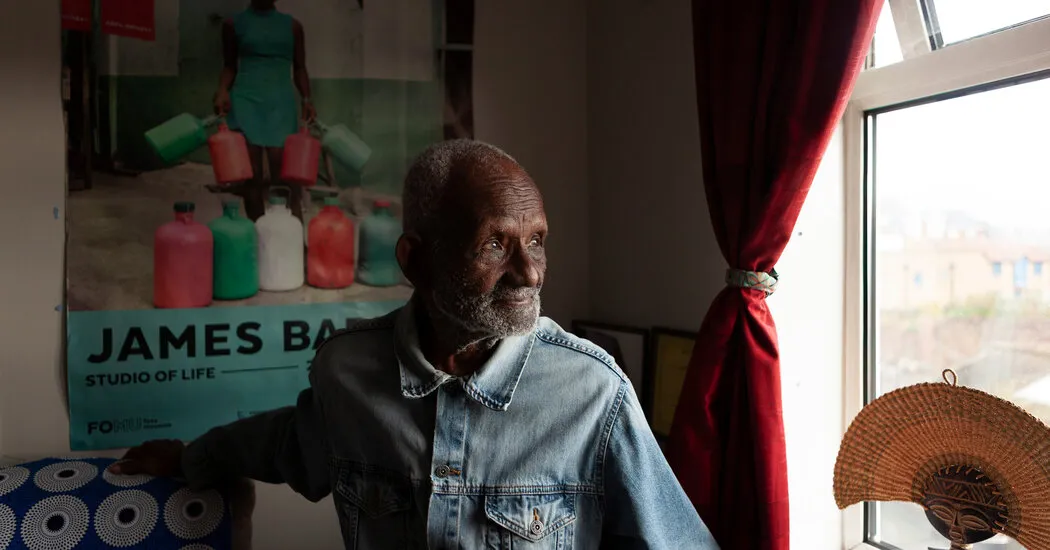
Barnor’s living room looks out onto a river and a bridge. The flat is part of an elderly-housing complex. It’s quiet here, and the river winds next to the building. Boats dot its banks. Barnor narrates the view for me with a smile on his face. He points to a storage facility directly across from us, on the other side of the river. “This was built within the last six months. It took some time to demolish what was there before and then to prepare the ground. I’ve been watching and sometimes photographing it,” he says. This and flowers are the only things he takes pictures of these days, using his phone, and he speaks of the resulting snapshots with the same care and curiosity with which he discusses his prodigious trove of studio, street, fashion and documentary photographs.
Barnor was born in 1929 in Accra’s Jamestown neighborhood to a family of image-makers — among his uncles and cousins were professional photographers, a studio owner and a darkroom worker. But it was a teacher who gifted Barnor his first camera, a tiny Kodak Baby Brownie. (A friend recently gave Barnor a close replica, which he keeps on a shelf in his home. “I haven’t used it yet,” he says. “I don’t want to rush. I want to use it properly.”) Barnor left school early, and in 1947, he began an apprenticeship at his cousin J.P. Dodoo’s portrait studio, where he learned the old formal methods: He used heavy cameras and plates, taking pictures with a large black cloth over his head. “We had to sit and wait for the customers to come. Mostly, the photos were for their albums, friends or a wall in their home,” he says. More formative for the young apprentice was meeting another cousin and photographer, Julius Aikins, who taught Barnor how to use smaller, roll-film cameras that allowed him to step outside the studio. With that lighter technology, Barnor says, “you move; you chase your pictures. That’s where the journalism comes in.”
In 1950, London’s Mirror Group established the Daily Graphic newspaper in Accra and, at Dodoo’s suggestion, tapped Barnor to be its first staff photographer — also making him, by many accounts, Ghana’s first photojournalist. As the country hurtled toward independence, Barnor took candid pictures of political gatherings, sporting events and other cultural happenings, enjoying a level of professional freedom that allowed him to shape his stories as he saw fit. Eventually, he opened Ever Young, where he leaned into a playful theatricality with the help of textile backdrops, costumes and a funny little figurine of a child carrying an umbrella that would regularly appear beside his sitters. One wall was painted with large clouds, and so, in some of his pictures — including two that are currently on view at the Museum of Modern Art in New York — the subjects seem to be gracefully adrift, not quite tethered to any one place.
The photographer made his way to England on Dec. 1, 1959, and spent the next decade learning new photography techniques at the London College of Printing and the Medway College of Art and the Colour Processing Laboratory in Kent. He also shot for different magazines, including Drum, an international publication from South Africa. Barnor returned to Accra in 1969 and remained there for more than 20 years. During that time, he helped set up Sick Hagemeyer, the country’s first color-processing lab, sharing what he’d learned abroad; opened a new portrait studio, Studio X23; taught schoolchildren traditional drumming and dancing through his cultural troupe, Fɛɛ Hii (“All Is Well”); and took photographs for the United States Information Service in Ghana and, later, for Ghana’s then-president, J.J. Rawlings. Despite his significant contributions to the field, by the ’90s, Barnor could no longer make a living as a photographer in Ghana, due in part to the lingering effects of a national economic crisis. So he went back to England and worked for a time as a cleaner at Heathrow Airport.
“My work has been in boxes and kept hidden for a long time,” says Barnor. “Now it’s being shown everywhere.” His first solo presentation took place in 2004, at the Acton Arts Festival in West London. His first book was published in 2015. These days, as major art institutions have caught up to Barnor’s legacy — his work has also been exhibited in Ghana, France, Switzerland and Mali, among other places — the photographer tells me there are a couple of important projects that he sees before him. He’s working every day to digitize a portion of his massive archive, and he’s trying to impart as much as he can to younger artists. There’s an urgency with which he speaks about preserving his memories. It’s likely owing to the fact that he’s acutely aware of being one of the last of his generation of photographers. It seems also to be a product of the photojournalistic instincts he’s spent a lifetime cultivating. A few weeks after I’ve left London, we speak again by phone, and Barnor talks about the cranes and other machines that have transformed the area outside his apartment: “You should see what’s gone on since you left,” he says. “And I’ve got the record of it. I’ve got the story.”
Here, Barnor answers T’s Artist’s Questionnaire.
What’s your daily routine?
At the moment, at 96, it’s so different than before. I live my life telling my story. I look through old pictures, answer questions, rest, read when I can — I wish I could spend the rest of my time just reading, but I can’t.
How many hours a day do you think you spend working on your archive?
When I open old pictures on one of my computers, it seems as if I don’t want to sleep. I don’t think of the hours. There are still quite a lot of images that haven’t been captioned. That’s the job left for me before I go — to make the archives complete, to make the negatives valuable. Without enough information on the negatives — without me explaining why and when they were taken, who the subjects are and so on — nobody will know.
What’s the first piece of art you ever made?
There are two photographs that I remember shooting with 127 film on that Kodak Baby Brownie. One is from when I was teaching. [As a teenager, because his family couldn’t afford to send him to secondary school, Barnor started teaching basket weaving at a missionary school.] I took the camera to school and rushed to take a picture of this girl in a church on the campus. She’s very small in the picture, which has a lot of background. There are so many pews and a boy behind her whom I hadn’t noticed. I didn’t know then what I should’ve done — like focusing properly or going close and filling the frame with the main objects.
The second shot is of a municipal bus, with a conductor minding his own business, selling tickets, and a bus inspector standing by watching over him. When I took it, there were trees around the bus, and it was very beautiful. I went there again some few years back, and I didn’t find a single tree; it’s all completely built up. You see, that shows the benefit of recording. I’m very proud of that picture.
What’s the first work you ever sold? For how much?
I remember when Nkrumah was imprisoned [by the colonial government], and then his party won the general elections, so he was released. The day he was released [Feb. 12, 1951], he was brought to an arena near where I lived. I ran with my box camera and took a couple of pictures. That night, I stayed indoors and printed copies. The next morning, I was selling them in the market.
After that, it took Ghana six years to prepare for independence. During that time, I was visiting the legislative assembly regularly and taking pictures and selling them to the parliamentarians and anybody else who wanted copies.
I also sent my work to England, to the Black Star photo agency. And one picture fetched almost 90 pounds. In Ghana, in the mid-1950s, to get that much for a picture in a newspaper was surprising.
The photos that you took of Kwame Nkrumah after he was released — do you remember how much you sold them for in the market?
No, no, I didn’t think of money at the time. If I’d had some business sense, by this point I’d be a millionaire.
Even now, I don’t think of money as mine, or as something for me to spend. I’ve never been on holiday before. I don’t eat expensive foods; I don’t wear expensive clothes. Now, politicians use money to make themselves big. But I don’t have any ambitions in politics at all. You know, money is nothing, but I’ll be blessed in that when I need it, I get it.
I wonder what the conversations were like with your editors at The Daily Graphic. How much were they instructing you on what to photograph, versus you independently shaping the story?
Even at that early age, I was independent. After [the newspaper] started, other photographers who joined were studying from me. There was somebody who was older than I was and had finished his apprenticeship in portrait photography before I did, but when he came to Graphic, he was under me. I could give him an assignment, or we could share assignments and not fight about images or anything like that. Later, after he lost his studio, I employed him in mine, because he was very good at retouching — even better than I was. And it made the work go on, rather than it being something I did for myself alone.
When you start a new piece, what’s the first step?
One of my “studios” was Makola Market. You can photograph anything there. When you’re in the market, do you pose the people or just take photographs of what you see?
One of my favorite things is photographing babies. When a baby of 3 months is brought to you, how do you go about it? I can’t tell you that. You’d have to be with me while I took the picture, and then I’d go through it with you.
OK, so I’d have to see it to understand it. You might feel the same way about this question, but: How do you know when you’re done with a piece?
When you’re an artist, and you have a brush, you can continue adding and making changes. But with a photograph, once you record the scene that was before you as faithfully as you can, you’ve done your work. So you can always tell when you’re finished. To think of where to sell it and whom the work will benefit — that’s another thing.
When you were working regularly, did you play any music while taking photographs or developing the prints?
I had a radio in Ever Young, so there was always some background music. I could tune into Congo-Brazzaville or Ghana Broadcasting Corporation, or GBC.
I photographed a model posed with the radio [around 1954]. There are two things about that picture that I adore. One is that old radio, a Morphy Richards. As soon as you see it, you start to hear the music yourself. And in the background, on the wall, there’s a notice with the header “Hands and Brains.” It’s a poster from the British Information Service about post-World War II education. People who couldn’t go to a secondary school or grammar school had to go apprentice somewhere. They learned to use their hands and their brains to build the country. These leaflets were sent all through the colonies. I didn’t go to secondary school. I pasted this in my studio, because I also got my education, and did my work, with my hands and brain — first as a weaver and then as a photographer.
What was your schedule like when you were operating your studio? What time would you wake up and when would you start working?
I lived at the Ever Young studio. When I woke up and my assistants or apprentices came in, we were ready to start working. Sometimes, I worked very late, through the night, on my own. At night, I didn’t have any disturbances whatsoever.
Did I tell you about the model Evelyn Abbew, who, at around age 90, came to my 95th birthday celebration [in Accra]? She was a friend, and she used to be a nurse. Sometimes, when I was working in the night, she would be, too, and we’d talk on the phone. And then, later, she’d come to the studio and help out like an assistant. I took many photographs of her; she’s even on the cover of one of my publications.
What did you usually wear when you worked?
You had to be neat and presentable. You can’t go to the castle [Osu Castle, where Nkrumah and, later, Rawlings resided as president] or be among members of parliament dressed in tatters.
Would you wear a suit?
A suitable suit! [He laughs.]
What’s your favorite artwork by someone else?
Bill Bell — Willis Bell — was an American photographer who settled in Ghana, and we became close. He published “The Roadmakers” (1961) [a collaborative photo essay done with the playwright Efua Sutherland that was commissioned by Ghana’s department of information services to celebrate the newly independent country]. His work was outstanding.
How often do you talk to other artists?
Other Ghanaian photographers kept to themselves most of the time [in Accra]. We knew one another. When we met on an assignment or in town, we talked. But they didn’t visit my studio unless they were short on plates and films, which I sold.
How about now?
There’s an artist in Tamale [the capital city of Ghana’s northern region], Ibrahim Mahama, who’s one of the people I can rely on to assist me in sharing my work in Ghana. There’s a young Nigerian photographer who lives in Ghana, Dennis Temituro, who took pictures of me on my birthday last year. We’re in touch on WhatsApp. Just yesterday, [we were discussing] a new assignment he’d received.
It seems like you’ve made a big effort to be in touch with the younger generation.
Whatever I have, I can pass on, and then we can share ideas.
Do you have friends nearby?
My friends would be old ones. Mostly, the people I came to meet here have gone. When I’m going through the photos of them, I relive everything. The photographs confirm the type of life I have lived.
This interview has been edited and condensed.