

Maduro says “I was captured” and pleads not guilty to drug trafficking charges in NY court
NEW YORK (AP) — A defiant Nicolás Maduro declared himself “the president of my country” while protesting his capture and said he was innocent Monday of federal drug trafficking charges that the U.S. government used to justify his removal from power in Venezuela.
“I was captured,” Maduro declared in Spanish, as translated by a courtroom interpreter, before being interrupted by the judge. When asked later about his plea to the charges, he stated: "I am innocent. I am not guilty. I am a decent man, the constitutional president of my country." She also pleaded not guilty.
The criminal case unfolds in a broader diplomatic context with a US-orchestrated regime change that US President Donald Trump has said will allow his administration to “run” the South American country.
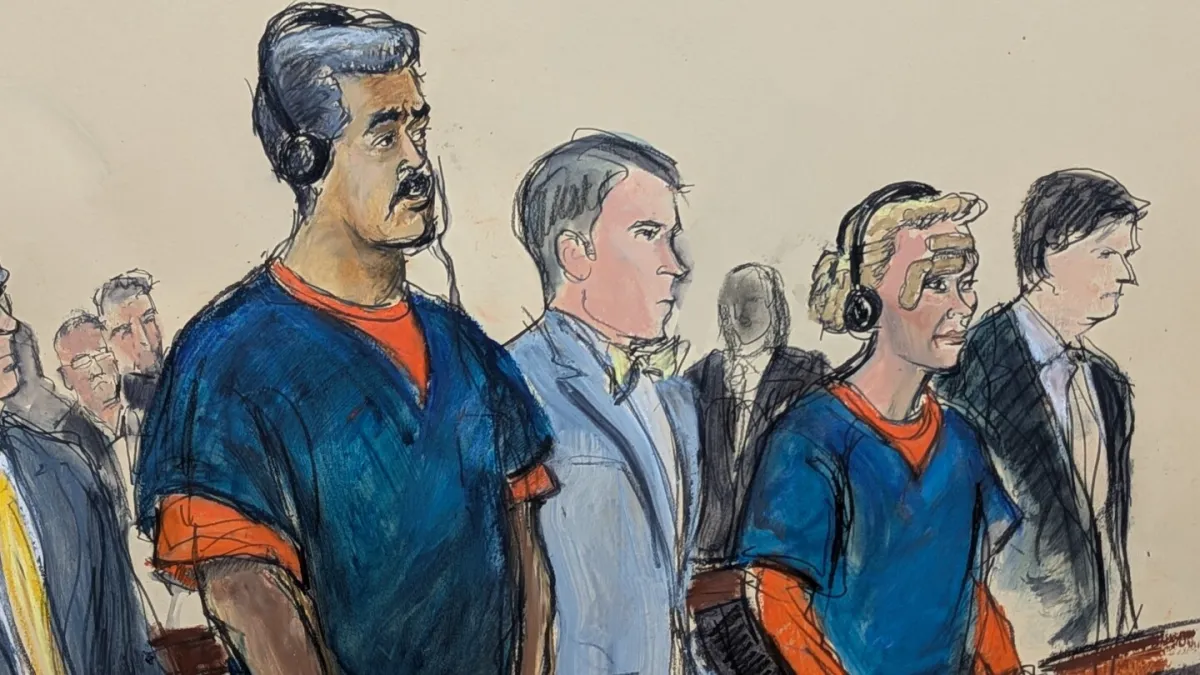
Maduro, 63, was brought to court under heavy security early Monday, transported by helicopter to Manhattan from the Brooklyn borough where he is jailed, and then taken to court in an armored vehicle. He and Flores were taken to court shortly before noon. Both were in leg shackles and prison clothing, and both put on headphones to listen to the English proceedings as they were translated into Spanish.
As Maduro walked out of the courtroom, a man in the audience denounced him as an “illegitimate” president.
A legal fight begins
Because he is charged under the United States legal system, Maduro will have the same rights as anyone else accused of a crime in the country, including the right to a trial by jury. But, given the circumstances of his arrest and the geopolitical stakes, it will also be almost — but not quite — unique.
That was clear from the beginning, as Maduro, who took copious notes during the proceedings and wished reporters a Happy New Year as he entered the courtroom, repeatedly mentioned that he had been illegally kidnapped.
“I have been kidnapped here since January 3, Saturday,” Maduro said, standing and bowing his head. tall figure towards a table microphone. “I was captured at my home in Caracas.”
U.S. District Judge Alvin Hellerstein, a 92-year-old jurist whom Bill Clinton appointed to the federal bench in 1998, interrupted, saying: “There will be time and place to review all of this.” Hellerstein added that Maduro's lawyer could do so later.
“Right now, I just want to know one thing: Are you Nicolás Maduro Moros?”
“I am Nicolás Maduro Moros,” the defendant responded.
Maduro's lawyer, Barry Pollack, said he plans to challenge the legality of his “military kidnapping.”
Pollack, a prominent Washington lawyer whose clients have included WikiLeaks founder Julian Assange, said Maduro is “head of a sovereign state and is entitled to the privileges and immunities that come with that office.”
Panamanian dictator Manuel Noriega unsuccessfully raised the same immunity defense after the United States carried out a similar military invasion in 1990. But Washington does not recognize Maduro as Venezuela's legitimate head of state, especially after of a very controversial reelection in 2024.
Flores, who identified herself before the judge as “first lady of the republic of Venezuela,” had bandages on her forehead and right temple. His lawyer, Mark Donnelly, said he suffered “significant injuries” during his capture.
A 25-page indictment accuses Maduro and others of working with drug cartels to facilitate the shipment of thousands of tons of cocaine to the United States. They could face life in prison if convicted.
Among other things, the indictment accuses Maduro and his wife of ordering kidnappings, beatings and murders of those who owed them drug money or undermined their narcotics trafficking operation. That included the murder of a drug trafficking leader in Caracas, according to the indictment.
Outside the court, police separated demonstrators protesting U.S. military action in Venezuela from demonstrators who favored the intervention. Inside the courtroom, as the proceedings concluded and Maduro prepared to leave, Pedro Rojas, 33, stood up and began speaking forcefully to him in Spanish.
Rojas later said he had been imprisoned by the Venezuelan regime. As bailiffs led Maduro out of the courtroom, the deposed leader looked directly at the man and responded in Spanish: "I am a kidnapped president. I am a prisoner of war."
They demand Maduro's return
Trump said Saturday that the United States would temporarily “administer” Venezuela, and on Sunday night he reiterated that “we are in charge,” telling reporters “we are going to run it, fix it.”
Secretary of State Marco Rubio tried to take a more cautious tone, saying on talk shows Sunday morning that the United States would not govern the country on a day-to-day basis, beyond enforcing a “quarantine.”
Before his capture, Maduro and his allies claimed that Washington's hostility was motivated by a desire to control Venezuela's rich oil and mineral reserves.
Trump has said that removing Maduro would allow more oil to flow from Venezuela, but oil prices rose 1.7% on Monday. There is uncertainty about how quickly crude oil production can be increased in the South American country after years of neglect, and there are also questions about the governance and oversight of the sector.
Venezuela's new interim leader, Delcy Rodríguez, has demanded that the United States return Maduro, who has long denied any involvement in drug trafficking. However, on Sunday night he adopted a more conciliatory tone in a social media post, inviting collaboration with Trump and “respectful relations” with the United States.
Rodríguez was sworn in on Monday before his brother, the president of the National Assembly, Jorge Rodríguez.
“I come with pain for the suffering that has been caused to the Venezuelan people after an illegitimate military aggression against our homeland,” he declared with his right hand in his hand. high. "I come with pain for the kidnapping of two heroes."
Maduro's son and Venezuelan congressman Nicolás Maduro Guerra warned on Monday that his father's capture could set a dangerous precedent worldwide, and demanded that his parents be returned.
"If we normalize the kidnapping of a head of state, no country is safe. Today it is Venezuela. Tomorrow it could be any nation that does not decide to submit. This is not a regional problem. It is a direct threat to global political stability,” said Maduro Guerra.
In another development on Monday, the United Nations Security Council held an emergency meeting, where the top UN official pointed out that the United States could have violated international law with its unilateral military action. The world body also highlighted the deep humanitarian needs in Venezuela. Its people have endured a complex and prolonged economic crisis.
___
Tucker reported from Washington. Associated Press journalists Regina García Cano in Caracas, John Hanna in Topeka, Kansas, Megan Janetsky in Mexico City, Farnoush Amiri and Jennifer Peltz at the United Nations, Josh Boak in Baltimore, Maryland; Darlene Superville aboard Air Force One and Joshua Goodman in Miami contributed to this report.
___
This story was translated from English by an AP editor with the help of a generative artificial intelligence tool.