

Make Sugar Cake Your New Holiday Tradition

The promise of presents makes waking up on Christmas morning exciting, but the promise of breakfast makes getting out of bed worth it in the Vreeland household. Growing up, the smell of shrimp and grits, biscuits and gravy and breakfast casserole would waft throughout my house, serving as an alarm in my teen years when I was less invested in toys and more invested in sleep. Like with any good meal, however, the savory stuff was just a pregame for the real headliner: Moravian sugar cake.
I knew I wanted sugar cake to be December’s Monthly Bake. For decades, my family has been eating the version from Dewey’s, a Moravian bakery in Winston-Salem, N.C., where my dad is from. I get excited when the grocery stores in Raleigh (where I’m from) begin stocking it at Christmastime because I crave a slice of sugar cake for 11 months out of the year. But this year, I set out to make my own and share it with you all.
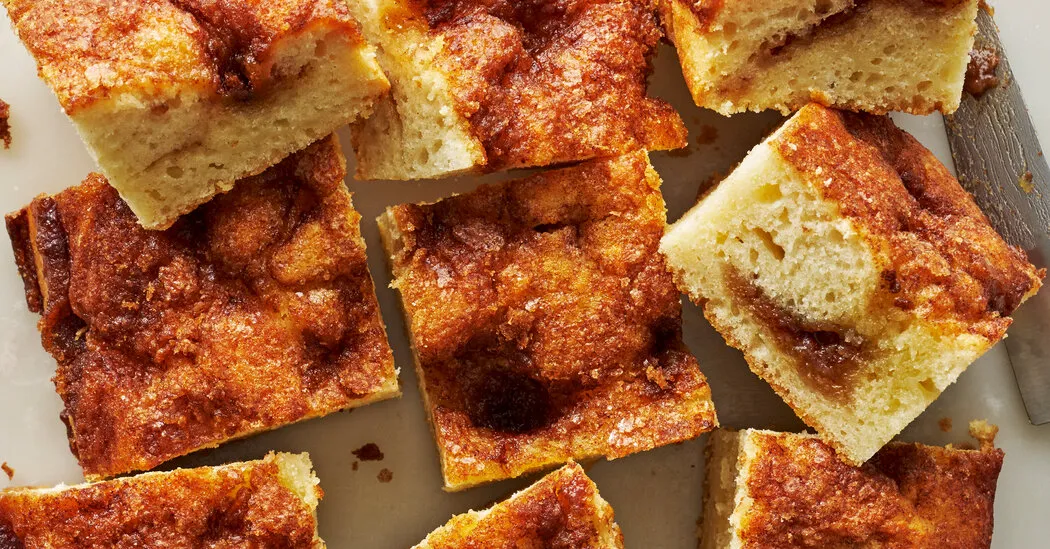
Moravian sugar cake is a pillowy cake-bread hybrid with a caramelized crust and, best of all, little pockets of crunchy, buttery sugar. Its name comes from the Moravians, with roots in what is now the Czech Republic. With large Moravian communities now settled in Bethlehem, Pa. and Winston-Salem, N.C., they’re famous for thin, crispy cookies called, fittingly enough, Moravian cookies, as well as this pillowy, brown-sugar-crusted goodness whose texture I can only describe as somewhere between a coffee cake and a cinnamon roll: the sugar cake.
It’s very simple to make, but it also challenges a lot of what I’ve learned over the years about cakes and yeasted breads. I consulted some Moravian church cookbooks (church cookbooks are a fabulous place to find great recipes, by the way) and then went straight to the source and spoke to Dewey’s about how they make theirs. I learned that no matter the recipe, they all rely on one secret ingredient: potato. Some call for potato flakes or instant potatoes, others call for good old boiled and mashed Russets. Either way, I love a secret ingredient.
The cake starts with an enriched yeasted dough, but it’s not exactly a bread dough. It’s also not quite a cake batter — it’s like cinnamon roll dough’s much stickier, potatoey cousin. But this dough doesn’t require a lot of kneading or proofing, and it’s lower maintenance than any cinnamon roll recipe I’ve seen. And the end result, in my humble opinion, is much more delicious.
With sugar cake, the less proofing, the better. The potato feeds the yeast and makes it more active, but you’re not waiting for it to create a super airy, open texture. This means your dough can be made in about two hours, which is perfect because brunch waits for no one.
The first time I tested it, I chilled it overnight for a nice, slow second proof, thinking the cake could be something I start the night before and bake off in the morning (like cinnamon rolls). Alas, I woke up to my fridge looking like the Upside Down from “Stranger Things” and learned a very valuable lesson: Don’t mess with tradition.
After two quick rises (20 minutes and then about 15), the dough gets dimpled like focaccia, topped with a brown-sugar-cinnamon mixture and drizzled with melted butter before baking. The result is crunchy, plush perfection that smells like Christmas morning. Sugar cake is something that needs to be served warm. If yours cools to room temperature, just zap any servings in the microwave for a few seconds or warm it back up in a 350-degree oven for a couple minutes. OK, enough chatter. Go read this recipe, and buy a potato!
Share your photos!
It’s always so fun when I get to see something I’ve grown up eating making its way into your homes! Share your photos by sending them to baketime@nytimes.com or tagging me on Instagram @vaughn. (By submitting photos to us via email, you agree to our reader submission terms here.)
The Monthly Bake
Moravian Sugar Cake
Click here to view this recipe in the app.
Total time: About 1½ hours, plus 1 hour proofing and 20 minutes cooling
Prep time: 15 minutes
Bake time: 32 to 36 minutes
Yield: One eight-inch square cake (8 to 10 servings)
INGREDIENTS
For the cake:
1 large russet potato (about 13 ounces), peeled and cut into one-inch cubes
4 tablespoons/57 grams unsalted butter, melted and cooled, plus more for greasing
¼ cup/60 grams whole milk
½ cup/120 grams lukewarm water
½ cup/100 grams plus 1 tablespoon/15 grams granulated sugar, divided
1½ teaspoons/5 grams active dry yeast
2½ cups/320 grams all-purpose flour
2 teaspoons kosher salt, such as Diamond Crystal, or 1 teaspoon table salt
1 large egg
For the topping:
¾ cup/165 grams light brown sugar
1 teaspoon ground cinnamon, plus more to taste if you prefer
½ teaspoon kosher salt, such as Diamond Crystal, or ¼ teaspoon table salt
4 tablespoons/57 grams unsalted butter
PREPARATION
Make the cake: In a medium pot, bring 2 quarts of water to a boil over high heat. Add the cubed potatoes, reduce the heat to medium and boil until fork-tender, about 20 minutes.
Meanwhile, grease one large bowl and an 8-inch-by-8-inch square cake pan with butter.
Turn off the heat, drain the potatoes and return them to the warm pot to dry out for about 30 seconds. Mash the potatoes with a fork or a potato masher until very smooth and then measure out 1 cup/190 grams of the mashed potatoes. (Save or discard any leftover potato.) Return the measured mashed potatoes to the pot, add the milk and whisk until very smooth. Set aside to cool slightly.
In the bowl of a stand mixer, stir together the lukewarm water, 1 tablespoon/15 grams of the sugar and all the yeast, and let sit for 5 minutes until foamy. Add the remaining ½ cup/100 grams sugar, plus the flour, mashed potato mixture, melted butter, egg and salt; mix with a wooden spoon or rubber spatula just until a shaggy dough forms.
Fit the mixer with the dough hook. On low speed, mix the dough for about 3 minutes and then use a spatula to scrape down the sides. Continue to mix until the dough is stretchy but still sticking to the hook, 2 to 3 minutes more. The mixture will look somewhere between cake batter and bread dough, and will be quite sticky to the touch.
With a bench scraper or flexible spatula, transfer the dough to the greased bowl, cover tightly with plastic wrap and let sit at room temperature for 30 to 40 minutes, until visibly puffier but not doubled in size. Set a small bowl of room-temperature water off to the side.
Uncover the bowl (saving the plastic) and, with a bench scraper or flexible spatula, transfer the dough to the greased baking pan. Using lightly damp hands, press the dough down into an even layer that reaches all corners of the pan. Cover with the plastic wrap and let sit for another 15 to 20 minutes, until the dough is a bit puffier.
While the dough proofs in the pan, heat the oven to 350 degrees. Make the sugar topping: Combine the brown sugar, cinnamon and salt in a small bowl. In a separate microwave-safe bowl, microwave the butter in 15-second bursts until fully melted (or melt gently on the stove in a small pot). Let cool for at least 5 minutes (it should be pourable but not hot).
Uncover the dough and, using slightly damp fingertips, press down to make about 25 dimples all over the surface. You may need to go back over the dimples with redampened fingertips to make sure the indentation nearly reaches the bottom of the pan. Sprinkle the brown sugar mixture evenly over the top, patting down slightly to compact, and drizzle the melted butter all over the sugar.
Bake for 32 to 36 minutes, until the cake is slightly risen, the top is crisp and the sugar looks deeply golden. Let cool in the pan for 20 minutes.
Turn the warm cake out onto a cutting board and cut into 9 squares (or whatever size pieces you desire). This cake is best served warm, so if baking ahead of time, reheat it in the microwave for 30 seconds or in a 350-degree oven for 2 minutes. Store any leftovers wrapped tightly in plastic for up to 3 days.
I must admit I did not test this recipe by hand. If some brave soul wants to try mixing the dough by hand, please let me know how it turns out. I’d use a greased bowl scraper and give it a good series of folds over the course of about five minutes!
Thanks for reading (and baking)! See you next week.
Was this email forwarded to you? You can sign up for Bake Time here.
Thanks for reading and cooking. If you like the work we do at New York Times Cooking, please subscribe! (Or give a subscription as a gift!) You can follow us on Instagram, Facebook and Pinterest, or follow me on Instagram. Reach out to my colleagues at cookingcare@nytimes.com if you have any questions about your account.