

Mapping an Ever-Evolving Cuisine
The food of Greece has a long history, some of which has translated seamlessly to New York, in neighborhoods like Astoria, Queens, where many Greek immigrants settled in the 1960s. But at newer restaurants, it’s cutting edge.
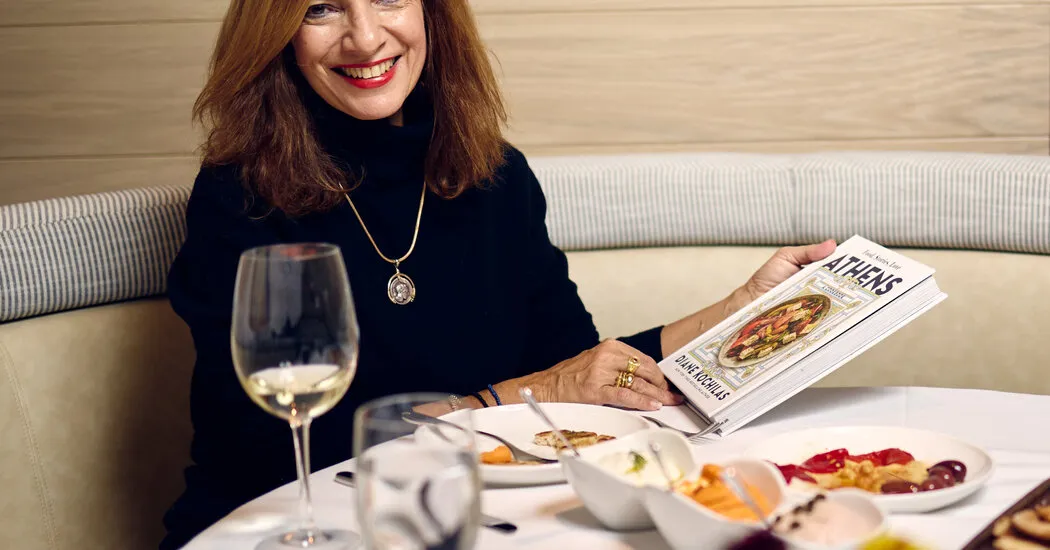
“Greek food is popular and stylish now, and perceived as healthy,” said Diane Kochilas, the food writer and critic, over dinner last month at the newest location of Avra, which she cited as a good example of New York’s Greek food scene today. That location occupies an immense space in a corner of the Moynihan Train Hall, and it’s where a plate of barbounia, or red mullet, fueled the conversation. Barbounia is a small and distinctive Mediterranean fish that, unlike the now ubiquitous branzino, has had as much trouble as our local bluefish finding its footing with a wide audience.
“It has to be very fresh,” Ms. Kochilas said, admiring what she was eating, “and there’s no other fish quite like it.” Barbounia is not a common item on New York Greek menus, and Ms. Kochilas made the point that, too often, the Greek restaurants here keep within a comfort zone of dips, salads, souvlakia and lamb chops.
“Restaurants can’t take dishes like those off their menus,” she said, “but there’s room for change.”

A native of New York who was born in Brooklyn and raised in Jackson Heights, Queens, Ms. Kochilas has lived in Greece for decades. She is a keen, highly qualified and ferociously opinionated observer of what’s going on here and in Greece, and was in New York to promote her new book, “Athens: Food, Stories, Love” (St. Martin’s Griffin, $40).
She noted that there were signs of evolution, from the early days with pioneers like Steve Tzolis, who opened Periyali in Chelsea in 1987 with Nicola Kotsoni and started pouring Greek wines, to Greek food today with its broad range of options, from elaborate to bare bones and even food trucks. And that’s not just in New York but also in Boston, Chicago and elsewhere. She also mentioned Costas Spiliadis, the founder of the Milos restaurants, as someone who “raised the money bar” when it came to Greek dining. He made high-end prices acceptable for a cuisine that sometimes shows up in diners.
“I’ve also seen the addition of popular non-Greek concepts like ceviche and carpaccio,” she said. She gives a nod to those in her book. At Avra, there’s sushi on the menu.
“What’s still missing is regional food like the food of Crete,” she said, adding that she would like to see different savory pies, square ones from Crete, more grain dishes and rabbit at Greek restaurants. Gus and Marty’s in Williamsburg, Brooklyn, and House of Stefas in Millbrook, N.Y., are places that have broken out of the “pastitsio mode,” in her view.
While living in Queens as a child, she summered with her family on her father’s native Aegean island of Ikaria, east of Mykonos, and she moved there permanently, with periodic trips back to the United States, about 30 years ago. That’s when she married, had a child and found journalism with a focus on food.
In Greece, as she described it, two factors upended the restaurant scene. First came better winemaking. “Winemakers were well-educated and the wines were modernized, and that drove the food revolution: The food caught up, and fine-dining developed,” she said. Then she cited the 2004 Summer Olympics, which put Greece in the spotlight and gave rise to a new generation of tavernas as chefs embraced their own culture. There was a “blossoming of restaurants,” as she put it.
Her new book focuses on Athens and describes, with recipes, the changes she has seen over the past several decades in Greece’s capital. Politics played a major role as the country became more stable after a period of civil strife and was able to join the European Union; influences from other countries, including immigrants, started showing up. But then came the financial collapse. It forced chefs and restaurants to go back to simpler basics and abandon some of the trendy notions they had embraced. This eventually gave way to a more confident approach that incorporated a global outlook.
It’s reflected in the recipes in her book, which starts with a richly varied assortment of hand pies that are symbolic of street food, including a spinach-feta croissant. Souvlakia and gyro, dips and mezze, and all the ways the Greeks fry cheese come next, with salads, of course, taverna fare and home cooked “bourgeois” dishes like pastitsio. New vegetarian ideas, including zucchini stuffed with black rice, and seafood (no barbounia), meat and desserts are also packed, like a well-made spanakopita, into the colorful book. History is braided throughout, and there’s a primer on Greek wines, including a newfound appreciation for the once-reviled retsina.
Follow New York Times Cooking on Instagram, Facebook, YouTube, TikTok and Pinterest. Get regular updates from New York Times Cooking, with recipe suggestions, cooking tips and shopping advice.