

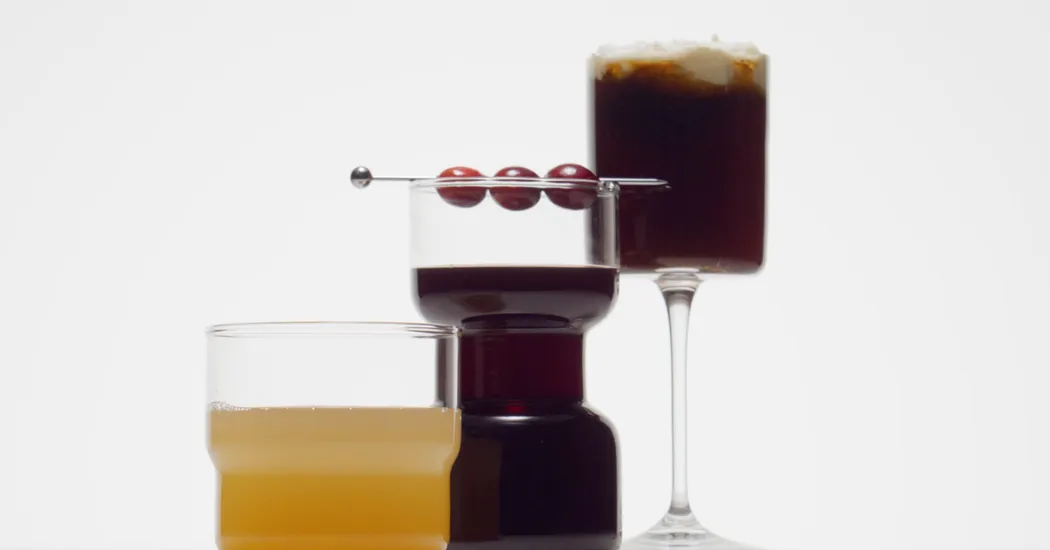
Recipes for Warm Winter Cocktails (That Aren’t Hot Toddies)
According to the historian David Wondrich, ice was first added to alcoholic beverages in the first half of the 19th century. “That’s when you transition from cocktail as medicinal shot to cocktail as epicurean experience,” he says. The practice soon spread — especially after ice no longer needed to be chipped from frozen lakes — and reverence for the very chilled drink persists, as exemplified by ongoing quests for the clearest ice and the coldest martini. And yet, this time of year, hot cocktails have their moment. They’re a perfect antidote to winter’s bite, if not the literal remedies for the common cold some would like to think they are. Then, too, for a bartender, crafting a hot cocktail can be an appealing creative task. As Ivy Mix, 40, a co-owner of the Brooklyn bar Whoopsie Daisy, says, “It’s a totally different way of thinking about flavors — heat inherently creates a flavor explosion.”
Index of Recipes
- Ivy Mix’s Glou Chaud
- Kip Moffitt’s Cafecito Mexicano
- Gelo Honrade’s Exotic Escape
While the winter warmer that first comes to mind is most likely a hot toddy — traditionally made with whiskey, hot water, lemon, cinnamon and cloves, and considered fashionable in the American colonies as early as 1764 — there are plenty of other classics and potential variations on those themes. With peak holiday party season upon us, we asked Mix — along with Kip Moffitt, 39, the head bartender of the Mexican American cocktail bar Superbueno, in Manhattan’s East Village, and Gelo Honrade, 43, a tiki aficionado with a new spot on the way— to share a recipe for a hot drink that goes beyond the toddy.
Ivy Mix’s Glou Chaud
Wine bars face the perennial problem of undrunk wine — what remains in bottles offered by the glass and threatens to go bad before they’re finished. In the past, Mix has experimented with using these leftovers to make vermouth. This winter, she decided to turn them into a mulled wine. The Greeks, out of the same impulse, made a precursor to the drink that they flavored with honey and spices. The Romans did something similar; in fact, the word “mulled” can be traced back to the Latin word mel, or honey. Warmed, spiced wine was also popular in medieval Europe, where water was often unsafe to drink, and variations abound: the Swedish glögg, the French vin chaud and the German glühwein.
Mix’s concoction — its name, the Glou Chaud, nods to glou glou, which is the French equivalent of “glug glug” and can refer to any easy-to-drink wine — mixes spices and orange rounds, considered traditional for mulled wine since the Victorian age, with raspberry eau de vie, or fruit brandy. Unlike other fruit-based spirits such as Calvados or Cognac, which take on the taste of the barrels they’re aged in, an eau de vie, the literal translation of which is “water of life,” tends to be unaged in order to preserve the vibrancy of the fruit captured during the distillation process. (Each bottle of the Etter that Mix recommends is made from four pounds of raspberries.) “I think eaux de vie are, in their essence, the purest representations of what they’re made from,” says Mix.
If you don’t have leftover wine for this recipe, she adds, choose an inexpensive bottle that has a little acid, some structure and a lot of juiciness: “Mulled wines are not the time to break the bank.”
Serves 5 to 6
Ingredients:
1 bottle red wine
8 ounces pure unsweetened cranberry juice
4 ounces raspberry eau di vie, preferably Etter
4-6 ounces maple syrup (depending on how sweet the wine is)
1 orange, sliced into thick rounds
6 cloves
3 whole star anise
2 cinnamon sticks
Pinch of nutmeg
For garnish:
¼ cup fresh cranberries
5-6 dehydrated orange wheels
Combine all ingredients in a saucepan and simmer over low heat for 10 minutes. Make sure mixture doesn’t reach a boil. Strain out the solids. Pour into mugs and garnish each drink with fresh cranberries and a dehydrated orange wheel.
Kip Moffitt’s Cafecito Mexicano
Moffitt has always loved rich winter drinks, like a hot chocolate so thick you have to drink it with a spoon. When he wanted to add a hot drink to Superbueno’s menu, he simultaneously channeled a decadent Irish coffee — thought to have been invented in 1943 by a chef at an airport in County Limerick, Ireland, who made it to comfort stranded trans-Atlantic passengers — and a café de olla, a nonalcoholic Mexican coffee drink sweetened with unrefined cane sugar and spiced with cinnamon that Moffitt was familiar with thanks to trips to Mexico and his years living in Texas. Moffitt’s drink, which like an Irish coffee has whiskey, coffee (in the form of cold-brew concentrate and coffee liqueur) and sugar (in a syrup infused with cinnamon and coriander), also features tequila. And instead of plain whipped cream, it’s topped with a cold sweet-corn cream, flavored with freeze-dried corn and Nixta, a liqueur made from the byproduct of nixtamalized corn whiskey.
The cocktail bar’s Cafecito Mexicano, prepared with housemade cold-brew concentrate, is kept in an immersion circulator that keeps it at the perfect temperature of 170 degrees Fahrenheit. The recipe here is for a simplified versionof that drink, which has been on the menu of Superbueno every winter since it opened in 2023, though regulars have been known to ask for it in the middle of summer.
NOTE: Freeze-dried corn shouldn’t be too hard to find online. (Those in New York City can find it at Kalustyan’s.) But if you can’t track it down, feel free to skip the corn entirely.
Serves 1
Ingredients:
1 ounce café de olla syrup (see below)
¼ ounce cold-brew liqueur, preferably Mr. Black or something comparable that isn’t very sweet. (Otherwise, add only a splash, and add an extra splash of tequila to compensate.)
¾ ounce tequila
½ ounce Irish/rye whiskey
4 ounces boiling water
Sweet-corn whipped cream (see below)
Layer the ingredients in a toddy/Irish coffee glass or mug: first the café de olla syrup, then the cold-brew liqueur, tequila and whiskey. Add hot water and stir.Top with sweet-corn cream and serve immediately.
Café de Olla Syrup (yields enough for 8 drinks)
Ingredients:
¼ cup/50 grams Demerara sugar
Tiny pinch/.25 grams ground cinnamon
¼ teaspoon/.75 grams kosher salt
1¼ teaspoons/6 grams golden raisins
½ teaspoon/5 grams whole coriander seeds
1 cup/250 grams cold-brew concentrate (If you’re making your own, a medium roast works best.)
Preheat a dry pan over medium-low heat. Add the coriander seeds and stir frequently to slowly toast the coriander seeds until fragrant, about two minutes. In a blender, combine the dry ingredients (don’t skip the raisins; they add a creaminess to the final texture) and the cold brew. Blend on slow for two minutes. If you blend too fast, the mixture will become foamy, which means that when it starts to settle, it will separate. Strain with a fine mesh strainer. Store in an airtight container for up to two weeks.
Sweet-Corn Cream (yields enough for 8 drinks)
Ingredients:
1 tablespoon/12.25 grams white sugar
½ ounce water
8 ounces heavy cream
4 ounces Nixta corn liqueur
3 teaspoons/7 grams freeze-dried corn
Make simple syrup by heating the sugar and water in a saucepan over medium heat and stirring constantly until sugar is completely dissolved. Remove from heat and, if using right away, place in the fridge or an ice bath to cool quickly. Grind freeze-dried corn (if using) into a very fine powder in a coffee/spice grinder. Combine heavy cream and cooled simple syrup and whip until it just starts to mimic the shape of the whisk. It should be fluffy but pourable. Add the corn liqueur and whisk for another 20 seconds. Using a spatula, gently fold in the corn powder and incorporate well. Store, refrigerated, in an airtight container for up to a week.
Gelo Honrade’s Exotic Escape
“A lot of people think of tiki as a blend of liquors, but I think of it as blending cultures in different ways,” says Honrade, a native of the Philippines who’s made a career out of modernizing tiki, a style of cocktail and bar that originated in the U.S. in the 1930s and borrows various rums from the Caribbean, as well as kitschy, stereotypical imagery of the Pacific islands. A tiki mainstay, the zombie, may have gotten its name after a customer returned to Don the Beachcomber, the Los Angeles bar where the drink was first served, in 1934 and relayed that, for days, it had left him feeling like a zombie. In addition to the usual blend of rums found in a zombie, Honrade’s take, which he calls the Exotic Escape, has grapefruit oleo-saccharum, allspice grenadine, cold Lapsang foam and a pandan garnish.
This mocktail version has a mix of four teas — Honrade recommends Harney & Sons for all four varieties — and Almave Ámbar, an alcohol-free alternative to tequila that he calls “the best nonalcoholic spirit I’ve ever tried.” A rendition of it, along with the boozy original, will appear on the menu at After Eden, a Vietnamese coffee bar with a cocktail program that Honrade plans to open on Manhattan’s Lower East Side in January.
NOTE: The recipe can easily be scaled up, but if prepping the teas in advance, place the concentrates in an ice bath so they cool quickly, preserving the flavor. The teas can then be combined and stored, refrigerated, in an airtight container for three days.
Serves 1
Ingredients:
6 tablespoons plus 1 teaspoon/57 grams loose-leaf tropical green tea
3 tablespoons/28 grams loose-leaf oolong tea
3 tablespoons/28 grams loose-leaf Lapsang souchong tea
3 tablespoons/28 grams loose-leaf soba roasted buckwheat tea
4 ounces boiling water
1.5 ounces Almave Ámbar
2 ounces coconut water
1 cinnamon stick
2½ tablespoons/31 grams white sugar
½ ounce grapefruit juice
¾ ounce lime juice
In four mugs each containing 1 ounce of boiling water, steep the teas separately to accentuate their individuality. After 2-3 minutes, squeeze the tea leaves to extract the potent tea concentrate, and remove them so it doesn’t get too bitter. Combine the teas, Almave Ámbar, coconut water, sugar and cinnamon in a saucepan and bring mixture just to a simmer. Take it off the heat. Add the grapefruit and lime juices and stir. Pour into a teacup or mug and serve with the cinnamon stick for garnish.