

Review: The Met Opera Unveils ‘I Puritani’ on New Year’s Eve
It’s called bel canto for a reason.
Italian for “beautiful singing,” this era of early 19th-century opera was one in which composers put the voice first, with long melodies and musical feats that continue to make watching any performance, at the highest level, no different from witnessing Simone Biles pull off a triple-double at the Olympics.
But the result should be moving, too. The composer Vincenzo Bellini once wrote to his librettist that through singing, a show must conjure tears, terror and even death. That may be an overstatement, but in the case of the Metropolitan Opera’s exceptionally sung new production of Bellini’s “I Puritani,” which opened on Wednesday night, it’s not much of a stretch either.
With a deceptively traditional, light touch by the director Charles Edwards, this “Puritani,” which will be broadcast to cinemas on Jan. 10, makes space for its stars. They deliver three hours of drama, a winding tale of madness and thwarted love in the English Civil War, with agile bravura, graceful sensitivity and, of course, beautiful singing.
“I Puritani” also solidifies a hat trick of bel canto successes in the first half of the Met’s season, beginning with Bellini’s “La Sonnambula” and Donizetti’s “La Fille du Régiment” in the fall. There have been a lot of high C’s, and some higher F’s, across casts that have lived up to the company’s slogan that “the voice must be heard.” And, impressively, the tenor Lawrence Brownlee has sung in all three.
As the Royalist Arturo on Wednesday, he showed a bit of effort as he vaulted to one of those high F’s in the final scene’s “Credeasi, misera!” But he reached it and quickly returned to his characteristically effortless tone, which over a long evening can betray a lack of nuance yet dazzle in its bright indefatigability.
And Brownlee thrilled next to the soprano Lisette Oropesa as Elvira, Arturo’s love across a political chasm, whom he leaves jilted on their wedding day to rescue the imprisoned queen (Eve Gigliotti). The couple reunite in Act III, with euphoric promises to stay together forever that leap and burst like the fireworks that were set off in front of the Met at midnight.
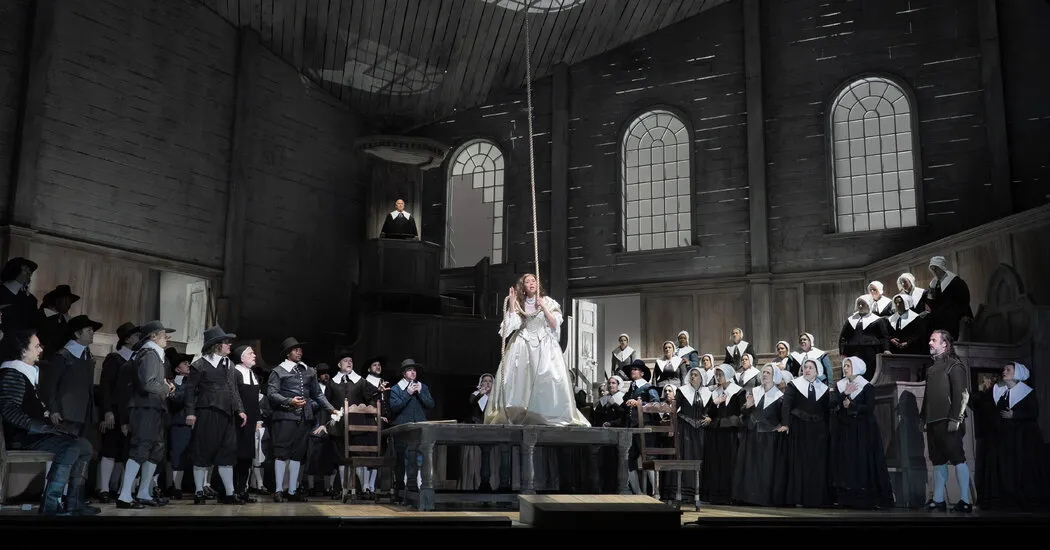
By this point in the opera, Elvira has undergone a transformation from a sunny young bride to a shattered woman who, in Edwards’s war-torn production, ends up with the crudely chopped hair and raggy clothes of a Fantine. In the Met’s recent revivals of “I Puritani,” this role has changed a lot depending on who sings it. Anna Netrebko’s Elvira was hearty and emotional; Diana Damrau’s was delicate and sympathetic. Oropesa’s has an outward state that swerves from ecstasy to insanity, but with a firmly held core. Even at her most desperate, she manages to retain control, especially over her voice.
This holds true regardless of whether she was primly composed in her Puritan garb or refusing for months to take off her wedding dress, a Miss Havisham in the making. Oropesa needed no time to warm up on Wednesday, entering with confidence, precision and agility. Her passaggio, the sometimes perilous transition between vocal registers, was smoothly imperceptible. In one phrase that ended with a chromatic descent, she so clearly articulated each pitch down the scale, it was like listening to someone run their fingers across the keys of a piano.
The other men in Elvira’s orbit, the baritone Artur Rucinski as Riccardo and the bass-baritone Christian Van Horn as Giorgio, were no less commanding. The villainous Riccardo stands in the way of Elvira and Arturo, but he was more complicated than that in Rucinski’s performance: self-destructive while still powerful, with a brilliant sense of shaping Bellini’s long melodies and a showman’s gift for finishing them off with sustained might. Van Horn’s Giorgio, Elvira’s uncle, was muscular and compassionate in equal measure, warm and persuasive as he pleaded a case for her happiness.
Throughout, the singers were well supported by Marco Armiliato. He’s a Met stalwart who here led the orchestra with an understated drive that kept the performance flowing, perhaps the challenge for a bel canto conductor.
Edwards often flatters the singers, too, in his production, which vastly improves on the one by Sandro Sequi that had been running at the Met since 1976. (The most recent revival, eight years ago, was painfully stiff and somnolent.) Sequi staged the opera as if it were a fairy tale; Edwards aims for something more starkly historical, with a damning view of Puritan life.
“I Puritani” is Edwards’s first outing as a director at the Met, but not his first production. In the past, he has worked with David McVicar, whose influence comes through in this staging’s handsome and gently stylized look. Edwards sets all the action in a 17th-century Puritan meetinghouse whose surfaces, from the ceiling to the pews, are tellingly whitewashed.
Over the course of the opera’s three acts (while the English Civil War “rages,” as projected text reminds the audience more than once), the meetinghouse comes apart. Its windows are haphazardly covered; its pews are torn up and used as firewood. By the end, one of its walls separates from the building and swings open to the dangerous world beyond.
The metaphor isn’t exactly subtle, but Edwards’s depiction of Puritanical rot and a turn toward barbarism is just one layer of commentary that makes his production less traditional than it first appears. Another is a gesture of light, by Tim Mitchell, that turns the entire stage Mountain Dew green whenever we enter the warped mind of Elvira. Not just a shift in perspective, it pays off with shocking effect in the finale.
Instead of a happy ending of deus-ex-machina implausibility, which would be difficult to reconcile with Edwards’s treatment of the Puritans, the production offers a tragic twist. Brutality wins out, and when the lights turn green one last time, it’s not clear whether they’ll ever turn off.
It’s all simple, effective and timeless. Sequi’s “Puritani” stuck around for nearly 50 years; you could imagine Edwards’s production easily doing the same. As long as it’s well sung.
I Puritani
Through Jan. 18 at the Metropolitan Opera, Manhattan; metopera.org.