

Supreme Court Refuses to Allow Trump to Deploy National Guard in Chicago
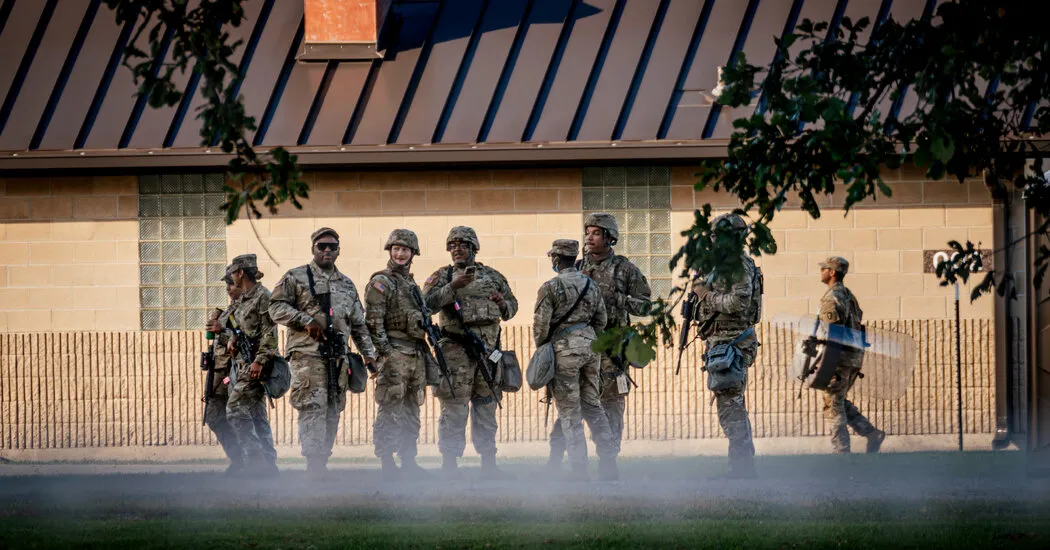
The Supreme Court on Tuesday refused to allow President Trump to deploy hundreds of National Guard troops in the Chicago area over the objection of Illinois officials, casting doubt on the viability of similar deployments in other American cities.
The justices’ order is preliminary, but it blocks the Trump administration for now from ordering the state-based military force to the Chicago area, where an immigration crackdown led to thousands of arrests and confrontations between residents and federal agents.
In its temporary ruling against the administration, the court refused to grant the president broad discretion to deploy the military in U.S. cities. It represented a rare departure from recent cases, in which the conservative majority has overwhelmingly sided with Mr. Trump in preliminary tests of presidential power.
At this stage in the litigation, the court said the Trump administration had not shown that the statute at issue “permits the president to federalize the Guard in the exercise of inherent authority to protect federal personnel and property in Illinois.”
Three conservative justices — Clarence Thomas, Samuel A. Alito Jr. and Neil M. Gorsuch — noted their dissents.
Mr. Trump had also in recent months ordered the National Guard to Portland, Ore.; Los Angeles; and Washington, D.C., over the objections of state and local leaders. The president’s efforts to use troops for domestic policing have prompted legal challenges accusing the Trump administration of exceeding its authority and infringing on traditional state powers over policing. The state-based troops are typically deployed at the request of governors to respond to emergencies in their own states such as natural disasters.
Federal law allows the president to federalize members of the National Guard without the permission of state officials in certain circumstances, including when there is a “rebellion or danger of a rebellion” against the government or when law enforcement is overwhelmed and cannot execute U.S. law.
Federal courts around the country have generally said the conditions do not exist to allow Mr. Trump to federalize guard troops. But an appeals court in Washington has allowed troops to remain in the nation’s capital while litigation continues, citing the city’s unique status as a federal district. The court battles come against the backdrop of street protests against the guard and violence in Washington, where a targeted attack on two National Guard members on Nov. 26 left one dead and another seriously injured.
With legal uncertainty hanging over the deployments, the Pentagon decided in November to withdraw hundreds of out-of-state soldiers from Illinois and Oregon, while keeping hundreds of other local troops activated.
At issue in the case in Chicago and a similar matter in Portland are competing accounts of the protests, which the administration characterizes as violent and coordinated and which local officials — and some lower court judges — have said do not amount to a rebellion.
The legal questions have divided the lower courts, and the Supreme Court’s order should set the ground rules for other litigation involving Los Angeles and Portland.
Before issuing its order, the Supreme Court took the unusual step of asking the parties in the Illinois matter to address the meaning of a key section of the statute. To federalize the National Guard, the president must determine that he is “unable with the regular forces” to execute U.S. laws. The justices asked whether “regular forces” referred to the military or civilian law enforcement.
The Trump administration told the court that “regular forces” referred to civilian law enforcement such as federal immigration agents. As a result, the administration said it should be permitted to unilaterally deploy the National Guard because federal agents were overwhelmed.
“It would be unprecedented and profoundly ahistorical to require the president to treat the standing military as the first line of defense for ensuring that federal laws can be executed,” D. John Sauer, the solicitor general, told the court.
The office of Attorney General Kwame Raoul of Illinois, a Democrat, countered that the term referred to the full-time professional military and said the justices should deny the president’s request on that basis, because he had not tried to use the standing military, nor could he.
“The president has not attempted to execute the laws with the regular forces in Illinois, let alone shown that he faces an inability to do so,” the attorney general’s office said in court filings.
The administration has sought to station National Guard troops from Texas and Illinois outside an Immigration and Customs Enforcement processing center in Broadview, Ill., a Chicago suburb where protesters have gathered.
A district court judge and an ideologically diverse appeals court panel in the Chicago litigation blocked the deployment, finding insufficient evidence that the demonstrations had significantly impeded the ability of federal officers to execute immigration laws. They noted that federal facilities had remained open and that immigration arrests and deportations had continued at a rapid clip.
The Trump administration appealed to the Supreme Court and asserted that its decision to federalize and deploy the Guard was not subject to court review. Even if it were, Justice Department lawyers said, the “prolonged, coordinated, violent resistance” by protesters interfered with law enforcement’s ability to do its job and justified the deployment.
Mr. Sauer told the justices in a court filing that agents could engage in even greater enforcement of immigration laws were they not operating under threat and that the protests posed “unacceptable risks” to their safety.
Lawyers for Illinois told the justices in their brief that an “unnecessary deployment” of troops would “escalate tensions and undermine the ordinary law enforcement activities of state and local entities.”
“No protest activity in Illinois has rendered the president unable to execute federal law,” Mr. Raoul and lawyers for the City of Chicago said in their filing. They noted that the crackdown on immigration has continued with nearly 3,000 people arrested since the end of October.
State and local officials got a boost from a bipartisan group of more than two dozen former governors and a group of former high-ranking U.S. military leaders, who expressed deep concerns in separate filings to the justices about the president’s actions.