

Three Great Documentaries to Stream
The proliferation of documentaries on streaming services makes it difficult to choose what to watch. Each month, we select three nonfiction films — classics, overlooked recent docs and more — that will reward your time.
‘Sketches of Frank Gehry’ (2006)
Rent it on Amazon, Apple TV, Fandango at Home and Google Play.
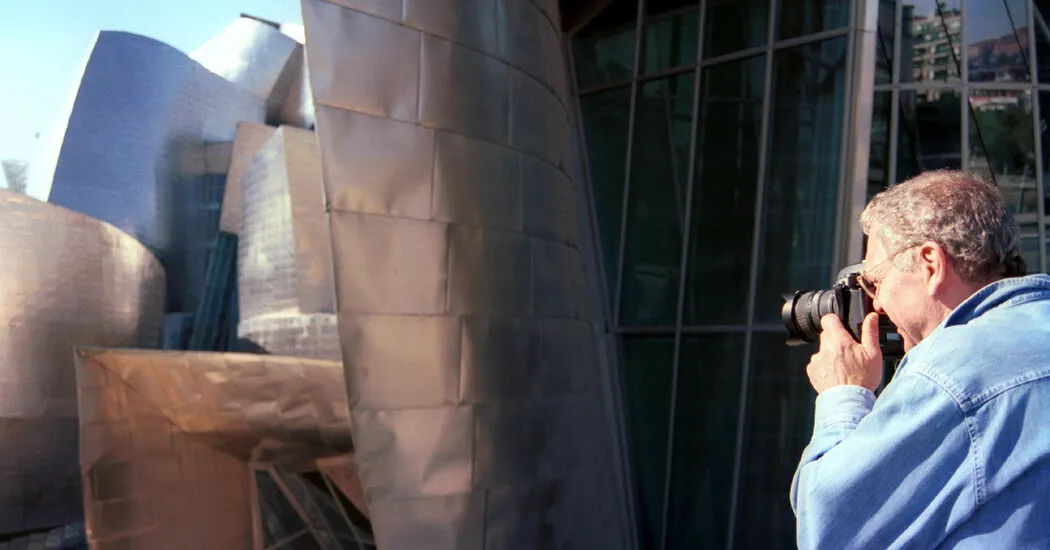
It’s hard to look at a work by the architect Frank Gehry without being amazed by at least two things. The first is the inventiveness of Gehry’s wavy, asymmetrical designs. The second is that the structure in question stays upright. “He mixes the freewheeling-ness of art with something that is really concrete and unforgiving, which is the laws of physics,” the artist Ed Ruscha says in the film “Sketches of Frank Gehry,” adding, “I believe all of his buildings have been standing.” Two decades before Gehry died this month at 96, he sat for this 2006 portrait documentary by his friend Sydney Pollack.
Because Pollack, who died in 2008, was a filmmaker with artistic ambitions of his own, the men find a lot of common ground talking about what Gehry calls the “give and take” of his creative process. He explains that he always works on two or three scales at once; it keeps his mind on the ultimate building, rather than on the model, which could easily become “jewelry.”
“What’s wrong is if it’s too easy,” Gehry says at another point; he’s convinced that an idea that’s too straightforward must either be a cliché or something he’s already done. Pollack offers gentle pushback on Gehry’s self-deprecation. When the architect says that he wishes he were a painter but has never been able to create what he regards as a painterly surface, Pollack counters with a montage of light hitting various Gehry buildings.
The director brings on the art critic Hal Foster as a voice of skepticism; Foster is convinced that the Guggenheim Museum Bilbao in Spain functions as a spectacle that overwhelms the art it’s meant to house. The artist Julian Schnabel makes the opposite case: If the art can be overwhelmed in that way, he suggests, maybe it wasn’t that good. But following Gehry’s death, perhaps the most striking moment is the sequence of the architect visiting Berlin’s DZ Bank building — at that time, a recent job, completed in 2001. Gehry knows he won’t be able to survey his handiwork for long. “I’m not going to get to live here and stay here, so I’m only going to see it today, and I leave,” he explains. “And maybe I’ll see it three or four more times in my life.”
‘Albert Brooks: Defending My Life’ (2023)
Stream it on HBO Max.
One of Rob Reiner’s last completed features was this endearing portrait of his lifelong friend Albert Brooks, whom he first encountered in high school drama class. When they met, Reiner recalls, the teenage Brooks was gauche enough to name-drop Carl Reiner, not yet realizing he was talking to Carl’s son. But even at age 16, Rob says, Brooks was capable of making his father and Mel Brooks laugh. He was, Rob adds, a prodigy.
Because the subject is Albert Brooks (birth name: Albert Einstein), “Defending My Life” is naturally very funny — and, just as naturally, a tad discomfiting. Brooks describes how his father, Harry Einstein, a comedian with a radio show called “Meet Me at Parky’s,” died onstage in 1958 after entertaining the crowd at a Friars’ Club dinner. Brooks channeled his at times contentious relationship with his mother, who put her singing career on hold to raise a family, into his 1996 feature, “Mother.”
We get to see career highlights both well-known (such as Brooks’s short films for “Saturday Night Live,” including one in which he tries his hand at open-heart surgery) and more obscure (informal 8-millimeter movies from the early 1970s by Steven Spielberg, who compares Brooks’s street-interviewing technique to Sacha Baron Cohen’s). Brooks turned to feature directing with “Real Life,” which, he ribs Reiner, predated “This Is Spinal Tap” as a pioneering mockumentary. Brooks says that “Modern Romance,” a movie in which he was unafraid “to look completely like a psychopath,” got him a complimentary phone call from Stanley Kubrick. “The Muse” came after marriage changed his outlook.
But the heart of “Defending My Life” is simply Brooks and Reiner talking at a restaurant, with the easy rapport of friends with decades of shared history and a deep sense of what makes each other tick. It’s a wonderful tribute, and a joy to watch even now.
‘Megadoc’ (2025)
Stream it on the Criterion Channel. Rent it on Amazon, Apple TV and Fandango at Home.
Up for one more artists-on-artists profile? When Francis Ford Coppola finally got to make his passion project “Megalopolis,” the filmmaker Mike Figgis (“Leaving Las Vegas”) tagged along. The result was this unusually candid behind-the-scenes documentary about the shoot. (Figgis doesn’t show the postproduction phrase; whatever madness awaited in the editing room is left to the viewer’s imagination.)
At the outset, Figgis notes that it’s unusual for one film director to watch another work, and there’s an intriguing tension between his desire to observe and his fear of interfering. (He says some cast members are more open to his presence than others.) There’s also the overriding tension between the “Megalopolis” that has existed in Coppola’s head for decades and the version he is trying to find on the set. Coppola engages the cast in nonsensical games that Figgis likens to experimental theater. Once filming starts, it is hard to tell how closely Coppola is following a blueprint — and on some level, he appears to enjoy cultivating that ambiguity for his collaborators. A producer, Michael Bederman, admits that the production lacks the basic safety net of “anybody who can say no.” George Lucas calls Coppola “a jump-off-the-cliff guy” rather than a careful prepper. Coppola describes showing footage to his composer and being surprised that it was a unified vision.
Figgis, who admits to having a stake in witnessing a tumultuous production (“Every time something negative happens,” he says, “I think, oh, that’s good for the documentary”), certainly encounters his share of drama, from the firing of a visual effects supervisor and the departure of the first production designer to friction between Coppola and the actor Shia LaBeouf, who seem to disagree over the basic nature of the film medium. Is what’s happening onscreen in “Kramer vs. Kramer” real or just, as Coppola tells LaBeouf, “flickering lights”? The whole spiraling process is strangely inspiring, although as with “Megalopolis” itself, you may come away a bit unsure of what you just saw.