

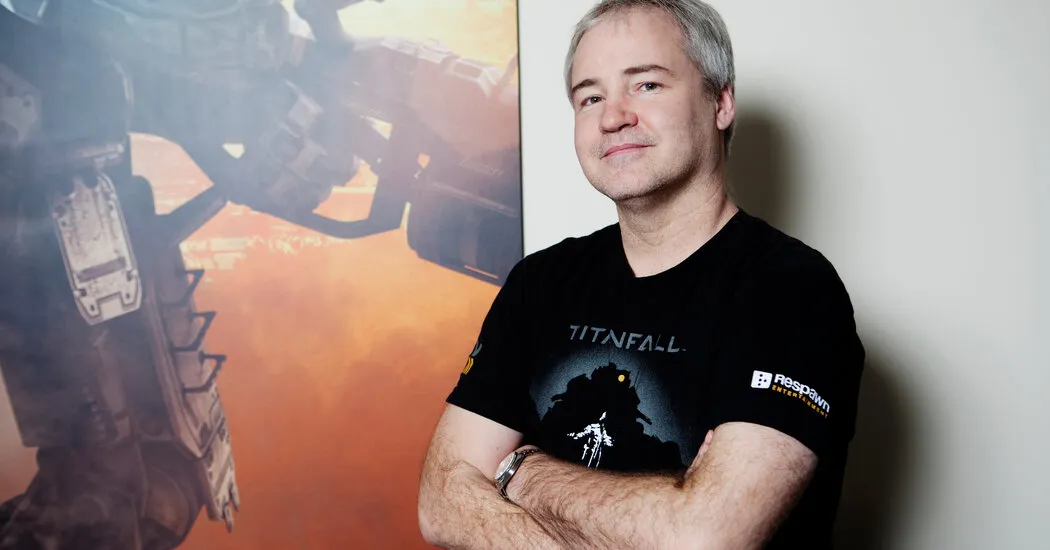
Vince Zampella, Formative Designer of Call of Duty Games, Dies at 55
Vince Zampella, a key figure in the creation of Call of Duty, the best-selling video game franchise that has reproduced World War II battles, riffed on modern global conflicts and imagined the technology available to future soldiers, has died. He was 55.
His death was confirmed by Electronic Arts, which owns Respawn Entertainment, the studio Mr. Zampella co-founded in 2010. It did not provide a cause.
“Vince’s influence on the video game industry was profound and far-reaching,” Electronic Arts said in a statement on Monday. “A friend, colleague, leader and visionary creator, his work helped shape modern interactive entertainment and inspired millions of players and developers around the world.”
Mr. Zampella was instrumental in the development of the industry’s most popular first-person military shooter games, including this year’s Battlefield 6, a Call of Duty competitor. He was the general manager of Respawn, which has produced the shooters Titanfall, in which players control giant robots, and Apex Legends, a sci-fi battle royale.
Among Mr. Zampella’s earliest video game credits was Medal of Honor: Allied Assault (2002), which included missions to sabotage a German U-boat and storm Omaha Beach on D-Day.
The game was made by 2015 Inc., where Mr. Zampella worked as a lead developer. Its success led Electronic Arts, which had contracted the studio, to desire similar titles created under its own umbrella. That left many developers on the outside looking in.
So in May 2002, Mr. Zampella, Jason West and Grant Collier founded Infinity Ward, hiring nearly two dozen people who had worked on Medal of Honor: Allied Assault.
“There was some tensions at the studio — it was obvious at some point that people were going to walk away and we decided to all walk away together,” Mr. Zampella said in a 2016 interview with IGN, a video game and entertainment news site. “We had a good cohesive team, and it just felt right for us to work together again.”
In October 2003, Infinity Ward released its debut game, Call of Duty, which dropped players into the roles of American, British and Russian soldiers amid the chaos of rumbling tanks and exploding grenades. Its code name was Medal of Honor Killer.
Activision invested in Infinity Ward and later fully acquired the studio. It has published a new Call of Duty game every year since 2005, selling more than 500 million copies. (Other studios, notably Treyarch, Sledgehammer and Raven, also develop Call of Duty games to keep up the relentless pace.)
The series moved beyond World War II for the first time in Call of Duty 4: Modern Warfare (2007), one of the most influential video games ever. Its single-player campaign immersed players in a conflict involving ultranationalist Russians; the in-game progression of its popular multiplayer mode unlocked new perks and weapons, hooking players and becoming an industry standard.
“You have that dream of the game being popular, but I don’t think you’re ever ready for that level of success,” Mr. Zampella, who was Infinity Ward’s chief executive, said in the 2016 interview.
A year after the release of Call of Duty: Modern Warfare 2 (2009), which made more than $1 billion, Activision fired Mr. Zampella and Mr. West for what it called insubordination. The ensuing battle highlighted the industry’s power struggle between corporations and its talent.
Mr. Zampella and Mr. West sued Activision, alleging that they had been fired because the company wanted to avoid paying them $36 million in bonuses and royalties. “After all we have given to Activision, we shouldn’t have to sue to get paid,” Mr. Zampella said in a statement at the time. Activision filed a countersuit, arguing that the men had been trying to damage the company after being lured by Electronic Arts.
A day before the case went to trial, the parties announced a settlement.
Information on Mr. Zampella’s survivors was not immediately available.
Reflecting on the success of Call of Duty in the 2016 interview, he said he was awed whenever the game was mentioned in TV and movies.
“It’s such a part of common culture nowadays,” Mr. Zampella said. He added, “To be a part of something that is so well known and so out there in the world, it’s a little unnerving.”
Alain Delaquérière contributed research.