

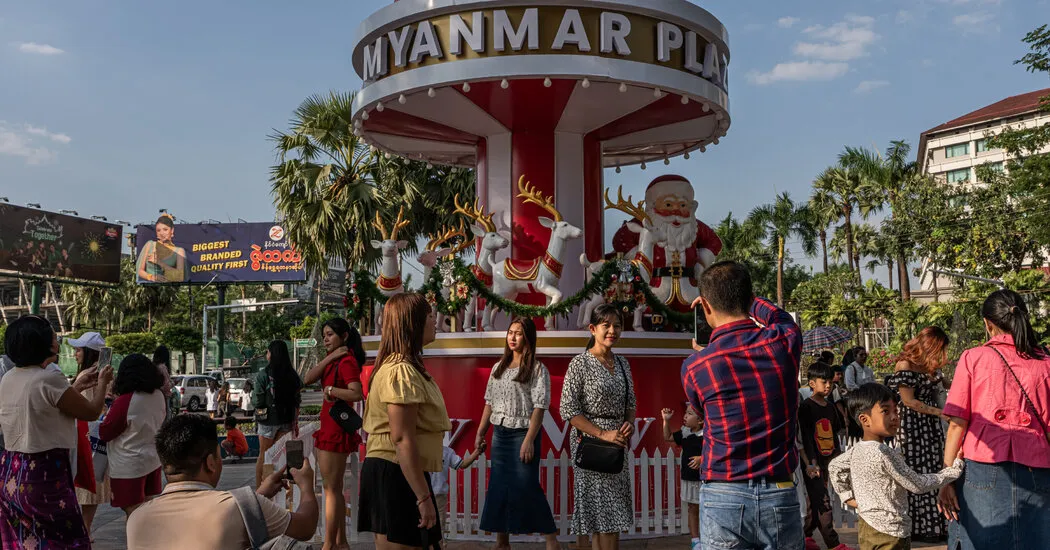
What to Know About the Vote in Myanmar
Myanmar’s military government is holding elections for the first time since it seized power in a coup five years ago, but Western governments and human rights groups regard the polls as a sham.
Voting will begin on Sunday amid a raging civil war, as pro-democracy forces and armed ethnic groups fight to overthrow the junta. The main opposition party is barred from participating and its leaders remain in prison. Ballots will be cast only in areas under military control, estimated to be less than half of the country’s territory.

Planned in one of the
election phases,
announced by the junta
No elections
will be held
Election plan to
be announced
Mandalay
Mandalay
Mandalay
Naypyidaw
Naypyidaw
Naypyidaw
Yangon
Yangon
Yangon

Planned in one of the
election phases,
announced by the junta
Election plan
to be announced
No elections
will be held
Mandalay
Mandalay
Mandalay
Naypyidaw
Naypyidaw
Naypyidaw
Yangon
Yangon
Yangon

Planned in one of the election phases, announced by the junta
Naypyidaw
Yangon
No elections
will be held
Naypyidaw
Yangon
Election plan to be announced
Naypyidaw
Yangon
Note: Inclusion in one of the junta’s announced phases does not guarantee that an election will ultimately be held. Source: Data compiled by The Democratic Voice of Burma (DVB) from Myanmar’s Union Election Commission. Weiyi Cai/The New York TImes
The war has left the military stretched so thin that it has scheduled three election days for different parts of the country: Dec. 28, Jan. 11 and Jan. 25.
Here’s what to know.
Why is the junta staging this vote now?
Critics of the regime say the vote is an attempt to legitimize the junta’s leaders after nearly five years of military rule, particularly Senior Gen. Min Aung Hlaing, the commander in chief of the armed forces.
Since the return to military rule in 2021, Myanmar has remained an international pariah with support from only some autocratic countries, like China, Russia and Belarus. Economic sanctions imposed by the United States and other Western nations have contributed to Myanmar’s isolation and helped cripple the economy.
By staging an event it can call an election, the junta plans to reconstitute itself as a civilian government with the aim of rebuilding business ties with other nations. General Min Aung Hlaing has already given himself the civilian title of “acting president.”
What is the international reaction to the plan?
China is a major backer of the election, but a U.N. expert has called it a “sham.”
The European Union and the Association of Southeast Asian Nations, known as ASEAN — of which Myanmar is a member — have said they will not dispatch monitors to see whether the vote is free and fair.
The United States, India and Cambodia, however, have all hinted that the elections might give them justification to resume business with Myanmar, which has a wealth of natural resources, including gems and rare earth metals.
Last month, the Trump administration cited the plan to hold “free and fair elections” as evidence of “notable progress” when it withdrew the temporary protected status of refugees who fled Myanmar after the coup.
Has Myanmar held fair elections in the past?
Myanmar has been ruled by the military for most of its history, but it has held three elections in the past 60 years that were recognized as legitimate. The National League for Democracy — the party of Daw Aung San Suu Kyi, a Nobel Peace Prize laureate — won all three elections in a landslide.
Even so, her party has seldom been allowed to participate in running the country.
In 1990, after the National League for Democracy won its first election, the military refused to accept the results, placed Ms. Aung San Suu Kyi under house arrest and continued to rule.
When free elections were next held, 25 years later, her party won again. This time, the military allowed it to share power and she named herself head of the civilian government. But under the military-drafted Constitution, the generals kept control of the army.
The National League for Democracy won again in 2020, soundly defeating the party backed by the military. But in 2021, on the day the new Parliament was to be sworn in, the generals staged their coup and arrested Ms. Aung San Suu Kyi and more than 120 newly elected members of Parliament.
Who will vote this time?
People living in rebel-held areas will not be allowed to participate and opposition political parties will be excluded from the ballot, including the military’s leading rivals.
Control of most of Myanmar is contested between the junta and resistance forces

INDIA
CHINA
BANGLADESH
Mandalay
MYANMAR
LAOS
Naypyidaw
Bay of Bengal
Yangon
THAILAND
Area of control
Military junta control
Resistance control
Contested
Other

INDIA
CHINA
Mandalay
MYANMAR
Naypyidaw
Yangon
Bay of
Bengal
THAILAND
Area of control
Military junta control
Resistance control
Contested
Other
Source: National Unity Government of Myanmar Agnes Chang/The New York Times
The junta dissolved the National League for Democracy in 2023 and many of its top leaders remain in prison, along with more than 22,000 other political prisoners arrested since the coup. The party was one of 40 disbanded by the junta because it refused to re-register under the military’s new election law, which would have required it to swear allegiance to the regime.
More than 100 people have been arrested since July for violating the draconian law, which makes it a crime to criticize the so-called election and bans organizing or speech that is deemed to disrupt the process. Some have been sentenced to the maximum seven years in prison.
The dissolution of the pro-democracy parties clears the field for the military-backed party, the Union Solidarity Development Party, which has polled poorly in previous elections.
Does the junta have popular support?
Known as the Tatmadaw, the military is an elite group that stands apart from the rest of the population, with separate schools and hospitals, and a vast network of businesses. Its role has long been to control the population, not defend against foreign invaders.
Since seizing power, the junta has only alienated the public further.
After the coup, the military crushed nationwide pro-democracy protests by shooting demonstrators in the streets. It has attempted to subdue the nationwide rebellion by bombing civilian sites, including hospitals, schools, temples, weddings and concert venues.
The conflict has driven 3.5 million people from their homes. A million more have fled the country.
Violence continues in the country years after the coup

Armed clashes in 2025
70
30
1
Mandalay
MYANMAR
Napyidaw
Yangon

Armed clashes in 2025
70
30
1
Mandalay
MYANMAR
Naypyidaw
Yangon
Source: Myanmar Peace Monitor Agnes Chang/The New York Times
Even as the vote nears, the military is not holding back.
On Dec. 5, a junta fighter jet bombed a tea shop in the Depayin Township of Sagaing Region, killing at least 18 civilians and wounding 20 others. Dozens of people had gathered there to watch the national women’s football team play a match.
Five days later, airstrikes destroyed a hospital in the Mrauk-U Township of Rakhine State, killing 34 and injuring at least 80, including patients, doctors and nurses.
How will the junta manage the voting amid a civil war?
Electronic voting machines designed and produced by the regime will be used for the first time, adding more uncertainty to the validity of the vote.
Some rebel groups have warned people to stay away from the polls and threatened violence against those who go to the polls.
General Min Aung Hlaing said in August that holding the vote on three different days will be necessary because the army cannot provide security simultaneously in all of the areas it controls.
“Given the current situation of the country, it will not be possible to conduct the election all at once,” General Min Aung Hlaing said, according to the junta-controlled media outlet, The Global New Light of Myanmar. “Instead, it must be carried out in phases.”