

You Know Panettone. Now Meet Its Rarer, Even More Difficult Cousin.
Twenty-nine Christmases have passed since Jim Lahey of Sullivan Street Bakery in New York jump-started a national affair with artisanal panettone, the voluptuous Italian sweet holiday bread. No fluffing agents. No binders.
Now it’s pandoro’s turn.
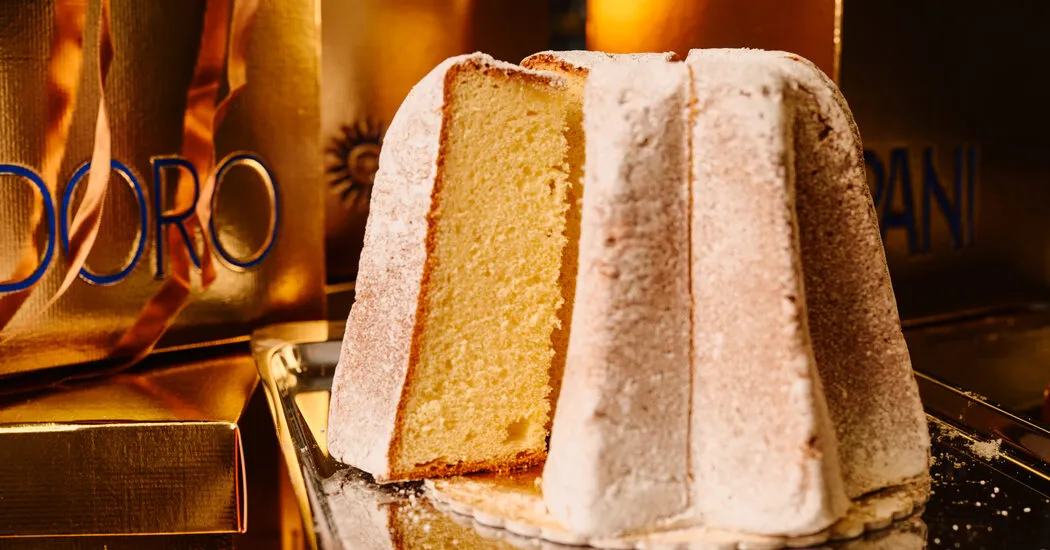
Pandoro, panettone’s much lesser-known little brother, is native to Verona, Italy. The two seasonal breads share the same basic ingredients: yeast, flour, butter, eggs, sugar, vanilla. But while panettone, with its bursting dome, includes raisins and candied citrus, pandoro is plain.
Often dwarfing panettone’s already high butter content, pandoro is made in a tall star-shaped mold with eight points. The breads’ crumbs are also different. These days, in the hotly competitive world of craft panettone, the fashion is for loaves that resemble cathedrals of ever deeper and taller chambers. Pandoro, on the other hand, is tight and uniform, tilting toward brioche in texture.

“There’s a die-hard group in Italy who loves panettone and a die-hard group who loves pandoro, and of course fringe groups who love both. It’s kind of endearing,” said Roy Shvartzapel, whose California-based company, From Roy, makes an acclaimed panettone and plans to introduce pandoro next Christmas.
“Both are essentially an emulsion of fats and sugars and water that you’re tasking with leavening naturally,” Mr. Shvartzapel said. “It shouldn’t work.”
Indeed, pandoro can be maddeningly difficult make. The delicate, enriched dough needs multiple rises, and environmental factors like temperature and humidity must be managed carefully. But when done right, the bread disappears in the mouth almost before there’s time to savor it, like Peggy Lee singing “By the Time I Get to Phoenix.” Even the finest and most expensive panettone can only dream of attaining pandoro’s evanescence.
Pierre Hermé, the Louis XIV of pastry in France, had hoped to crack the pandoro code in time for Christmas, but was thwarted by “inconclusive” test results.
“It took us years to get panettone right,” Mr. Hermé said. “It’s the most difficult thing we’ve ever made — until pandoro.” The three-part dough is yet more temperamental, unforgiving and testily sensitive to variables than panettone, the chef said, adding, “Pandoro is a cloud.”
Two branches of the Settepani family have a certain hold on domestic pandoro production in the United States, with two Settepani bakeries in Brooklyn and one in Harlem, and Bruno’s in Freehold, N.J. Settepani will bake 4,000 loaves of panettone this season — and just 100 of pandoro.
“I wish people appreciated it more,” said the company’s head baker, Bilena Settepani. “It’s the bread that doesn’t get enough fame, always sort of forgotten, even though it’s more beautiful and accommodating than panettone.” She suggests serving pandoro with marmalade, pistachio and hazelnut spreads, vin santo and gelato. Zabaglione would be a no-brainer. Pandoro even sometimes replaces ladyfingers in the tiramisù at the restaurant adjoining the Settepani bakery in Manhattan.
After Mr. Lahey, the next great champion of panettone in the United States was Mr. Shvartzapel, who has been selling sought-after versions of the bread since 2015 — priced at $109 this year, a once unthinkable sum for panettone. (Mr. Lahey, whose Sullivan Street version is $67, is grateful to Mr. Shvartzapel for spreading the gospel, but expressed sticker shock with words that cannot be printed in a family newspaper.)
Like Mr. Hermé, Mr. Shvartzapel is betting his reputation that he can offer pandoro next year. For Mr. Shvartzapel, it will be only the second addition to his product line since opening. He trained with Mr. Hermé in Paris and in Brescia, Italy, with Iginio Massari, the universally recognized high priest of panettone who also makes a pandoro.
Carol Field’s version, in her book “The Italian Baker,” is made in just seven to nine hours, unusually quick for pandoro. At two days-plus, Mr. Massari’s is more typical. Pandoro isn’t cooled upside down, eliminating perhaps the most tedious and daunting step in the preparation of panettone, but it’s still a challenge.
Mr. Shvartzapel said that while he had no desire to discourage home bakers, “with pandoro, it’s not like someone handing you a recipe for chocolate chip cookies.” He stressed that making pandoro is “diving into the abyss,” a void filled with misinformation, wishful thinking and spurious legend.
In her otherwise useful book, Ms. Field writes that many imported panettone “seem to last forever.” You could say the same thing about pandoro. Ms. Field attributes the heroic shelf life to “a special natural yeast.”
In other words, Mr. Shvartzapel said, additives.
“More than 90 percent of Italian pandori are industrial, baked in June or July for sale in December — and designed to last until the following Christmas,” he said. “Look at the label. You will almost certainly see mono- and diglycerides” — fats and oils that delay staling. “The rest is all grandmother mythology.”
“It’s all smoke and mirrors,” Mr. Lahey agreed about the preserving agents.
It seemed hopeful when two Italian government ministries issued a decree in 2005 laying down the ingredients and characteristics pandoro must have to be sold under the name. But the fine print permits preservatives and vanillin, an inferior and often synthetic form of vanilla flavoring that yields a supernatural neon-yellow crumb.
One might take add-ins for granted in packaged supermarket baked goods. But it’s more of a surprise when your favorite pandoro from the Verona region contains emulsifiers.
After Mr. Lahey’s success with panettone in 1995, pandoro seemed like a natural follow-up. He baked about two dozen two years later, and they were well-received. But he never sold pandoro again. The molds are still kicking around somewhere.
“I’ve never made anything that sits in cold storage for nine months,” Mr. Lahey said. “I’m a baker, not a businessman.”
He added that pandoro was “a whim. I’d consider it again if I had a baker’s studio in a three-story building on Christopher Street financed by a venture capitalist and dedicated to my ego.”
Ms. Settepani’s pandoro went on sale online the day after Thanksgiving and will be removed, if any remain, on Epiphany, Jan. 6.
“It’s not made to last,” she said. “Pandoro is where panettone was when my father first made panettone in 1982: one batch. Give pandoro a few more years and it will get there.”
Follow New York Times Cooking on Instagram, Facebook, YouTube, TikTok and Pinterest. Get regular updates from New York Times Cooking, with recipe suggestions, cooking tips and shopping advice.