


Your Holiday Party Food Should Be a Shrimp Tower
For 364 days, a 13-inch foam cone sits atop my refrigerator like a dunce cap, a constant reminder of hedonistic foolishness.

You see, this is the apparatus for a shrimp tree, the centerpiece of my annual holiday party. With a little patience, a lot of leafy greens and more shrimp than most people eat in a year, a craft-store item transforms into a spectacular (if not plainly silly) Christmas tree you can eat. Over the last few years, this kitschy midcentury party tower has re-emerged on holiday buffet tables as nostalgia — no more potent than around Christmastime — continues to tighten its grip on us all.
“There is this desire for memory and for something that’s rooted in history,” said Lilli Sherman, the founder of Oma Loves Fun, an events and brand marketing studio, who also cited the popularity of expansive tablescapes inspired by Dutch paintings.
But the shrimp tree’s appeal isn’t just retro revivalism. A brief scroll through Pinterest or TikTok will reveal that all kinds of party food are veering vertical, with hosts pushing the bounds of what can tower. Once-novel Champagne pyramids and croquembouches are now as customary as charcuterie boards, and tiramisù towers, grape topiaries, Hawaiian roll obelisks and cornichon trees are today’s monuments to abundance. The taller the food, the closer to party heaven.
“A core part of making something look interesting is having levels,” said Libby Willis, a chef, culinary producer and fellow shrimp-tree devotee. “Food can be a beautiful pile, but having something that you can really give a lot of height and drama to will always make a table more interesting.”
And as screens and algorithms ceaselessly claw at our attention and flatten cultural experience, there is increasing appeal in the analog, the whimsical and the detail-oriented task. “There is effort inherent in these things,” Ms. Sherman said. “I think that’s something, working with your hands and being creative, that people are very inspired by.”
But a party tower isn’t just striking and playful. At a holiday gathering, where the buffet table quickly fills up with large platters, a party tower can be an efficient use of space.
And despite its precious appearance, a shrimp tree is really doable for a home cook. You don’t need to weave parsley through chicken wire — you don’t need chicken wire at all. Your standard-issue foam cone, often used for floral designs, and some toothpicks will get the job done with little mess or stress. Though you can also play around with different shapes, as Ms. Willis has, by stacking thick foam disks on top of one another.
“There’s something about these trees in particular, these foam-based sculptures, being approachable,” Ms. Willis said.
Recreating the bushy contours of a balsam fir allows for some freestyling. Curly kale is forgiving and easy to tuck into barren spots. While you can keep whole leaves intact and layer them vertically on the cone, ribs and all, I prefer to cut two long strips along the rib as best as I can and use those to shingle around the base horizontally, as if you’re trimming a Christmas tree with lights. Is it marginally more tedious? Or is it a meditative craft project? Both can be true.
Ms. Willis, too, used curly kale when she sold miniature shrimp trees embellished with cherry tomatoes and a star cut out of lemon at her now-closed restaurant, MeMe’s Diner. “Now I like a little more sleek, a little more modern,” she said. She reaches for moodier lacinato kale or all different kinds of greens for her own Christmas entertaining, and uses banana leaves when doing non-holiday events for brands. Curly endive might be historically accurate. Pineapple leaves might be insane.
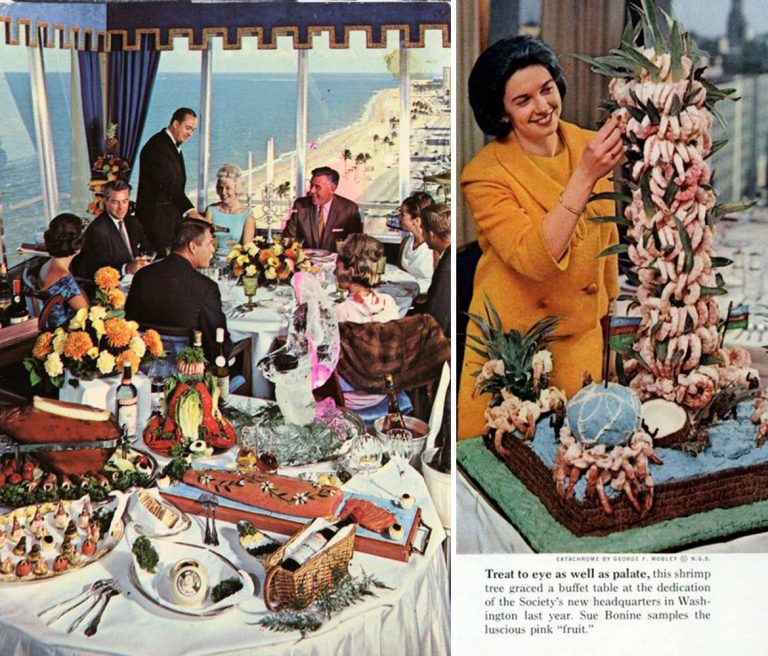
Fastening the greens and, eventually, the shrimp, can be done with cocktail picks or toothpicks, though Ms. Willis has also used prongs made of floral wire and even hot glue to secure the base covering in more commercial settings.
I look for toothpicks with little baubles or ornaments at the end, which saves me from needing (or wanting) to adorn the ends with olives or pickles or cherry tomatoes, and keeps those garnishes from potentially going to waste. If you’re especially meticulous (I’m looking in the mirror when I say this), keep in mind that where you pierce the greens is where you’ll be able to hang your featured food, so keep spacing and the size of your shrimp in mind. And don’t forget to set out a dish for any picks and tails.
If you’re not using greenery, or are making a tree exclusively of, say, King’s Hawaiian rolls, as Ms. Sherman has, she encourages first-time tree sculptors to be mindful of how the base will look as the night goes on. “Once people start pulling them off the foam, you are seeing, you know, the undercarriage,” she said. Her solutions are wide-ranging but all simple and food-safe: Layers of Saran Wrap, multicolored cellophane, or even Christmas or Hanukkah wrapper can creatively obscure it.
Keeping things fresh is of great import. “Nobody wants a warm shrimp,” Ms. Sherman said. If there is concern that guests will let them linger too long, resist the urge to buy the tallest cone at Michael’s in favor of a couple of smaller cones, and keep one tree in the fridge until you need to make a swap. Or hang fewer shrimp initially, and make several tree-trimming passes throughout the night to replenish. Poaching your own shrimp will always taste better, but I’d never stop you short of store-bought shrimp cocktail. You’re doing enough.
“Party food is the best because it gets people talking, it gets people excited,” Ms. Willis said. “I love camp, I love whimsy and I think there’s nothing campier than a shrimp tree.”
Follow New York Times Cooking on Instagram, , YouTube, TikTok and Pinterest. Get regular updates from New York Times Cooking, with recipe suggestions, cooking tips and shopping advice.